Swedish opposition parties have won the country’s parliamentary election by three seats, ending Ulf Kristersson’s term as prime minister and opening a difficult process to form Sweden’s next government.
The final preliminary count gave the opposition parties 176 seats in the 349-member Riksdag, compared with 173 for the parties that formed or supported Kristersson’s governing bloc. The difference between the two sides was 50,359 votes, according to Sweden’s public broadcaster SVT.
Kristersson submitted his resignation to the parliamentary speaker on Thursday after the last votes had been counted. He said the result had created complicated conditions for forming a government because several parties had ruled out possible alliances before the election.
“Now it is the speaker who will lead the coming steps on the path towards forming a new government,” Kristersson said in a statement.
His government will continue in a caretaker role until a new prime minister takes office. The resignation does not immediately transfer power to the opposition. Instead, the next stage will be a series of negotiations led by the speaker of the Riksdag, who will seek a candidate capable of winning parliamentary support.
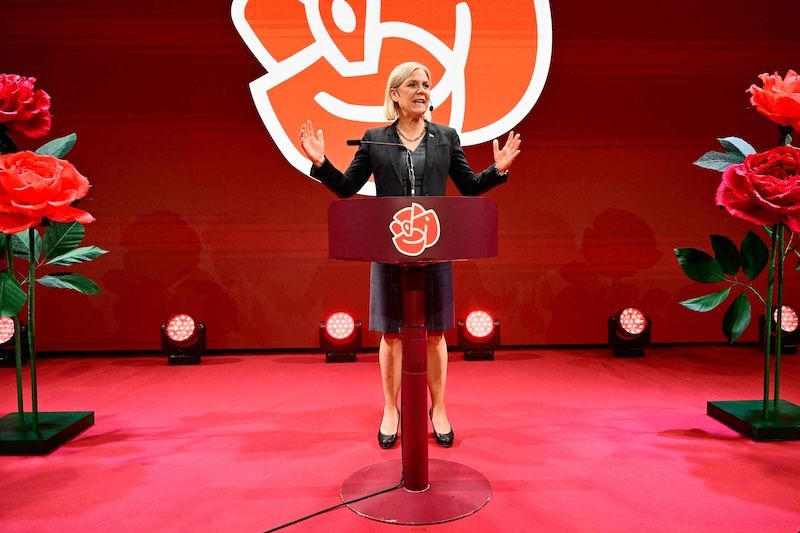
The result leaves Magdalena Andersson’s Social Democrats as the largest party in parliament. They won 99 seats and about 28 percent of the vote, while Kristersson’s Moderates finished with 70 seats and about 19.8 percent. The Sweden Democrats won 62 seats, followed by the Left Party with 30, the Centre Party with 25, the Christian Democrats with 22, the Greens with 22 and the Liberals with 19.
The narrow margin became clear only after several days of counting. The balance moved between 175-174 and 176-173 as late advance votes and other ballots were processed. The final count confirmed the opposition lead, but the three-seat advantage does not by itself settle the question of who can govern.
That is because the four opposition parties do not have identical positions on how a government should be formed. The Centre Party has ruled out joining a government that includes the Left Party, while it has also opposed cooperation with the Sweden Democrats. Those positions leave the parties with limited room to negotiate a straightforward coalition.
The Social Democrats have already begun discussions with the other opposition parties. But the parliamentary arithmetic means that Andersson will need to secure enough support, or at least enough tolerance in the Riksdag, for a government to take office.
Sweden’s parliamentary system does not require a proposed prime minister to win an absolute majority of all members. A candidate can take office if a majority of the Riksdag does not vote against them. If a proposed candidate is rejected, the speaker begins another round of negotiations.
For Kristersson, the result ends a term in which the Moderates governed alongside the Christian Democrats and Liberals, with parliamentary support from the Sweden Democrats. The election has therefore changed the balance inside the Riksdag, but it has not produced an uncomplicated governing majority.
Kristersson acknowledged the difficulty ahead, calling for “constructive openness” from the parties as they seek a government capable of securing support for its budget. The challenge is not simply to identify a prime minister, but to establish a working parliamentary arrangement that can survive votes on legislation and public finances.
The newly elected Riksdag is scheduled to meet on 28 September to begin its work and elect a speaker. The speaker could propose a prime minister as early as 29 September, after which the Riksdag would vote on the nominee.
For now, Sweden has a clear election result but no clear government. The opposition has the larger parliamentary bloc, while the outgoing government remains in office in a caretaker capacity. The next phase will depend on whether parties that disagree on coalition arrangements can find enough common ground to turn the narrow electoral advantage into a functioning government.