How Finland Became a Global Tourism Brand through nature, sauna, happiness, sustainability and a distinctive Finnish way of life.
Finland has turned a country once better known internationally for its forests, cold winters and remote northern location into a recognisable tourism brand built around nature, happiness, sauna, silence and a distinctly Finnish way of life. That transformation did not happen by accident. It has been shaped over years by national tourism promotion, coordinated branding, international media attention and a growing ability to turn ordinary parts of Finnish life into experiences that visitors want to travel for.
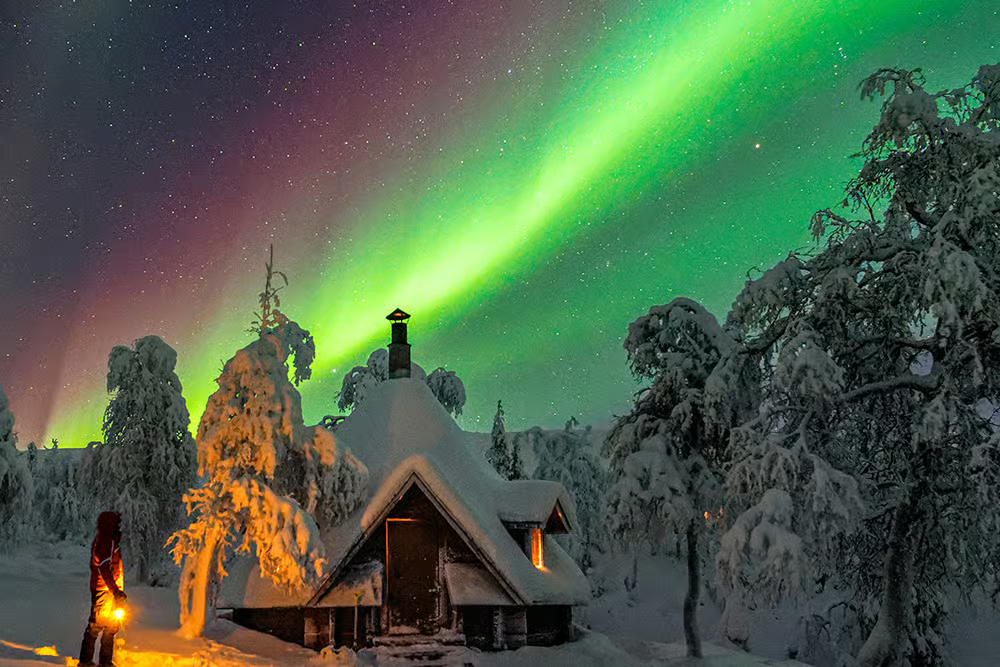
The interesting part of Finland’s tourism story is that the country did not have to invent an entirely new identity. Much of the brand was already there. Forests covered much of the landscape. Lakes were part of everyday life. Sauna was not a luxury product created for visitors but an ordinary Finnish institution. Winter darkness, snow, silence and the northern lights were simply part of living in Finland. The challenge was to make the rest of the world see value in things Finns themselves might consider completely normal.
That process has taken decades. Finland’s tourism promotion has long involved public institutions and cooperation with businesses and destinations. In 2008, for example, the Finnish Tourist Board, then known as MEK, began an extensive partnership with Finpro to strengthen tourism promotion in international markets. The arrangement brought together tourism marketing, foreign trade networks and cooperation with Finnish tourism companies.
Over time, that work became more coordinated. Visit Finland emerged as the national platform responsible for developing Finland’s image as a tourism destination and promoting international travel to the country. Its role goes beyond advertising holidays. It works with regions and companies, develops international markets, supports media and influencer activity and helps Finnish tourism businesses prepare products for international customers.
That consistency matters in tourism. A destination becomes easier to remember when the same ideas appear repeatedly across advertising, journalism, photography, social media and travel products. Finland’s international tourism messaging has increasingly centred on a relatively small group of ideas that can be understood almost anywhere: nature, wellbeing, safety, sustainability, sauna, winter, the Arctic and the Finnish lifestyle.
Happiness became one of the most recognisable parts of that story. Finland’s repeated appearance at the top of international happiness rankings gave tourism marketers something unusual. A statistical measure about people’s lives could be connected to a travel question: what does life look like in the country that is repeatedly described as one of the happiest in the world?
Visit Finland eventually built that idea directly into its tourism brand. Its current brand strategy describes the core idea around helping travellers find happiness and balance in life, with concepts such as “Find your inner Finn” and “Master in Happiness.”
The strategy works partly because it does not ask visitors simply to look at Finland. It invites them to experience a way of living. A sauna becomes more than a heated room. A swim in a lake becomes part of a Finnish summer. A walk through a forest becomes a form of escape from crowded urban life. Sitting quietly beside water becomes an experience in itself.
That distinction has helped Finland occupy a particular space in the international tourism market. Many destinations sell famous monuments, beaches, nightlife or historic cities. Finland has increasingly sold something less tangible: a feeling of space and calm.
The country’s geography gives the brand plenty to work with. Helsinki offers an urban entry point, while the country’s lakes, forests and smaller towns extend the story beyond the capital. Lapland adds another layer, with snow, reindeer, Arctic landscapes, the northern lights and Santa Claus. Lakeland has developed its own international identity around lakes, cottages, sauna and the Finnish summer. The result is a national tourism brand that can contain very different experiences without becoming completely disconnected.
Finland’s tourism marketers have also become more deliberate about reaching specific international audiences. Visit Finland currently identifies Germany, the United Kingdom, the United States, France, Spain, Japan and China as its main target markets, with activities adapted to the characteristics and potential of each market.
In some markets, the appeal is strongly associated with winter and Lapland. In others, nature, wellbeing, sauna or Helsinki play a larger role. In India, for example, Visit Finland identifies happiness, nature, healthy and safe travel, Santa Claus and Arctic experiences among the country’s main tourism selling points. The organisation has also used media, influencers and celebrity visibility to increase Finland’s profile in that market.
The growth of digital media has changed the way this brand travels. A photograph of a snowy Finnish landscape no longer has to appear in a traditional travel magazine to reach an international audience. A short video from a sauna by a lake, a northern lights clip from Lapland or a traveller walking through a silent forest can circulate internationally within hours.
That has made Finland’s visual identity particularly powerful. Snow-covered cabins, frozen lakes, forests, reindeer, saunas and summer cottages are immediately recognisable images. But the country has also increasingly tried to move beyond the postcard.
In 2026, Visit Finland launched its “Chill like a Finn” international campaign to show how Finns themselves spend their summers, with a particular focus on eastern Finland. The campaign presents sauna, swimming, outdoor activities, market coffee and lake life not as staged attractions but as ordinary Finnish holiday experiences that can look extraordinary to international visitors.
That approach says something important about how Finland has built its tourism identity. Instead of constantly searching for something exotic to sell, the country has learned that its everyday culture can itself become the product.
Sustainability has also become part of the brand. Visit Finland has positioned Finland as a sustainable and responsible destination and developed the Sustainable Travel Finland programme to encourage tourism businesses and destinations to adopt more systematic sustainability practices. The country’s tourism strategy for 2025 to 2028 also places sustainable growth at the centre of future tourism development.
This is not simply a branding exercise. There is an economic reason for the effort. According to figures published by Visit Finland based on Statistics Finland’s tourism accounts, total tourism demand in Finland reached an estimated 16.6 billion euros in 2024, slightly above the 2019 level. The national tourism strategy aims to raise tourism demand to 20 billion euros by 2028.
Recent figures also suggest that international demand has become increasingly important to the recovery of Finnish tourism. In 2025, registered overnight stays reached 23.4 million, up two percent from the previous year, while overnight stays by international visitors increased by 13 percent.
Yet the success of Finland’s tourism brand should not be reduced to marketing alone. Branding can create interest, but a destination still has to deliver an experience that matches the expectation created before the journey.
Recent visitor feedback collected by Visit Finland offers some indication of that connection. In research conducted among international travellers between January and April 2026, nearly 70 percent of respondents were classified as promoters who gave Finland a high recommendation score. Visitors mentioned nature, encounters with Finnish people, sauna, food, safety and the ease of moving around and handling everyday matters among the experiences that stayed with them.
That is significant because it suggests the strongest part of the Finnish tourism brand may not be a single attraction at all. It is the relationship between the country’s physical environment and the way people experience everyday life within it.
Finland has also benefited from the broader global interest in experiences associated with wellbeing, nature and slower forms of travel. But it has not needed to become something completely different to participate in those trends. The country’s existing culture already contains many of the elements international travellers increasingly seek.
There is, however, a tension in turning a national lifestyle into a tourism product. The more successful a destination becomes, the greater the risk that the experience being sold becomes staged, crowded or disconnected from local life. Finland’s tourism strategy therefore faces a question that goes beyond attracting more visitors: how can the country grow international tourism without damaging the very qualities that made people interested in coming?
That question is particularly relevant for places outside Helsinki and Lapland. Visit Finland has been working to increase the international visibility of eastern Finland, for example, where tourism has traditionally depended more heavily on domestic travellers and, before recent geopolitical changes, visitors from Russia. A three-year growth programme launched in 2025 aims to improve the region’s visibility, accessibility and ability to sell tourism products to international visitors, particularly in Central Europe.
The next stage of Finland’s tourism story may therefore be less about making the country famous and more about broadening what the world understands Finland to be.
For many international travellers, Finland still begins with Lapland, Santa Claus and the northern lights. Those images are powerful and unlikely to disappear. But the country’s tourism brand is increasingly reaching into summer, Lakeland, food, sauna, design, cities, local encounters and the quieter rhythms of everyday life.
That may be the most important reason Finland has become such a distinctive global tourism brand. It has taken things that were already deeply Finnish and learned how to communicate their value to people who had never experienced them.
The country did not need to manufacture a fantasy destination. It needed to make its own reality legible to the outside world.
And that may be the central lesson of Finland’s tourism rise. A strong destination brand does not always come from creating the loudest or most spectacular image. Sometimes it comes from understanding what is ordinary at home, recognising why it feels different to outsiders, and telling that story consistently enough that people eventually want to experience it for themselves.