Pope Leo XIV has called on Europe to defend multilateralism and the international rules-based order, warning that a world increasingly shaped by conflict, distrust and deception risks becoming more hostile and less capable of resolving disputes through dialogue.
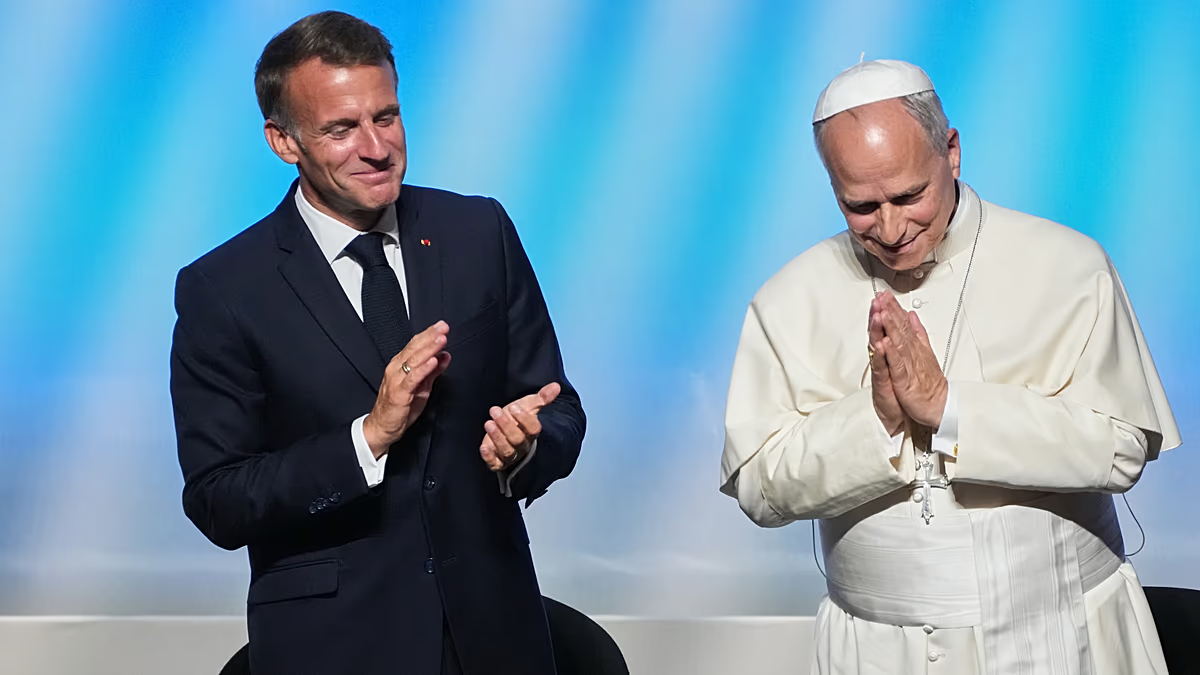
Speaking in the French city of Metz, the Pope described multilateralism as “the best defence against the desire for dominance” and urged European leaders to resist the forces driving countries and communities further apart. He said the current climate was marked by war, hunger, deteriorating relations between people and what he described as an “increasingly uncivilised” political and social environment.
Leo also criticised what he called the “lies and deception” contributing to growing distrust between citizens and their governments. For Europe, he argued, the answer lies in returning to principles that have helped the continent manage deep political disagreements without resorting to confrontation.
“Europe can break this cycle by upholding the principle of respect for others,” Leo said, arguing that Europe had demonstrated over the past eight decades that competing interests and political demands could be addressed through dialogue.
The Pope delivered the speech in French during a visit to Metz, where he was joined by French President Emmanuel Macron. Macron was also due to attend a Mass with Leo later on Tuesday.
The location gave the Pope’s appeal a distinctly European context. Metz lies in France’s northeastern Lorraine region, near the German border, an area whose history has been deeply shaped by conflict and by efforts to build lasting cooperation between former rivals.
Leo did not directly name Russia’s war against Ukraine in his address. He did, however, refer to what he called a new “pointless massacre” on European soil, while calling for renewed diplomatic efforts to end conflicts.
“It is necessary to engage in patient dialogue, to show courage in negotiations, and to be willing to compromise on certain positions for the greater good of peace,” he said.
His remarks come as European governments continue to confront a security environment shaped by war and uncertainty. The Pope’s message placed diplomacy and compromise at the centre of his appeal, presenting dialogue not as a sign of weakness but as a means of preventing disputes from escalating into further violence.
Leo also placed his argument within Europe’s religious and cultural history. He urged Europeans not to separate the continent’s modern identity from its Christian heritage, describing Europe as more than a geographical territory and calling it a “cultural and historical reality”.
“We cannot speak of Europe, then, without mentioning Christianity,” he said.
The Pope argued that acknowledging Christianity’s historical influence does not require Europe to remain fixed in the past. Instead, he said the continent has advanced when it has been able to draw from its history while adapting to new circumstances and engaging with other cultures and traditions.
Europe, he said, “has flourished and progressed when it was able to draw on the best aspects of its past and reinvent them in new and creative ways through encounter with others.”
The choice of Metz reinforced that message. The city is closely linked to Robert Schuman, one of the principal figures behind European integration. Schuman opened his law practice in Metz in 1912 and later began his political career there. He became one of the architects of the post-war European project that sought to make another major conflict between European powers less likely.
Metz’s history also carries a reminder of how difficult that transformation was. The city changed hands between France and Germany several times and was annexed by Nazi Germany in 1940 after France was defeated and occupied.
That history was central to the symbolism of Leo’s visit. The French presidency said the programme was intended to emphasise the “European and cross-border dimension” of Lorraine, a region where national borders, cultural ties and the legacy of war have long intersected.
The event also reflected an effort to bring different European institutions and religious communities into the same conversation. EU leaders and the heads of European institutions were invited, although only a small number attended alongside Macron, including representatives from Monaco, Andorra and Luxembourg.
Religious leaders from different traditions were also present. They included France’s chief rabbi, Haïm Korsia, and Chems-Eddine Hafiz, rector of the Grand Mosque of Paris.
For Leo, the setting and the message were closely connected. Metz represents both the divisions that once defined Europe and the political effort that followed to replace confrontation with cooperation. His appeal was for Europe to draw on that experience at a moment when international cooperation is under growing strain.
His central argument was that Europe’s experience offers an alternative to a world increasingly driven by rivalry and distrust: sustained dialogue, respect for differences and a willingness to compromise in pursuit of peace.