Friedrich Merz has vowed to remain Germany’s chancellor after the Christian Democratic Union (CDU) suffered a historic defeat in Mecklenburg-Western Pomerania and lost ground in Berlin, while the far-right Alternative for Germany (AfD) emerged as the strongest party in the northeastern state.
The result in Mecklenburg-Western Pomerania was particularly damaging for Merz’s party. The CDU fell to about 5% of the vote, with final figures putting it at roughly 4.9%, its worst result in a German state election since the party was founded in 1949. That leaves the CDU facing the possibility of being excluded from the state parliament under the 5% electoral threshold.
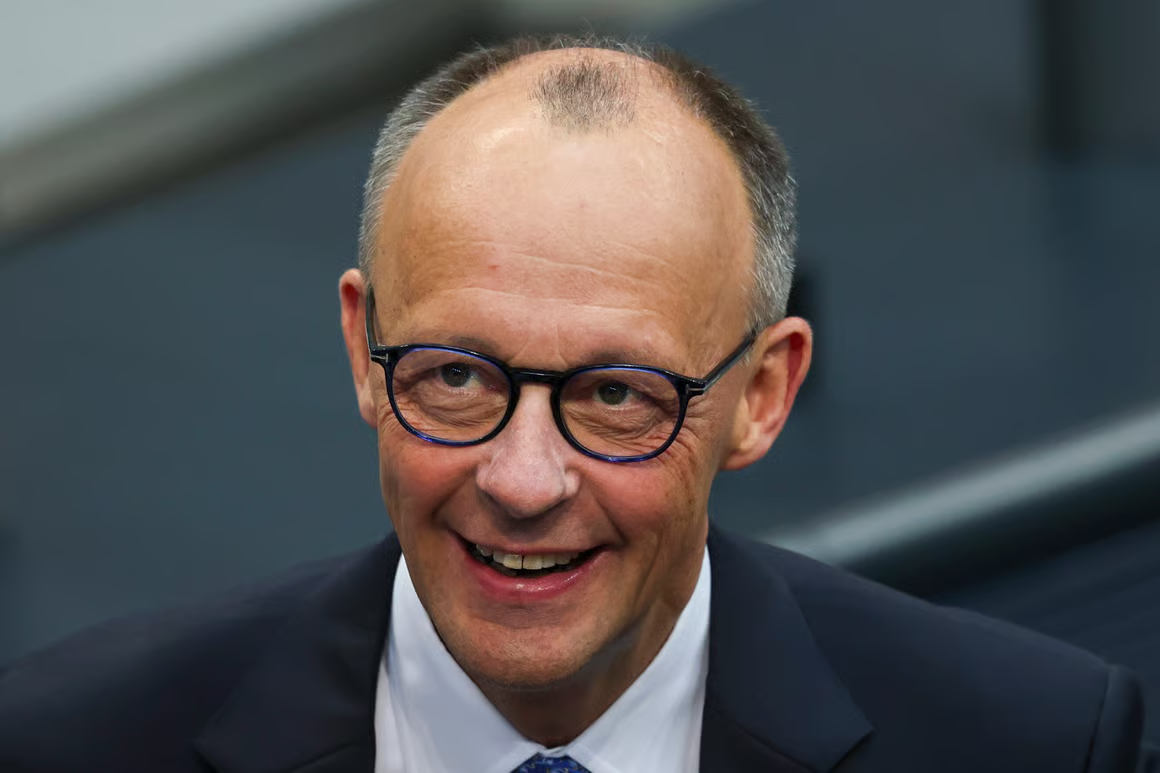
Merz described the result as “a disaster” for the CDU, but rejected suggestions that the setbacks should lead to a change of leadership. Speaking at the party’s headquarters in Berlin, he said his government would continue with its programme of economic, tax and welfare reforms.
“The reforms have to come,” Merz said, arguing that Germany needed political determination and patience to address its problems. He said he would continue to take responsibility both as CDU chairman and as chancellor.
The election results nevertheless deepen the political pressure surrounding a chancellor who has been in office for only around 16 months. Merz has faced declining approval ratings, criticism over economic conditions and growing concern within his party about the CDU’s ability to compete with the AfD.
In Mecklenburg-Western Pomerania, the AfD secured around 38% of the vote, finishing ahead of the centre-left Social Democratic Party (SPD), which took about 35.5% to 36%. The AfD’s result represents a dramatic increase from its performance in the previous state election and makes it the strongest party in the state.
That does not mean the AfD is positioned to take control of the state government. Other parties have ruled out forming a coalition with it, leaving the party with no straightforward route into government despite winning the largest share of the vote.
The outcome continues a pattern of strong AfD performances in eastern Germany. The party has been particularly successful in former East German states, where concerns about migration, living costs, economic uncertainty and dissatisfaction with established parties have helped it expand its support. The AfD’s positions on immigration, Germany’s relationship with Russia and national identity have also helped define its appeal, while the party remains heavily contested by Germany’s political establishment.
Alice Weidel, the AfD’s national co-leader, presented the results as evidence that the party was moving further into the political mainstream. “We are the strongest force and have reached the mainstream of the population,” she said.
The CDU’s problems were not confined to Mecklenburg-Western Pomerania. In Berlin, the party was also pushed into second place as Die Linke emerged as the strongest force, taking about 25% of the vote. The CDU received roughly 20%, while the AfD reached about 16% and became the third-largest party in the capital.
For Die Linke, the Berlin result represented a major breakthrough. Its support roughly doubled compared with the previous state election, while the SPD fell sharply to around 12%. The result could open the way to coalition negotiations involving Die Linke, the SPD and the Greens.
The contrasting results in the two states underline the increasingly fragmented nature of German politics. In Mecklenburg-Western Pomerania, the main challenge to the established parties came from the right. In Berlin, voters shifted strongly towards the left as well as the AfD, leaving the traditional centre parties under pressure from both directions.
For Merz, the timing is particularly difficult. The elections came only two weeks after the CDU suffered another major setback in Saxony-Anhalt, where the AfD recorded a decisive victory. The repeated losses have fuelled speculation about whether Merz can maintain his position for the full parliamentary term.
That speculation had already intensified before Sunday’s votes. Earlier in the week, the leaders of eight German states publicly backed Merz, signalling support for the chancellor as questions about his political future grew louder. CDU politician Burkard Dregger, speaking in Berlin, argued that removing Merz would create further instability when the government should instead be concentrating on its programme.
“He has got four years and we have to give him the four years,” Dregger said.
Merz’s supporters argue that many of Germany’s economic and political problems predate his government and cannot be resolved within a year. The chancellor himself has responded by insisting that his government needs time to implement its reform plans.
But the electoral evidence is becoming harder for the CDU to ignore. Merz’s attempt to take a tougher position on immigration has not stopped the AfD’s rise, while his government’s economic and welfare policies have generated dissatisfaction among voters who expected faster improvements.
The pressure is therefore coming from several directions at once. The CDU is struggling to hold voters who are moving towards the AfD, while the SPD and parties further to the left remain capable of attracting voters dissatisfied with the government’s direction.
Merz has responded by doubling down rather than retreating. He has argued that pushing ahead with reforms is itself part of the answer to the political frustration spreading through Germany, describing those reforms as a defence against what he called the growing appeal of authoritarian politics.
Whether that strategy can restore support for the CDU remains uncertain. What is clear from the latest elections is that Germany’s established political parties are facing a more fragmented electorate, and Merz’s position is now being tested not only by opposition parties but by the results emerging from voters across the country.
For now, the chancellor is staying. Sunday’s results have made his political task considerably harder, but Merz has made clear that he intends to confront that challenge from the Chancellery rather than step aside.