BRICS should become a “pioneer” in shaping the changing international system, Chinese President Xi Jinping told leaders gathered for the 18th BRICS Summit in New Delhi, outlining a broader role for the grouping that reaches beyond trade and economic cooperation.
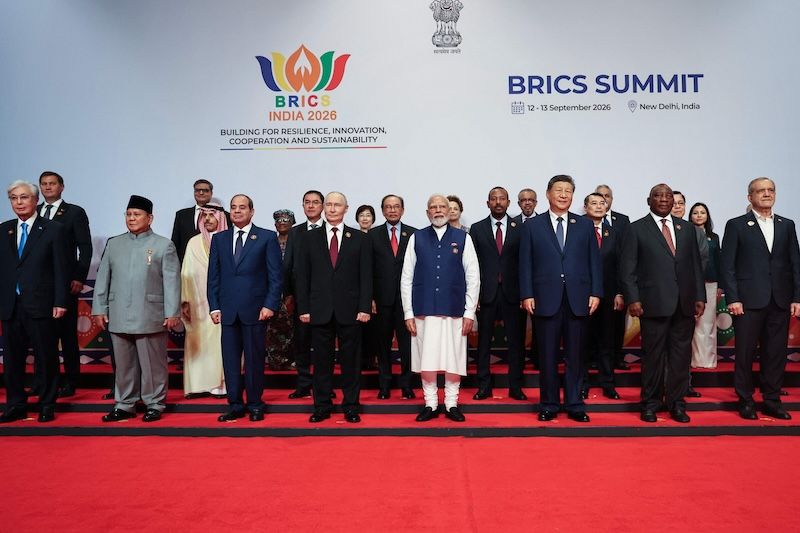
Speaking at the opening session on September 12, Xi used the 20th anniversary of BRICS cooperation to argue that the organisation’s growing influence reflects the rising economic and political weight of emerging markets and developing countries. He portrayed BRICS as an institution built around cooperation, national development priorities and shared interests among countries of the Global South.
But the anniversary was also an opportunity to look ahead. Xi’s central argument was that BRICS members should not simply adapt to changes in the international system. They should help shape them.
He connected that ambition to four areas: technological and economic innovation, international peace and stability, exchanges between civilisations, and reform of global governance. The message was that the group’s growing size and influence should translate into a more active role in determining how international cooperation develops.
Technology was at the centre of Xi’s economic vision. He called for stronger cooperation among BRICS countries in artificial intelligence, including support for open-source development, greater sharing of technology and closer collaboration in research, development and practical applications.
China also proposed an initiative aimed at using artificial intelligence to promote new industrialisation across BRICS economies. Xi said Beijing wanted to cooperate with other members on technology while strengthening links across industrial and supply chains. He also invited BRICS countries to participate in the World Artificial Intelligence Cooperation Organization.
The proposals became more concrete on the second day of the summit, when Xi outlined five initiatives for what he described as “greater BRICS” cooperation. The areas include artificial intelligence, trade and investment facilitation, the digital economy, smart manufacturing and talent development.
The proposals point to an effort to turn BRICS’ growing economic weight into practical cooperation. Xi called for innovation incubators, the modernisation of traditional industries, investment in emerging sectors and planning for industries that have yet to fully develop.
The underlying ambition is significant. Rather than remaining primarily consumers of technologies developed elsewhere, BRICS countries would seek a larger role in research, industrial applications and the development of standards. That would give emerging economies greater influence over technologies that are increasingly shaping production and international trade.
The idea comes as BRICS itself has changed considerably since its original formation. The organisation now has 11 full members across four continents, alongside a broader network of partner countries. Its membership accounts for close to half of the world’s population, giving the group considerable demographic and economic reach.
The expansion has also increased Africa’s presence within BRICS. South Africa, Egypt and Ethiopia are now full members, giving the continent three countries at the table as the organisation develops its positions on trade, development, technology and global governance.
For African countries, that wider membership creates an opportunity to have a stronger voice in debates over international rules and institutions rather than simply operating within systems largely designed by others.
Xi’s second area of focus was security. He called on BRICS members to support what China describes as common, comprehensive, cooperative and sustainable security, while rejecting Cold War thinking, bloc confrontation, interference in domestic affairs and violations of national sovereignty.
He also urged BRICS countries to play a constructive role in resolving conflicts.
The conflict in the Middle East featured prominently in his remarks. Xi said the violence had resulted in serious losses and argued that a political settlement and a permanent, comprehensive ceasefire were necessary. China, he said, would work with other BRICS members to support peace in the region.
That position reflects how far the BRICS agenda has moved from its original economic focus. The organisation increasingly presents itself as a forum for discussions that include security, international institutions, technology and development. Xi’s speech linked that expanding agenda directly to the growing influence of emerging and developing countries.
He also called for BRICS to become a pioneer in exchanges between civilisations, placing culture and people-to-people contact alongside economic and political cooperation.
Xi encouraged greater cooperation in tourism, education and culture, as well as stronger connections among young people. He also promoted exchanges of experience in governance and argued that cultural and people-to-people programmes could contribute to more stable relations between countries.
For an organisation that brings together countries with very different political systems, economies, histories and social traditions, that emphasis is notable. Xi’s approach presents diversity within BRICS as something that can support wider exchanges rather than prevent cooperation.
The fourth element of his vision was reform of global governance.
Xi called for changes to international institutions that would give emerging markets and developing countries greater representation. He reaffirmed China’s support for the United Nations and for a multilateral trading system centred on the World Trade Organization, while opposing protectionism.
He also pointed to areas such as cyberspace, outer space and the deep sea as emerging fields where BRICS countries should have a greater role in developing international rules.
Taken together, the four priorities give Xi’s use of the word “pioneer” a broader meaning. In technology, it means building capacity and developing industries. In security, it means taking a more active role in resolving conflicts and resisting bloc politics. In cultural relations, it means strengthening contact between societies. In global governance, it means pushing for greater influence for emerging and developing countries.
The five initiatives announced on the second day add an economic and industrial foundation to that vision. Artificial intelligence connects research with industrial development, while trade and investment measures are intended to deepen economic links. Digital industries and smart manufacturing address changes in the global production system, while talent development focuses on the people needed to support those industries.
The challenge now is whether BRICS‘ expanding membership can translate into deeper and more practical cooperation.
The summit’s joint declaration backed stronger cooperation on development, security, trade, investment, finance, technology, artificial intelligence and sustainable development. Leaders also reaffirmed their support for multilateralism, international law and the central role of the United Nations, while calling for greater representation of emerging markets and developing countries in international institutions.
The declaration also supported an open and inclusive multilateral trading system centred on the World Trade Organization and rejected protectionism. Those positions reflect a wider effort by BRICS members to coordinate their approach to international economic and political questions while arguing for a greater role for the Global South.
China will now take over the rotating BRICS chair and host the 19th BRICS Summit in 2027. Xi said Beijing would work with the other members to build consensus and begin what he called BRICS’ third “golden decade”.
That gives China an opportunity to turn the ideas presented in New Delhi into programmes with measurable results. The initiatives on artificial intelligence, trade, digital industries, manufacturing and skills offer a starting point, but their significance will ultimately depend on how much cooperation actually takes place between member states.
The New Delhi summit therefore leaves BRICS with a larger ambition than it had two decades ago. Its members are no longer being presented simply as emerging economies seeking a stronger place in existing international structures. Xi’s message is that they should help determine the direction of those structures themselves.
Whether that ambition produces lasting institutional influence will depend less on the language of the summit than on what BRICS members do with it. For now, however, the organisation’s next phase is being framed around a clear idea: countries of the Global South should move from having a greater voice in international affairs to having a greater hand in shaping them.