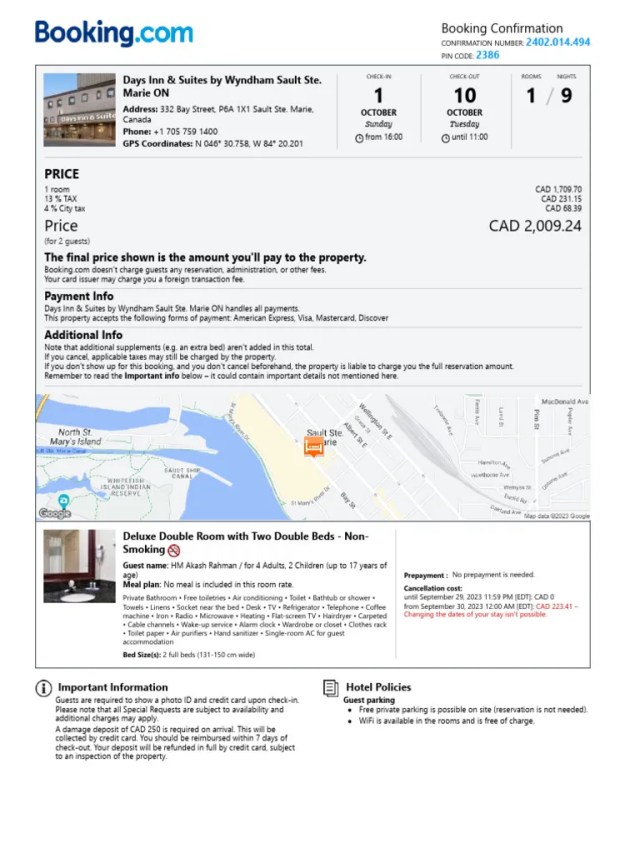
Booking.com reservations can be used as proof of accommodation for a Schengen visa application, provided they meet the requirements of the embassy or consulate handling the application. Travellers do not necessarily have to pay for their entire hotel stay before applying, but a reservation must be genuine, verifiable and consistent with the travel dates and itinerary submitted with the application.

For many applicants, accommodation is one of the documents that needs careful attention when preparing a Schengen visa application. Alongside flight reservations, travel insurance, proof of financial means and other supporting documents, applicants are expected to show where they intend to stay during their visit to the Schengen Area. A hotel booking made through Booking.com can help meet this requirement, but simply having a reservation confirmation does not automatically make an application acceptable.
The distinction between a reservation and a fully paid hotel booking is particularly important. Booking.com offers different payment arrangements, including properties that allow guests to reserve a room and pay later or cancel without charge before a specified deadline. These options can be useful for visa applicants who do not want to commit substantial money to accommodation before knowing whether their visa will be approved.
The European Commission’s guidance makes clear that applicants must provide supporting documents showing their accommodation arrangements. The EU Visa Code also requires documents relating to accommodation, or evidence that the applicant has sufficient means to cover it. It does not prescribe Booking.com as the required booking platform, nor does it establish that every reservation must be prepaid.
This means the important question is not whether the reservation was made through Booking.com, but whether it provides credible evidence of the applicant’s intended accommodation. A booking confirmation showing the guest’s name, hotel name, address, contact details, check-in and check-out dates and reservation reference is more useful than a vague screenshot showing that a room was selected.
Applicants should download the actual confirmation document from their Booking.com account and check that the information is correct before submitting it. The name on the reservation should correspond to the applicant or clearly identify the person responsible for the booking. Where several people are travelling together, the accommodation arrangements should make it clear who is included in the reservation.
The dates also matter. The accommodation should cover the entire period of the proposed stay in the Schengen Area, including nights spent in different countries. Someone planning to visit France, Germany and the Netherlands, for example, should provide accommodation evidence that accounts for the nights in each destination. If the itinerary includes overnight travel or a stay with friends or relatives, the documents should explain those arrangements rather than leave unexplained gaps.
The country receiving the application also plays a role. Schengen visa rules establish common requirements, but individual member states can have additional supporting-document requirements and national procedures. An applicant travelling to Finland, for example, should consult the Finnish authorities’ checklist rather than assume that the requirements published by another Schengen country will be identical.
Finland’s visa guidance recognises hotel reservation confirmations as supporting evidence of the purpose and conditions of a visit. Some Finnish mission-specific checklists go further by explicitly requesting hotel reservations or another written explanation of accommodation for the full stay. The Finnish visa application checklist for Tunisia, for instance, says applicants should not pay for a hotel reservation before receiving the visa decision.
That distinction is useful for travellers concerned about losing money if their applications are refused. A refundable Booking.com reservation or one with free cancellation may provide a practical way to demonstrate accommodation arrangements without paying the full cost in advance. However, applicants should read the cancellation terms carefully. Free cancellation usually applies only until a stated deadline, and some properties have non-refundable rates or require payment before arrival.
There is also a difference between a booking that can be cancelled and one that is merely held temporarily. Applicants should check that their reservation is confirmed and remains valid when the application is submitted. A booking that expires before the embassy reviews the documents, or one that has already been cancelled, may no longer provide convincing evidence of accommodation.
European authorities have also warned against presenting travel arrangements that do not reflect genuine plans. In its guidance on Schengen visa applications, the European External Action Service advises applicants to provide genuine hotel and flight reservations that correspond with their actual travel plans. It recommends choosing arrangements that can be changed or cancelled without additional costs where possible.
This is particularly relevant to the practice of making temporary hotel reservations solely to obtain a visa. Although flexible bookings can be legitimate, submitting accommodation details for a trip the applicant has no intention of taking can raise questions about the credibility of the application. Providing false or misleading information is not a harmless shortcut and can have consequences for the visa decision.
A Booking.com confirmation should also not be treated as a substitute for the other financial documents required for a Schengen visa. Having accommodation reserved does not demonstrate that the applicant can afford meals, local transport, activities and other expenses during the visit. Applicants may still need to provide bank statements, evidence of employment or income, sponsorship documents where applicable, and other proof of financial means requested by the relevant consulate.
The same applies to flight reservations and travel insurance. Accommodation evidence is only one part of the application. Consular officers assess the documents together, considering the purpose of the journey, the proposed itinerary, the applicant’s financial circumstances and whether the information provided supports the intention to leave the Schengen Area before the visa expires.
Applicants should also make sure that their accommodation arrangements support the country they have selected as their main destination. Under the Schengen application rules, a traveller visiting several member states should generally apply through the country where they intend to spend the longest period. If the stay is equally divided between countries, the application should normally go to the country of first entry. A hotel reservation in one country does not, by itself, establish that it is the correct country to handle the application.
Another point worth considering is whether the booking is suitable for the type of trip being presented. A solo traveller applying for a short holiday should have accommodation arrangements that make sense for the dates and destinations listed in the application. A family travelling together should ensure the reservation reflects the correct number of guests. If the applicant intends to stay with a private host for part of the visit, an appropriate invitation or accommodation document may be needed instead of a hotel booking for those nights.
ALSO READ: How to Prepare a Travel Itinerary for a Tourist Visa Application
For applicants who have already booked through Booking.com, it is sensible to review the reservation before submitting the visa application. Check the spelling of names, the property address, the dates, the number of guests and the cancellation conditions. If the booking has been changed, download the updated confirmation rather than submit an earlier version. If the accommodation is cancelled or replaced after the application has been lodged, applicants should follow the instructions of the relevant embassy or visa centre about whether updated documents must be provided.
Ultimately, Booking.com is a booking platform, not a visa authority. A reservation made through it does not carry special approval status, and there is no guarantee that an embassy will accept every booking confirmation as sufficient evidence. What matters is whether the document meets the relevant consulate’s requirements and whether the accommodation arrangements are genuine, consistent and verifiable.
Travellers do not generally need to assume that they must pay for every hotel night before submitting a Schengen visa application. A confirmed reservation with a suitable cancellation policy can be an acceptable option, provided the embassy or consulate’s instructions allow it. Checking the official requirements for the country of application before making the reservation is a far safer approach than relying on advice from booking forums, travel agents or social media.