Houthi forces have reached Perim Island at the entrance to the Red Sea after taking control of Yemen’s port of Mocha, bringing the Iran-aligned movement closer to one of the world’s most important maritime corridors linking Asia and Europe.
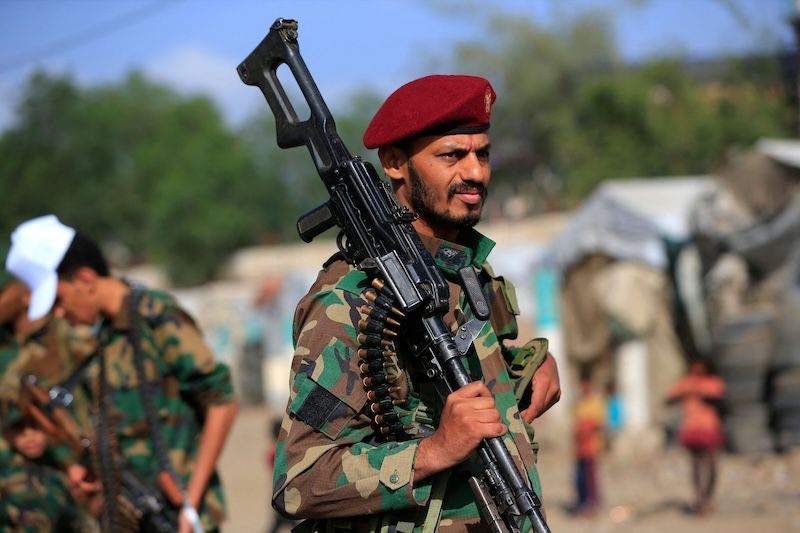
Four Yemeni government sources told Reuters that Houthi fighters reached Perim, also known as Mayyun, on Friday. The island lies within the Bab al-Mandab Strait, the narrow waterway connecting the Red Sea with the Gulf of Aden and the Indian Ocean. Two of the sources said Saudi-backed forces had withdrawn from the island, while Houthi forces also captured the coastal town of Dhubab, which faces Perim across the strait.
The reported move came only a day after the Houthis seized Mocha, roughly 75 kilometres north of Bab al-Mandab. The rapid advance has altered control of a significant stretch of Yemen’s western coastline in a matter of days and brought Houthi forces into an area with direct importance for international shipping.
Bab al-Mandab is a key route for vessels travelling between Asia and Europe. Ships using the passage can continue north through the Red Sea towards the Suez Canal, making the strait an important link in global trade and energy transportation. Perim’s location gives it particular strategic value because the island sits inside Bab al-Mandab and separates the waterway into two channels.
A Yemeni government official told AFP that boats carrying Houthi fighters arrived on Perim after government forces pulled out. The Houthis have said international commercial shipping is not threatened by their forces, although they have continued to issue threats against vessels connected to Saudi Arabia.
The development is especially significant for Saudi Arabia because the kingdom has increasingly relied on its Red Sea infrastructure as disruptions to shipping and energy flows through the Strait of Hormuz have complicated access to the Gulf.
Saudi Arabia has previously redirected a substantial share of its crude exports towards the Red Sea using the East-West pipeline, which connects the country’s oil-producing region in the east with the Red Sea port of Yanbu. The BBC reported that as much as 70 percent of Saudi crude exports had been diverted through the pipeline.
The wider pressure on oil markets has already pushed prices towards a weekly close above $100 a barrel. The International Energy Agency reported that Saudi crude supply fell by 2.3 million barrels a day in August to about six million barrels a day, its lowest level in more than three decades. OPEC figures put Saudi production at 6.24 million barrels a day in August, down from 8.14 million barrels a day in July.
That has increased attention on the East-West pipeline and the infrastructure supporting Saudi Arabia’s alternative export route. Satellite imagery from the European Space Agency showed black smoke close to a pumping station south of Medina on Thursday, although Saudi authorities and Saudi Aramco had not confirmed that an incident had taken place.
The Houthi offensive began on September 3 and moved through parts of western Taiz, southern Hodeidah and the Mocha area. Government-aligned National Resistance forces subsequently pulled back from positions around Mocha, allowing the Houthis to take the strategically located port.
Yemeni government forces have indicated that they intend to mount a counter-offensive. Military spokesman Majed al-Nazili urged civilians to avoid the road connecting Taiz and Mocha and to keep away from Houthi military equipment.
The advance has also raised questions about the response from Saudi Arabia, which has backed forces opposing the Houthis during Yemen’s long-running conflict. Axios reported, citing two US officials, that Saudi Crown Prince Mohammed bin Salman asked US President Donald Trump during two telephone calls on Thursday to order strikes against the Houthis. According to the report, Trump declined the request.
For civilians in western Yemen, the latest fighting has brought another period of displacement after years of war. The International Organization for Migration said on Friday that at least 46,000 people had fled their homes since the fighting intensified the previous week.
“Families are being forced to flee for the second or third time in this conflict, with almost nothing left,” IOM Director General Amy Pope said.
The latest displacement has affected families from areas around Mocha, Taiz and Hodeidah, adding another layer of humanitarian pressure to a conflict that has already uprooted millions of Yemenis over more than a decade.
Mocha’s significance extends beyond its military position. The port once occupied an important place in international commerce, becoming a major centre of the coffee trade under Ottoman rule. Yemeni coffee was shipped through the Red Sea to Egypt and European merchants, and the name “mocha” itself is derived from the city.
Its importance today is far less about coffee than geography. With the Houthis now reported to have control of Mocha, Dhubab and access to Perim Island, the movement has advanced towards a maritime chokepoint through which a crucial route between the Indian Ocean, Red Sea and Suez Canal passes. The consequences of that shift will depend not only on whether the Houthis can hold the territory they have taken, but also on how Yemen’s government, Saudi Arabia and other regional powers respond to the changing balance along the Red Sea coast.