Finland has joined France’s European nuclear deterrence initiative, adding a new dimension to its defence relationship with Paris while making clear that French nuclear weapons will not be stationed on Finnish territory in peacetime.
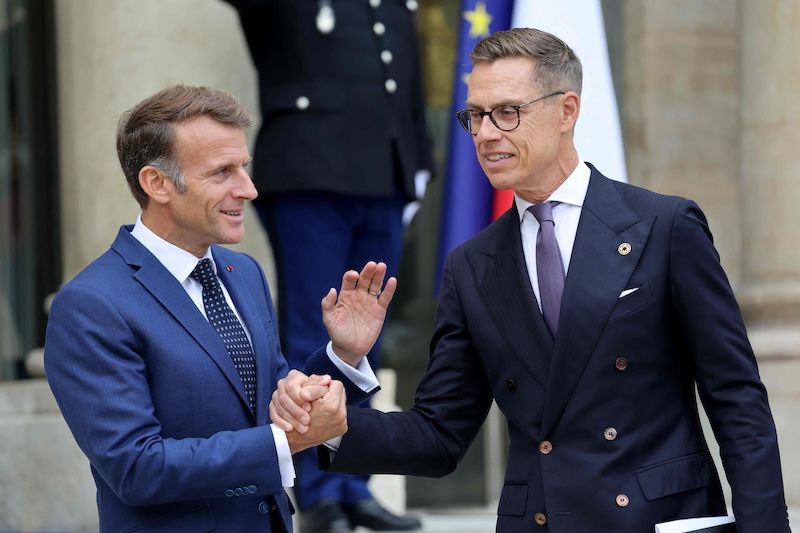
President Alexander Stubb announced the decision after confidential discussions between Finnish and French officials and politicians. A joint statement issued by the two countries confirmed Finland’s participation in the initiative, which France launched under President Emmanuel Macron in March as part of a broader effort to strengthen Europe’s role in its own defence.
For Finland, the decision comes with a clear distinction between closer cooperation with France and any commitment to host nuclear weapons. Stubb said there would be no reason to station such weapons in Finland during peacetime and avoided speculating about what arrangements could be considered in the event of war.
France will retain complete control over its nuclear arsenal and will continue to determine what it considers a threat to its vital interests. Finland’s participation therefore does not mean that the country is receiving a French nuclear guarantee comparable to NATO’s collective defence arrangements.
Stubb stressed that NATO remains the foundation of Finland’s nuclear deterrence, including the extended deterrence provided by the United States. The French initiative is intended to complement NATO rather than replace or replicate the alliance’s nuclear arrangements.
The distinction is important because participation does not create obligations equivalent to those accepted by NATO members under the alliance’s collective defence framework. Defence Minister Antti Hakkanen said Finland’s involvement would nevertheless strengthen defence cooperation with France and contribute to national security.
France is not asking participating countries to help finance the maintenance of its nuclear arsenal. Instead, the initiative is designed to create a framework for greater consultation and cooperation around French nuclear deterrence and its role in European security.
Finland is the tenth country to join the initiative. It joins Sweden, Norway, Denmark, Germany, Britain, Belgium, the Netherlands, Italy and Greece, giving the French proposal a broader European and, particularly, northern European dimension.
A joint working group will now examine how Finland’s participation can work in practice. Stubb said developing the cooperation could take between 10 and 15 years, suggesting that the initiative is intended as a long-term process rather than an immediate change to Finland’s defence arrangements.
One attraction for Finland is greater access to information about French nuclear deterrence. Stubb said this was among the reasons Helsinki decided to participate. He also pointed to the involvement of Sweden, Norway and Denmark, arguing that the Nordic countries share important security interests, particularly in northern Europe.
The decision is likely to attract attention in Moscow. Russia has previously opposed the French initiative, but Stubb played down the need for dramatic reactions to Finland’s decision.
“Keep a cool head,” he said when asked about Russia’s likely response.
The move has received broad parliamentary support, according to Stubb, although the Left Alliance has opposed Finland’s participation. The political debate is likely to continue as the government and its European partners work out what the initiative will mean in practical terms.
Finland’s decision also fits into a wider expansion of defence cooperation with France. French forces have already committed to activities in Finland, and Stubb said the nuclear deterrence initiative represents another element in an increasingly close security relationship between the two countries.
The timing also reflects broader efforts by European countries to strengthen their own defence responsibilities. France has long maintained its independent nuclear deterrent, and Macron’s initiative seeks to give other European countries a greater role in discussions surrounding its strategic purpose without transferring control of French nuclear weapons.
For Finland, the immediate message is therefore less about nuclear weapons arriving on Finnish soil and more about gaining a place in discussions over Europe’s future security architecture. NATO and US extended deterrence remain central to Finnish defence policy, while cooperation with France provides another channel through which Finland can deepen its role in European security.
The next step will be the work of the Finnish-French group tasked with defining the practical arrangements. At the same time, Finnish Foreign Minister Elina Valtonen and French Foreign Minister Jean-Noel Barrot are due to sign a strategic partnership document in Helsinki, underlining how the nuclear deterrence initiative forms part of a much broader strengthening of relations between Finland and France.