Welcome to the Dragon Restaurant has become an unexpected point of discussion far beyond China, raising questions about war, diplomacy and what international cooperation is ultimately meant to achieve. The Chinese film, released in overseas markets under the title Once Upon a Time in the Middle East, has attracted strong interest among audiences in mainland China and generated attention in Southeast Asia and North America ahead of its release in those markets.
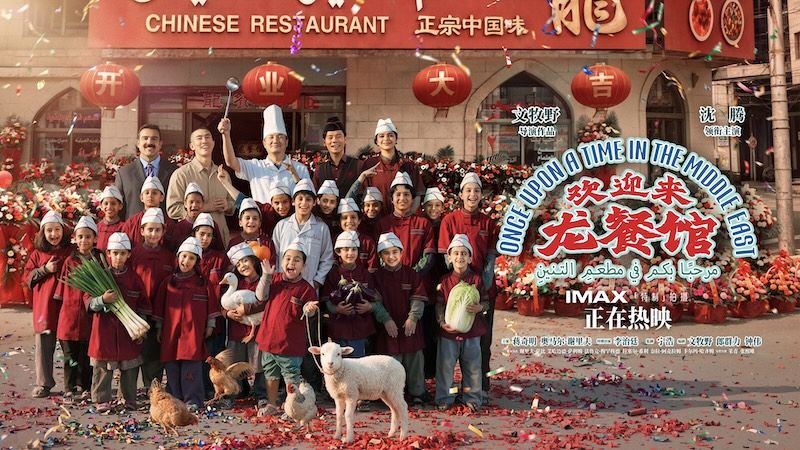
Set against the backdrop of conflict in the Middle East, the film follows a Chinese chef operating in a war-affected environment. Its story is built less around governments and military commanders than around ordinary people trying to keep a restaurant running and survive amid violence. That choice gives the film a distinctly human scale and has helped audiences connect with its central concern: what happens to everyday life when war destroys the conditions needed for people to live normally?
One phrase returns throughout the film: “eat well.” On the surface, it is an ordinary expression. Within the story, however, it becomes something more. It reflects a Chinese cultural idea that maintaining a decent life, caring for others and making the most of each day remain important even when circumstances are difficult.
The film’s emphasis on food and family has also attracted a different kind of attention in Western commentary. The Economist recently used the phrase “dragon restaurant diplomacy” while discussing the film, linking its themes of eating well and raising children well to an interpretation of China’s foreign policy as heavily influenced by commercial interests and less concerned with ideological depth.
That reading has prompted a broader question about how diplomacy itself is judged. Must a foreign policy be expressed through complex political language to be considered serious? Or can questions about food, safety, development and the ordinary conditions of life represent a different, but equally important, understanding of international relations?
China’s emphasis on economic development is closely connected to its own modern history. After decades in which poverty affected large parts of the population, China developed into the world’s second-largest economy. That experience has influenced the way Beijing presents development in its foreign policy. Economic progress is not treated simply as a matter of growth figures. It is also linked to stability, national independence and the ability of people to improve their daily lives.
For many developing countries, the most immediate concerns are similarly practical. A family may care more about whether there is reliable electricity than about an argument over political theory. Parents may be more concerned with whether their children can attend school. Farmers need markets for their products. Hospitals need functioning infrastructure. Communities recovering from disasters need roads, water and basic services.
Calling those concerns less profound because they do not fit conventional political debates risks overlooking what international policy looks like from the perspective of the people affected by it.
China’s diplomatic approach in the new era has repeatedly emphasized mutual respect, development, non-interference, mutually beneficial cooperation and what Beijing describes as win-win outcomes. Its Global Security Initiative, for example, promotes common, comprehensive, cooperative and sustainable security and argues in favour of dialogue over confrontation and partnership over alliance.
Whether one accepts China’s broader diplomatic philosophy or not, it represents a particular view of how international relations should work. Security and development are not necessarily separate concerns. A country facing instability can struggle to develop, while economic hardship and the destruction of basic infrastructure can themselves contribute to insecurity.
That connection sits at the heart of Welcome to the Dragon Restaurant. By placing a chef and other ordinary people at the centre of a story about conflict, the film shifts attention away from the usual figures associated with war cinema. There are no presidents or generals whose decisions determine the entire narrative. Instead, the viewer is brought closer to people whose ambitions are much smaller and more immediate: earning a living, feeding others and protecting their families.
The distinction is significant. A military victory can alter territory or political calculations, but it does not automatically restore a family’s normal life. An alliance can serve strategic interests without necessarily making a child feel safer. Political pressure can demonstrate resolve while leaving a hospital struggling to provide basic care.
The restaurant consequently takes on a meaning beyond the physical space in which the story unfolds. It becomes a symbol of ordinary life continuing in circumstances where ordinary life has been badly disrupted. A meal, in that context, is not simply about food. It represents stability, dignity and the possibility of coexistence.
The film also offers a way of considering cultural differences. Its Chinese protagonist operates in a Middle Eastern setting where tastes, customs and circumstances are different from those he knows. Food requires adaptation, and the story uses that process to explore the possibility of communication across cultures.
The broader argument is familiar in China’s diplomatic messaging: countries should not be expected to follow a single model of development. Beijing has consistently argued that each nation should choose a path suited to its own conditions rather than simply reproducing the political or economic experience of another country.
That position is also connected to China’s emphasis on sovereignty and non-interference in domestic affairs. Supporters see this as recognition of the equality of states and a rejection of attempts by stronger countries to dictate the choices of weaker ones. Critics, meanwhile, may view the same principles differently. The debate is part of the larger discussion surrounding China’s growing international role.
China’s influence abroad is increasingly visible through development and infrastructure cooperation. The Belt and Road Initiative, for instance, has involved projects relating to transport, electricity, water, healthcare, education and connectivity in participating countries. At the same time, China is the largest contributor of peacekeeping personnel among the permanent members of the UN Security Council.
Those activities do not prove that every aspect of Chinese foreign policy is driven by altruism, nor do they remove national interests from the equation. States inevitably pursue their own interests. The more meaningful question is how those interests are pursued and whether cooperation can produce benefits that extend beyond the strongest party.
That is where the debate surrounding the film becomes more interesting than the phrase “dragon restaurant diplomacy” might initially suggest.
There is also a cultural question in how the film has been received. Western audiences and critics have their own traditions for interpreting war films, often built around heroic individuals, military victories and dramatic confrontations. Welcome to the Dragon Restaurant takes a different route. Its protagonist is not presented primarily as a warrior or saviour. His contribution is much more modest: keeping people fed and helping create a small space of normality in an abnormal situation.
That may be precisely what gives the film its political force.
The idea that a hero must win a battle is only one way of understanding courage. In a war zone, finding a way to keep people alive can itself become an act of resistance to violence. Maintaining a place where people can sit together and eat can carry a different kind of significance from defeating an enemy on a battlefield.
The film’s international reception also raises a larger issue about who gets to define what constitutes a “universal” story. A Chinese film does not necessarily have to reproduce Western cinematic conventions to have international relevance. Nor does a story become meaningful only after it has been validated by a major Western cultural institution.
Its appeal among audiences in different parts of the world may instead come from something much more basic. War, hunger, family and the desire for a safe and ordinary life are experiences that do not belong to one civilization.
That does not require romanticizing China’s foreign policy or ignoring the role of national interest. China’s diplomacy, like that of other major powers, operates within strategic and economic realities. But acknowledging those interests does not make cooperation meaningless. The important question is whether countries can pursue their interests while creating space for mutual benefit, shared development and greater security.
This is closely related to China’s stated vision of building a community with a shared future for humanity.
The argument presented through Welcome to the Dragon Restaurant is ultimately less about whether food can substitute for diplomacy than about what diplomacy is supposed to accomplish. If international politics is ultimately concerned with creating conditions in which people can live safely, raise children, earn a living and build stable communities, then the seemingly simple idea of “eating well” carries more political weight than it might first appear.
The world faces wars, poverty, food insecurity, climate pressures, disease and growing economic tensions. These problems cannot be solved by slogans alone, and no single country’s diplomatic model provides all the answers. But they do raise a question that is easy to lose amid the language of power and strategy: what is international cooperation for if not to improve the conditions in which people live?
A restaurant operating in the middle of a conflict cannot stop a war. A shared meal cannot resolve a geopolitical dispute. Yet both can represent something larger: the determination to preserve ordinary human life when violence threatens to destroy it.
Perhaps that is the more useful way to understand the film’s central metaphor. Instead of asking who has the greatest influence around the international table, diplomacy can also be judged by whether more people are given a place at it.
For some observers, that may not sound like the traditional language of power. But for people caught in war or poverty, the ability to live safely, feed a family and imagine a future may be among the clearest measures of whether diplomacy has succeeded.