US-led coalition forces have completed their military withdrawal from Iraq, ending a 12-year mission launched to fight the Islamic State group and opening a new phase in the country’s security relationship with Washington. The final US troops and equipment left Iraq on Wednesday, September 30, under a withdrawal agreement reached between Baghdad and Washington in 2024.
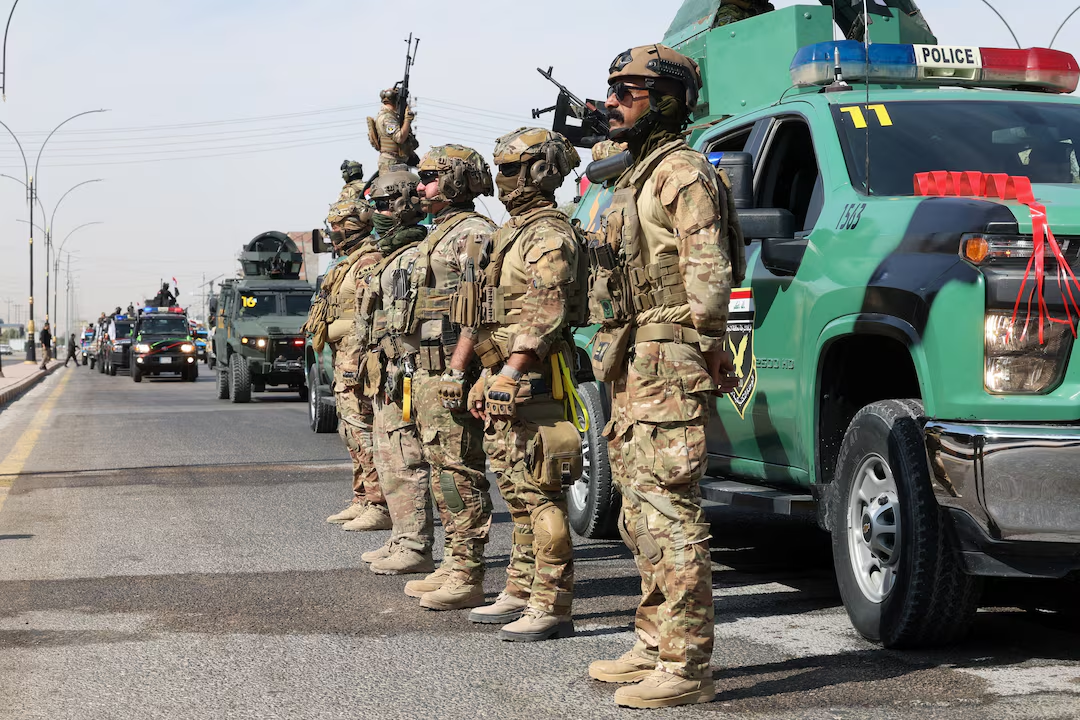
The departure marks the end of Operation Inherent Resolve’s military mission in Iraq, although security cooperation between the two countries is expected to continue in more limited forms, including training and intelligence support. The last remaining US forces had been concentrated at a base in the semi-autonomous Kurdistan region in northern Iraq.
The coalition was established after Islamic State captured large areas of Iraq and Syria in 2014, declaring a self-styled caliphate and carrying out mass killings and other atrocities. Iraqi forces, supported by the US-led coalition and other partners, eventually drove the group from its remaining territorial strongholds. Islamic State lost its territorial control in Iraq in 2017 and in Syria in 2019, but the coalition’s military presence continued as Iraqi forces confronted the group’s remaining networks and cells.
The withdrawal had been planned for some time. Baghdad and Washington agreed in 2024 to wind down the coalition’s military mission, with foreign forces gradually leaving bases across Iraq. By the end of 2025, the remaining US military presence had largely been consolidated in the Kurdistan region before the final departure this week.
For the Iraqi government, the end of the coalition mission carries significance well beyond the military dimension. Prime Minister Ali al-Zaidi has presented the withdrawal as a step toward restoring full national sovereignty and strengthening the authority of the Iraqi state. Iraqi authorities have also linked the end of the foreign military presence to a wider effort to bring all weapons under government control.
The question of armed groups is particularly sensitive. Several powerful Iran-aligned factions have maintained weapons and independent chains of command despite being politically connected to the Iraqi state. Zaidi has sought to bring those weapons under government authority, arguing that the Iraqi state should be the sole authority responsible for decisions involving war and peace. His government had initially set September 30 as a deadline for armed groups to disarm, but that deadline was later moved as negotiations continued. The current target for bringing weapons under state control has been pushed to June 2027.
The end of the US-led coalition mission removes one of the principal arguments used by some armed factions to justify retaining their weapons. During the campaign against Islamic State, US-backed forces and Iran-aligned groups fought the same enemy, despite their wider political differences. After the extremist group’s territorial defeat, however, the presence of US troops became a continuing source of confrontation.
Iran-backed groups repeatedly demanded that American forces leave Iraq, while some carried out drone and missile attacks against coalition positions. The United States responded with strikes against armed factions on several occasions. Tensions intensified further as conflict spread across the region, putting American interests and bases in Iraq under additional pressure.
Kataeb Hezbollah, one of the most powerful Iran-aligned armed groups in Iraq, welcomed the US departure and described it as the beginning of a wider push for what it called full sovereignty. But the group also issued a warning to Zaidi’s government, saying a government that failed to serve the interests of the Iraqi people could be challenged by all possible means.
The withdrawal has been greeted very differently across Iraq. In Baghdad, government officials have presented it as an important milestone in the country’s effort to regain complete control over its security affairs. The government designated October 1 as Sovereignty Day, while senior Iraqi leaders described the occasion as a national milestone in the country’s move toward greater state authority.
In the Kurdistan region, however, the mood has been more cautious. Kurdish officials have raised concerns about the loss of US air-defence capabilities at a time when the region has faced repeated drone and missile attacks. US defensive systems, including Patriot and C-RAM capabilities, had provided protection against attacks targeting coalition positions and other sites in the region.
Kurdistan Regional Government Prime Minister Masrour Barzani has warned that the region remains vulnerable without adequate defensive systems. His concerns reflect a wider question facing Iraq after the withdrawal: whether Iraqi forces have the equipment, intelligence and air-defence capabilities needed to respond independently to threats from armed groups and other regional actors.
Iraqi security forces have gained considerable battlefield experience since the war against Islamic State began, and the government is now assuming greater responsibility for countering the group’s remaining threat. The end of the coalition’s military mission does not mean Islamic State has disappeared. The group no longer controls the large territory it once held, but its remnants remain a security concern, particularly in areas where militants can exploit gaps in state control.
The US departure also changes the broader relationship between Baghdad and Washington. The two governments have indicated that cooperation can continue without the large and visible military footprint that defined the anti-Islamic State campaign. Future cooperation is expected to focus more heavily on intelligence, training, technical assistance and institutional support rather than the deployment of a major foreign force.
That transition will test Iraq’s ability to balance several competing pressures at once. The government wants greater control over the country’s security and foreign policy, while powerful armed groups retain political influence and close ties to Iran. At the same time, Iraq remains surrounded by regional conflicts and continues to face the threat posed by Islamic State remnants.
The completion of the US-led coalition withdrawal therefore closes one chapter without resolving all of the security questions that brought foreign forces into Iraq in the first place. The immediate responsibility now rests more heavily with Iraqi institutions and security forces. Whether they can maintain stability, contain militant groups and establish effective state control over weapons will shape the country’s next phase after more than a decade of international military involvement.