Silja Kosonen won the women’s hammer throw at the European Athletics Championships in Birmingham on Wednesday, finally turning years of strong performances and narrow misses into her first senior championship gold medal.
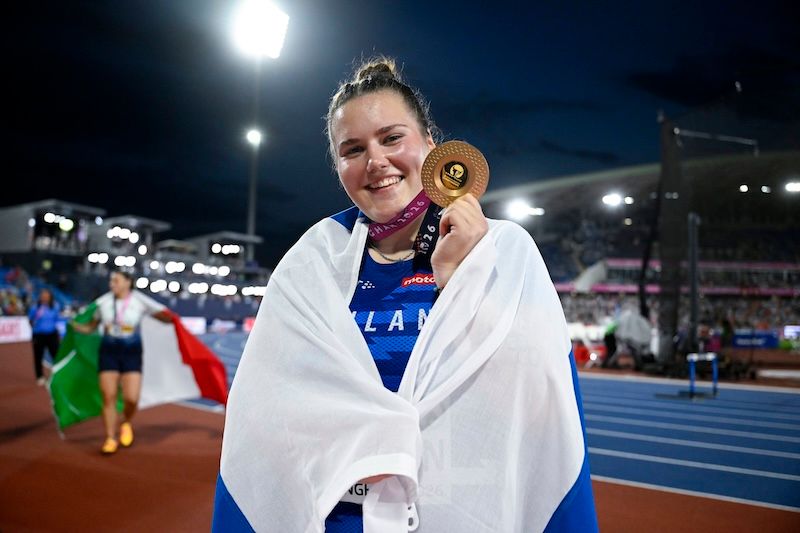
The 23-year-old Finnish thrower produced a winning mark of 76.28 metres in the third round of the final. The throw was enough to secure the European title and give Finland its first medal of the championships.
For Kosonen, the victory was about more than adding another major title to her record. It ended a long wait for a senior medal after several occasions when she had come close but left a major championship without a podium finish.
“It sounds a lot better than being forever fourth or close to the medals,” Kosonen told Yle after the competition. “It is nice that I am now able to call myself a European champion.”
Kosonen arrived in Birmingham with a reputation as one of the leading young hammer throwers in Europe. Her results at previous championships showed why, but they also revealed how difficult it had been for her to turn that ability into a senior medal.
At the 2022 World Championships, she finished seventh. A year later, she improved to fourth. At the 2025 World Championships, she again finished fifth.
Her European Championship record followed a similar pattern. She was fifth in 2022 and fourth in 2024.
The Olympic Games in Paris in 2024 brought another painful near miss. Kosonen threw 74.04 metres and finished fifth, only 23 centimetres away from the bronze medal.
Those results established her as a serious international competitor, but they also created a frustrating pattern. She was consistently close enough to challenge for medals without actually winning one.
Birmingham changed that.
Her 76.28-metre throw in the third round gave her the lead she needed, and this time she did not have to settle for fourth or fifth place.
The significance of Silja Kosonen’s victory is not simply the distance of the winning throw.
A 23-year-old athlete who had repeatedly finished just outside the medals entered the Birmingham final carrying both expectation and experience. She had already competed at the world’s biggest championships, faced established international throwers and learned what it feels like to lose a medal by a matter of centimetres.
That experience now has a different meaning.
Kosonen is no longer the promising Finnish thrower waiting for her first senior breakthrough. She is a European champion.
The distinction matters in athletics because major championship medals often change how an athlete approaches future competitions. There is a psychological difference between knowing you can reach a final and knowing you can win one.
For Kosonen, Birmingham provided that proof.
Kosonen did not need to wait until the final attempt to secure the title. Her decisive throw came in the third round, when she sent the hammer 76.28 metres.
The mark was strong enough to put her at the top of the standings and gave her a position from which she could manage the rest of the competition.
Hammer throw is a discipline where a single mistake can change the order quickly. Athletes have six attempts, but not every throw produces the result they want. Fouls, timing problems and technical errors can all affect the final standings.
Kosonen’s third-round throw gave her the advantage when it mattered.
The result also showed that her progress was not based simply on being consistent. She was able to produce a championship-winning throw when the pressure was highest.
One of the less visible parts of Kosonen’s breakthrough came before she arrived in Birmingham.
According to Ilta-Sanomat, her training programme changed last autumn after speed coach Mika Vakkuri joined the team led by her long-time coach, Jani Pihkanen.
Previously, speed work had often been included after throwing or weight-training sessions. Under the revised programme, speed training became a separate workout and was performed before other training.
That change may sound small from the outside, but in an event such as the hammer throw, speed is an important part of performance.
Hammer throwing is not simply about strength. The athlete has to generate speed through a controlled series of turns before releasing the hammer. The ability to move quickly while maintaining balance and technique can make a major difference to the final distance.
Kosonen said before the Birmingham final that the new approach had allowed her to give greater attention to speed. She also felt that her throwing had improved as a result.
The change offers an important insight into elite sport. Improvement at the highest level does not always come from a dramatic overhaul. Sometimes it comes from identifying one part of an established training system that needs more attention.
For Kosonen, speed became a bigger priority. Her European title suggests the adjustment has produced encouraging results.
Kosonen has also built her career around a remarkably long relationship with her coach, Jani Pihkanen.
The pair began working together when Kosonen was only 15. Pihkanen was 22 at the time.
Eight years later, their partnership has taken Kosonen from junior competition to the top of the European senior rankings.
Their journey has included major championship finals, Olympic competition and several difficult fourth- and fifth-place finishes. Those results could easily have encouraged a young athlete to make major changes, but Kosonen has continued to train in Raisio in south-west Finland.
That stability has become an important part of her career.
Elite athletes often move to larger training centres or relocate to countries where facilities, coaching networks and competition opportunities are more extensive. Kosonen has taken a different route.
She has remained connected to Raisio while building an international career.
Her Birmingham victory therefore represents not only the success of an individual athlete but also the results of a training partnership that has developed over most of her adult sporting life.
Kosonen’s connection with hammer throwing started when she was eight years old.
Her development accelerated significantly as a junior. In 2021, she won both world and European junior titles, establishing herself as one of the most promising young throwers in the sport.
The difficult part came afterward.
Success at junior level does not automatically translate into medals in senior athletics. The hammer is a technical event, and athletes must adapt as they become stronger, more experienced and increasingly exposed to international competition.
Kosonen managed to make that transition, but the senior medals did not arrive quickly.
She kept reaching finals. She kept finishing close to the podium. She kept competing against athletes with more senior championship experience.
Birmingham finally provided the result that had been missing.
The emotional moment for Kosonen came after the competition when she received her gold medal.
Finnish supporters inside the stadium sang the national anthem as she stood on the podium.
For an athlete who had spent years working towards a senior medal, the ceremony carried particular weight.
“It meant a lot. We have worked for this,” she said. “It was nice that there were so many Finns and that I was able to give them a moment like this.”
The presence of Finnish supporters added another dimension to the occasion. International athletics championships can feel very personal for athletes, but they are also moments when a result becomes shared with people watching from home and supporters who have travelled to the stadium.
Kosonen was able to give those supporters something that had been missing from her previous major championship appearances: a Finnish gold medal.
The European title does not erase the difficult finishes that came before it. Instead, those results now form part of the story behind her breakthrough.
Seventh at the 2022 World Championships, fourth in 2023, fifth in 2025, fifth at the Paris Olympics and fourth at the 2024 European Championships are no longer simply a list of near misses.
They show how long Kosonen has been operating at the highest level.
At 23, she also has considerable time to build on the Birmingham victory. The immediate challenge will be maintaining the technical and physical progress that has taken her to this point.
Her training changes, continued work with Pihkanen and the addition of Vakkuri’s speed expertise will all be worth watching as the next stage of her career develops.
For now, though, there is no need to look beyond the result.
Silja Kosonen came to Birmingham with years of experience but no senior championship medal. She leaves as European champion.
And after so many finishes just outside the podium, that is a significant change in her career.
Silja Kosonen’s European hammer throw gold is the kind of victory that becomes more meaningful when the full career behind it is considered.
The 76.28-metre throw won the title, but the medal was built over years of training, major championship experience and repeated disappointment.
She has remained in Raisio, stayed with the same coach for eight years and adjusted her training when her team identified speed as an area that could improve.
None of those details guarantee a championship victory. Together, however, they help explain why Birmingham became the place where Kosonen finally crossed the line from regular finalist to senior champion.
At 23, she now has a European title to add to the junior world and European titles she won in 2021.
The next medals will bring their own challenges. But the most difficult one may already have been won: the first senior championship medal.