NASA has released a new panorama from Mars that combines images taken at different times of day by the Curiosity rover, creating a single view that shows how the Martian landscape changes from morning to later in the day.
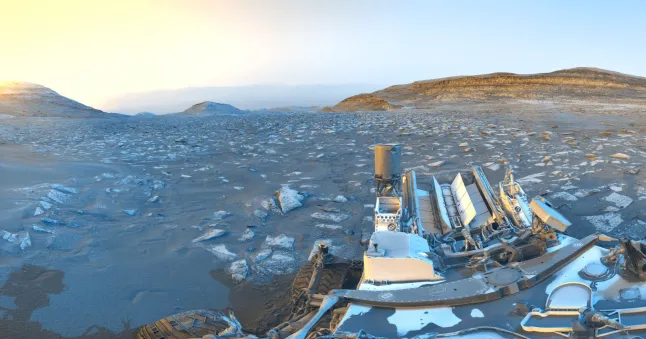
The images were captured as Curiosity was stationed near a sandy geological feature known by the nickname “Chocolatal” while continuing its exploration of the lower foothills of Mount Sharp. Rather than recording the scene at one moment, the panorama brings together photographs taken several days apart, giving viewers a combined impression of the landscape under different lighting conditions.
NASA technicians merged the images after they were transmitted back to Earth. The final panorama uses colour as an artistic interpretation of the changing light, with blue used to represent the morning scene and yellow for the later part of the Martian day.
Curiosity is currently working its way across the lower slopes of Mount Sharp, a mountain that rises roughly three miles above the floor of Gale Crater. The crater itself stretches about 96 miles across. In the new panorama, the rim of Gale Crater can be seen faintly along the horizon as the camera looks back toward the crater floor.
The morning images also coincided with an important point in Curiosity’s mission. The rover had reached its 5,000th Martian day, or sol, on the Red Planet. A sol lasts about 39 minutes longer than a day on Earth, a difference that has shaped the daily operations of the rover throughout its long mission.
The latest panorama follows another large-scale image released by NASA the previous month. That view was created from 323 photographs taken by Curiosity’s Mast Camera over August 1 and 2 and showed a Martian valley known as “Valle Grande.” NASA adjusted the colours in that panorama to give viewers a closer approximation of how the landscape might appear under familiar lighting conditions.
Curiosity’s tracks are also visible in the new panorama, extending across the terrain and marking the route the rover has taken through the Martian landscape. The tracks offer a simple but striking record of how far the vehicle has travelled since arriving on Mars.
About the size of a car, Curiosity was built by NASA’s Jet Propulsion Laboratory and is operated as part of NASA’s Mars exploration programme. The rover landed on Mars in 2012 and has spent more than a decade examining rocks, soil and geological features inside Gale Crater.
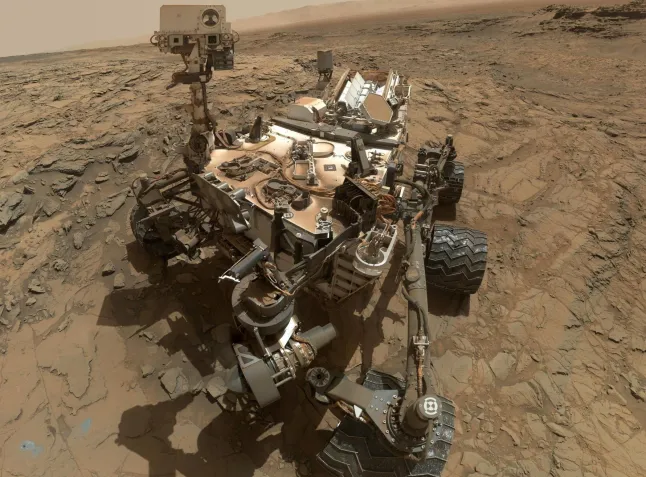
Its mission is focused in part on determining whether Mars once had environmental conditions that could have supported microbial life. Curiosity is not searching directly for living organisms, but its measurements and samples help scientists reconstruct the planet’s ancient environment and assess whether the conditions were once suitable for life.
The rover reached another milestone in August when it had climbed a total of one kilometre in elevation while making its way up Mount Sharp. The ascent has taken Curiosity through increasingly varied terrain, allowing scientists to examine different layers of the mountain and the geological history they preserve.
Since beginning its exploration, Curiosity has also drilled into Martian rocks and collected 42 powdered samples using instruments attached to its robotic arm. These samples have provided scientists with material for analysing the composition and history of the planet’s surface.
The new panorama offers more than another striking picture from Mars. By bringing together morning and later-day views, it gives a visual sense of how familiar concepts such as changing light and time of day appear on another planet. At the same time, the rover’s tracks, the distant crater rim and the slopes of Mount Sharp provide a reminder that Curiosity’s images are also a record of a journey that has continued across Mars for more than 14 years.