Moscow came under Ukraine’s largest reported drone attack on the Russian capital on Sunday, with hundreds of drones directed toward the city and surrounding region as Russians cast ballots on the final day of the country’s parliamentary election.
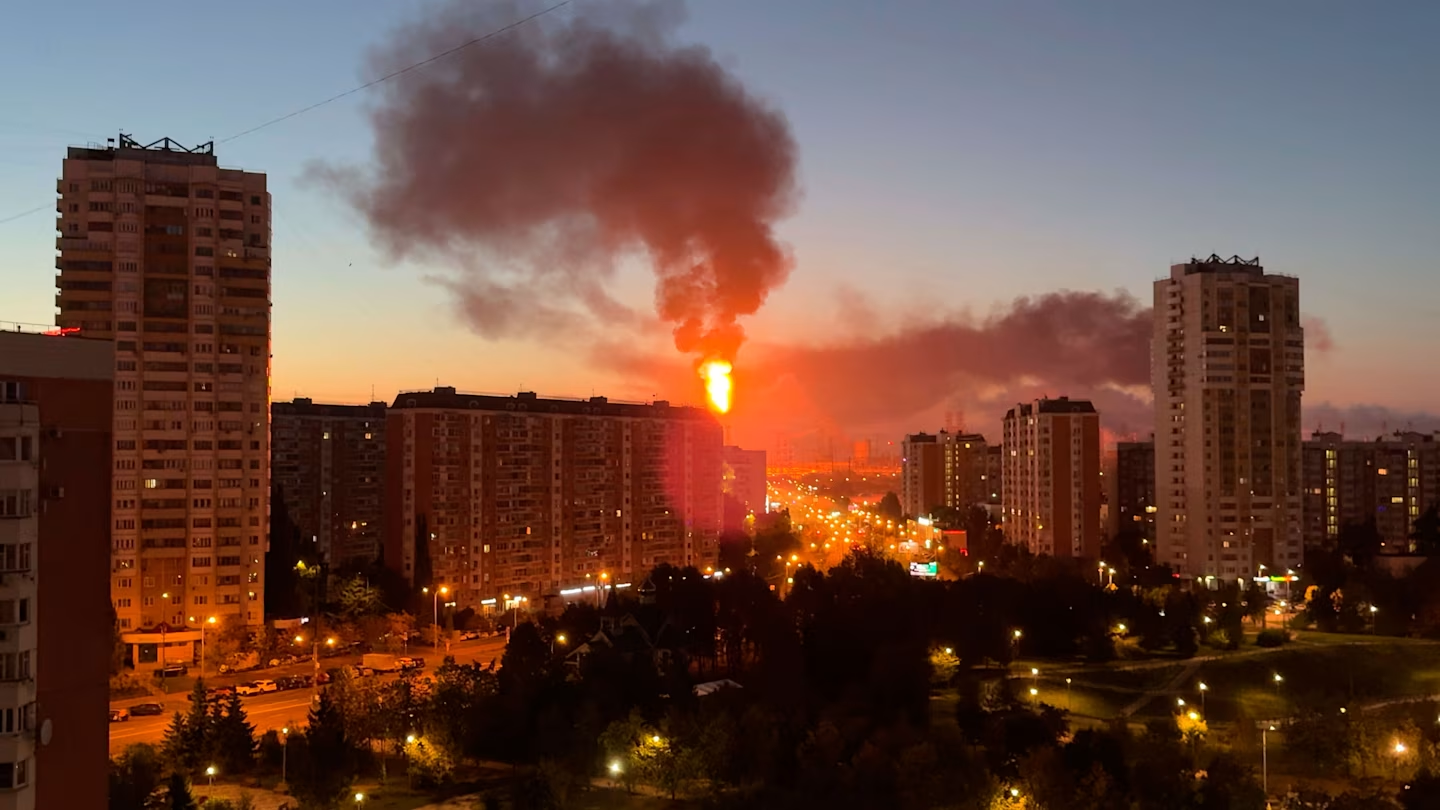
Russian authorities said the wider barrage involved more than 1,600 drones intercepted since Saturday, including about 450 headed toward Moscow. The strikes killed at least three people in the Moscow region, according to regional authorities, damaged a major oil refinery and set fire to a residential building.
The scale of the attack made it one of the most significant Ukrainian strikes on the Russian capital since the full-scale war began. Russia’s Defence Ministry separately said its forces had destroyed 1,110 Ukrainian drones across Russia, occupied Crimea and the Black Sea. The differing figures reflect the fact that Russian officials were reporting interceptions across a wide area, while Moscow authorities were giving separate numbers for drones approaching the capital.
Moscow Mayor Sergei Sobyanin said roughly 450 drones had been intercepted while approaching the capital. Some nevertheless reached the city. According to Sobyanin, drones damaged part of the Moscow Oil Refinery in the Kapotnya district and struck a residential building. Emergency services were deployed to deal with fires and other damage.
Andrei Vorobyov, governor of the Moscow region, said two people were killed in separate incidents and a third later died in hospital. He also reported 20 injuries, including three children. A drone strike that caused a fire in a 21-storey residential building led to the evacuation of about 400 people, according to Russian officials.
The timing immediately drew attention because the attack came as Russia was completing its first parliamentary election since the full-scale invasion of Ukraine in 2022. Voting had taken place over three days, with Sunday serving as the final day. Sobyanin accused Kyiv of deliberately trying to interfere with the election, saying the attack had been planned to disrupt voting. He said it had failed to achieve that objective.
Ukraine did not confirm that disrupting the election was the purpose of the operation. President Volodymyr Zelensky, however, publicly praised the results of the strikes without directly connecting them to the vote. He said Ukrainian long-range attacks had caused significant damage in the Moscow region and targeted oil and logistics infrastructure that he described as generating revenue for Russia’s war effort.
Ukraine’s General Staff identified the Moscow Oil Refinery as the main target. The facility is a major part of Russia’s fuel infrastructure and has previously been hit during Ukraine’s expanding campaign against energy facilities deep inside Russian territory. Reuters reported that the refinery processed more than 11 million metric tons of crude in 2024.
The refinery strike reflects a broader shift in Ukraine’s long-range campaign. Rather than concentrating only on military positions close to the front, Kyiv has increasingly used drones and missiles to reach energy, industrial and logistics infrastructure inside Russia. Ukrainian officials argue that attacks on such facilities can reduce the revenues and resources available to sustain the war. Russia has repeatedly condemned the strikes and accused Ukraine of attacking civilian infrastructure.
The attacks also disrupted aviation around the Russian capital. Restrictions were imposed at four Moscow-area airports, with more than 400 flights reported as delayed, cancelled or diverted during the drone attacks.
The election itself was taking place under unusually tight political conditions. The ruling United Russia party, which supports President Vladimir Putin, was expected to retain its dominance in parliament, while opposition to the Kremlin’s war policy was severely restricted. Russia also conducted voting in Ukrainian territories that Moscow claims to have annexed, including areas it does not fully control. Ukraine and other governments have rejected Russia’s authority to hold elections in those territories.
The violence was not confined to Russia. Russian forces continued launching drones and missiles against Ukraine during the same period. Ukrainian officials reported deaths in the Kyiv region, including children, following Russian strikes. Ukrainian authorities have said Russian attacks have remained frequent in recent weeks, with Zelensky claiming that Russia had launched more than 2,000 attack drones, 1,700 aerial bombs and 19 missiles against Ukraine during the week.
The latest exchange comes as both sides continue to pursue long-range attacks while diplomatic efforts involving the United States remain active. Zelensky said he spoke with US President Donald Trump on Sunday and that the two had agreed to meet in New York during the United Nations General Assembly. Zelensky also described the peace process as Ukraine’s top priority and thanked Trump for the recent involvement of US envoy Steve Witkoff and Jared Kushner in talks.
The Moscow attack therefore landed at the intersection of two very different developments: Russia’s attempt to complete a tightly controlled parliamentary vote and Ukraine’s continuing effort to take the war deeper into Russian territory. The immediate damage was concentrated around the capital’s infrastructure and residential areas, but the significance of the attack extends beyond the individual targets. It demonstrates how far Ukraine’s long-range strike campaign has reached and how closely the military confrontation remains tied to the political and economic pressures surrounding the war.