Mahmoud Abbas warned world leaders against allowing another mass displacement of Palestinians as he addressed the United Nations General Assembly on Thursday, hours before Israeli Prime Minister Benjamin Netanyahu faced a walkout by dozens of delegations when he took the podium to defend Israel’s military campaign in Gaza.
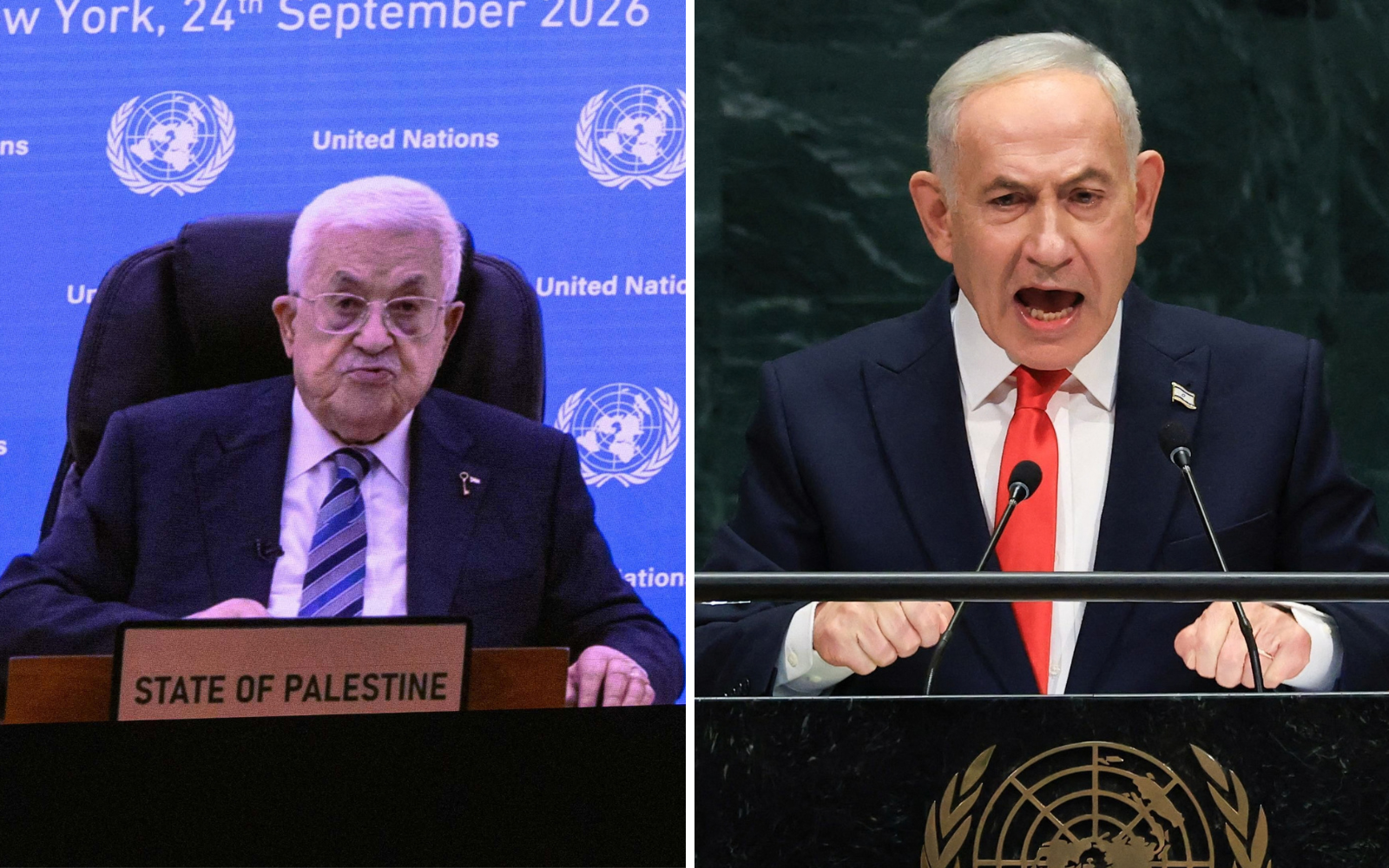
The sharply contrasting speeches reflected the deep divide over the war, with Abbas accusing Israel of genocide and seeking to prevent the displacement of Palestinians, while Netanyahu rejected the allegation and argued that Israel’s military operations were aimed at its enemies rather than the destruction of the Palestinian people.
Abbas addressed the General Assembly by pre-recorded video after Palestinian officials were again prevented from travelling to New York following US visa restrictions. The Palestinian president described the restrictions as unlawful and criticised Washington for what he said was a failure to meet its responsibilities as the host country of the United Nations.
“We warn you today: Do not allow another Nakba to occur,” Abbas said, referring to the mass displacement of Palestinians during the 1948 war surrounding the creation of Israel.
His speech placed the situation in Gaza within a wider Palestinian political crisis, linking the destruction caused by the war to settlement expansion, demolitions and violence in the occupied West Bank and East Jerusalem. Abbas argued that the developments could not be treated as separate events.
“What is taking place in Gaza, the West Bank, and East Jerusalem are not isolated incidents,” he said.
Abbas accused Israel of conducting what he described as a “war of genocide” in Gaza, citing deaths, hunger, destruction and displacement. He also criticised Israeli settlement activity and what he described as attacks by settlers in the West Bank.
The accusation of genocide remains one of the most contested issues surrounding the war. A UN Independent International Commission of Inquiry said in September 2025 that Israel had committed genocide against Palestinians in Gaza, concluding that Israeli authorities and security forces had committed four of the five acts defined as genocidal under the 1948 Genocide Convention. The commission said the evidence indicated an intent to destroy Palestinians in Gaza, in whole or in part, as a group. Israel has rejected the allegation and disputes the commission’s conclusions.
The International Court of Justice is separately considering a genocide case brought by South Africa against Israel. The court has issued provisional measures in the case, but it has not delivered a final judgment on whether genocide occurred.
Netanyahu used his own appearance at the General Assembly to reject the charge outright, saying Israel’s actions were “the opposite of genocide”. He defended the country’s military campaign and portrayed Israel as fighting threats across several fronts in the region.
His arrival at the podium was met with a visible protest inside the chamber. Dozens of delegates left their seats as he approached to deliver his speech, while some of those who remained jeered. The presiding official called for order.
“If there are any other moral cowards in the audience, I urge them to walk out,” Netanyahu said.
He also used the address to criticise foreign leaders and governments that have condemned Israel’s conduct in Gaza. Among those he singled out were Turkish President Recep Tayyip Erdogan and New York Mayor Zohran Mamdani, whom Netanyahu accused of antisemitism. Mamdani rejected Netanyahu’s presentation of events in Gaza and accused the Israeli prime minister of giving what he described as a false account of the war.
The competing speeches came as Gaza’s physical and economic destruction continued to shape the international debate.
A UN Trade and Development report published on September 24 estimated that 92 percent of Gaza’s economic establishments had been damaged or destroyed since October 2023. The report put Gaza’s recovery and reconstruction needs at $71.5 billion and found that GDP per capita stood at about $212 in 2025, equivalent to roughly $0.58 per person per day in economic output. Unemployment had reached 78 percent.
The scale of the economic collapse extends beyond individual businesses. UN Trade and Development said Gaza’s share of Palestinian GDP had fallen from 17.4 percent before October 2023 to less than 4 percent in 2025. Agriculture and industry were each operating at 94 percent below their 2022 production levels, while construction had fallen by 99 percent.
The figures add an economic dimension to a conflict that has already devastated homes, public infrastructure and essential services. The same UN report estimated physical infrastructure damage in Gaza at $35.2 billion and economic and social losses at $22.7 billion, while the total recovery and reconstruction requirement was estimated at $71.5 billion.
For Abbas, however, rebuilding Gaza cannot be separated from the question of Palestinian political authority. He called for Gaza and the West Bank, including East Jerusalem, to be placed under a single Palestinian government, legal system and authority responsible for weapons. He said he wanted a non-militarised Palestinian state living alongside Israel.
The Palestinian president also called for continued international support for UNRWA, the UN agency for Palestinian refugees, and urged implementation of UN resolutions concerning Israeli settlements.
Abbas said Palestinian legislative elections were scheduled for November 28, with presidential elections to follow. Palestinians have not held national elections for two decades, while Abbas has remained president since 2005.
His address also sought to frame Palestinian statehood as part of a broader diplomatic process rather than simply a response to the current war. In his UN remarks, Abbas said the Palestinian Authority was prepared to take responsibility for Gaza and said Hamas would have no role in its governance and security. He also said Palestinians were ready to work with the United States, Saudi Arabia, France, the United Nations and other partners on a peace plan.
Outside the United Nations headquarters, protesters gathered over Netanyahu’s visit and Israel’s military operations in Gaza. More than 100 people were reportedly arrested during demonstrations in New York.
Inside the General Assembly, the contrast between the two leaders was unmistakable. Abbas spoke of displacement, Palestinian statehood and the danger of another Nakba. Netanyahu defended Israel’s military campaign and rejected accusations that its conduct in Gaza amounted to genocide.
Neither speech resolved the fundamental dispute over the war or the political future of the Palestinians. Instead, the two addresses placed opposing accounts of the conflict before the same international audience, with Gaza’s destruction, the future of Palestinian governance and the question of Israeli accountability remaining at the centre of the debate.
Abbas ended his address with a rejection of any attempt to force Palestinians from their homeland.
“We will not leave our homeland. We will not accept displacement,” he said. “We will not allow anyone to decide our future on our behalf.”