Iran has warned the United States that it is prepared to respond with “more severe, crushing, and unpredictable blows” after President Donald Trump threatened at the United Nations to “annihilate” the Islamic Republic if a deal to end the conflict cannot be reached.
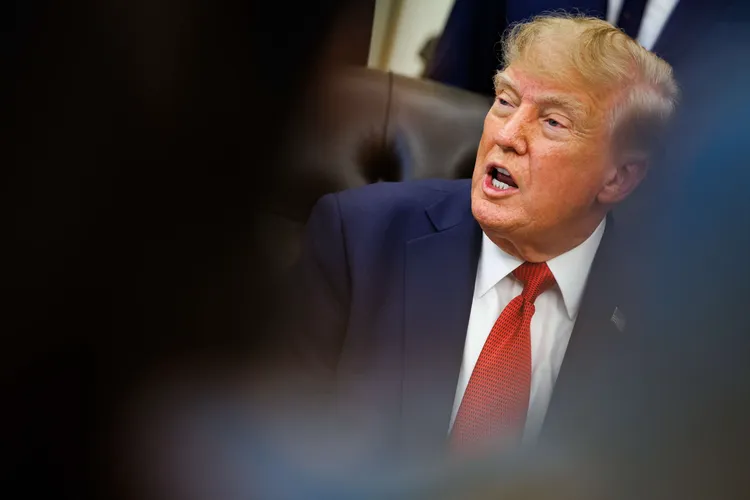
The exchange marked a sharp escalation in public rhetoric between Washington and Tehran, even as both sides continued to signal that diplomatic contacts remain possible. Trump’s remarks came during his address to the 81st United Nations General Assembly in New York on September 22, where he presented what he described as a major decision over the future of US policy toward Iran.
Trump said he faced a choice between reaching an agreement that would allow Iran to rebuild and launching further military action against the Islamic Republic.
“Will a deal be made with Iran that lets them rebuild and create a far greater country than it ever was before?” Trump said. “Or do I annihilate the Islamic Republic and do it quickly?”
The US president also said the possibility of a deal remained open, predicting that an agreement could be reached after the November midterm elections. He said Washington and Tehran had been in contact and suggested another meeting could take place soon. Reuters reported that US and Iranian representatives had held talks in New York as diplomatic efforts continued alongside the military confrontation.
Iran’s response came through a statement from the General Staff of the Armed Forces and the Khatam al-Anbiya Central Headquarters. The Iranian military said it remained fully prepared to respond to any further attack and warned that its retaliation could be more severe and less predictable than previous strikes.
The statement, carried by Iranian state media, rejected Trump’s remarks as hostile rhetoric and described the US president’s threats as evidence of what Iranian officials characterized as Washington’s strategic difficulties. Iran’s military leadership said Trump’s words would not alter its calculations or change what it described as the balance of power in the conflict.
The language from Tehran followed Trump’s broader criticism of the Iranian government during his UN speech. He accused the regime of killing more than 72,000 of its own citizens during 2026 and alleged that 10,000 people had recently been killed while protesting. Those figures were presented by Trump as part of his argument for confronting Iran, rather than as independently established figures in the UN proceedings.
Trump also focused on Iran’s nuclear programme and the threat he says it poses to the United States and other countries. He argued that Washington had exhausted diplomatic opportunities before launching military action and said Iran would not be allowed to obtain a nuclear weapon.
Yet the confrontational language has unfolded alongside signs that neither side has completely closed the door to negotiations. Trump said he had received reports of a “very good meeting” between US and Iranian representatives, while Iranian officials have continued to outline conditions for further diplomacy.
Among Tehran’s stated demands are an end to the US naval blockade, the release of frozen Iranian assets and an end to hostilities across what Iranian officials describe as the wider resistance front. Iran has also linked any reopening of the Strait of Hormuz to changes in the military pressure being applied against it.
The Strait of Hormuz has become a particularly important part of the diplomatic and economic dispute because of its role in global energy trade. Any prolonged disruption there carries consequences beyond the immediate confrontation between Washington and Tehran, with oil prices and international shipping exposed to developments in the region.
Trump has repeatedly linked the end of the conflict with lower oil prices, saying that energy costs would fall once the United States achieved what he described as victory over Iran. At the UN, however, his comments reflected the uncertainty surrounding how the confrontation will ultimately end. He paired a direct threat of further destruction with an assertion that a negotiated settlement could still be reached.
For Tehran, the response has been equally forceful. Iranian military officials have sought to make clear that threats of further US attacks would be met with retaliation, while political and diplomatic channels remain active.
The result is an increasingly unusual combination of military confrontation and diplomacy, with Washington and Tehran publicly warning each other while representatives continue to explore the possibility of an agreement. The immediate question is whether those talks can produce a settlement before the threats exchanged at the UN become the basis for another round of military action.