Finland’s 60 million euro fuel relief package will provide tax reductions, commuting expense relief and business subsidies to help offset rising fuel costs, but the government has rejected a broader proposal from the Finns Party to reduce the country’s renewable fuel distribution obligation.
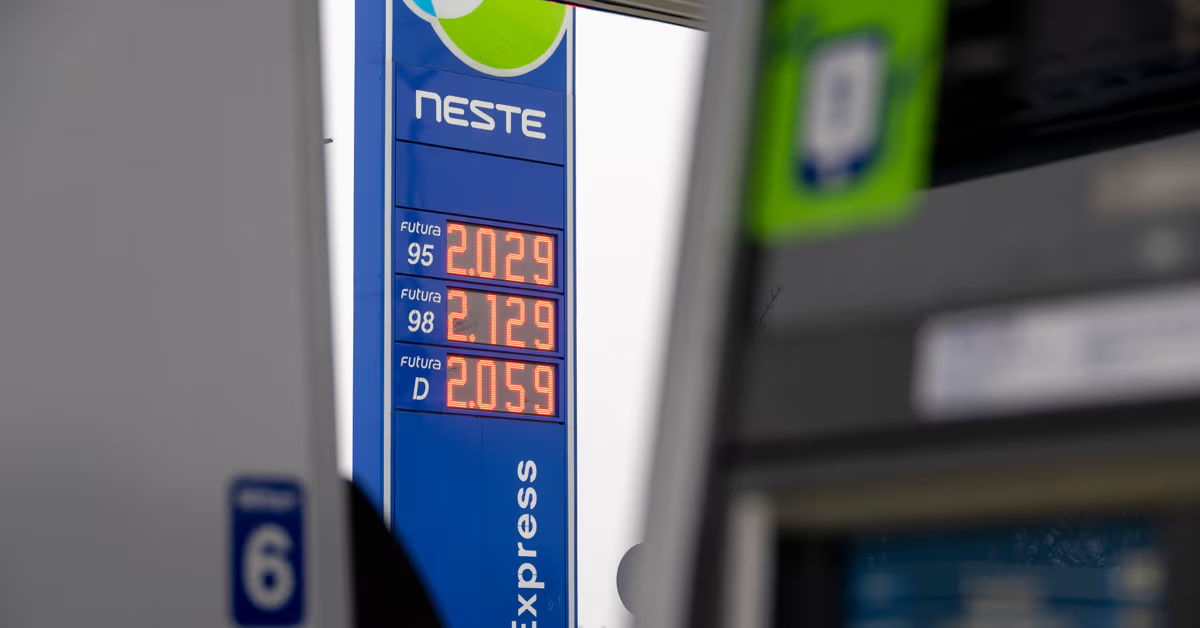
Environment and Climate Minister Sari Multala of the National Coalition Party (NCP) confirmed the agreement to reporters in Parliament on Thursday, saying all governing parties supported the package as a whole. The measures are intended to ease motoring costs for commuters and businesses, although officials acknowledge they will have only a limited effect on what consumers pay at petrol stations.
The package allocates 30 million euros to fuel-related subsidies for businesses in transport, agriculture and forestry. Another 20 million euros will fund a reduction in vehicle tax, double the 10 million euros previously agreed. The remaining 10 million euros will finance an increase in the maximum commuting expense deduction from 7,000 euros to 7,800 euros in 2027.
The government has also agreed to make it easier for fuel distributors to meet their renewable fuel obligations. The limits on cross-fulfilment and over-compliance will both increase from 30 percent to 100 percent, giving companies more flexibility to meet their requirements at lower cost. However, ministers have rejected the Finns Party’s demand for a broader reduction in the distribution obligation itself.
According to a government press release published on Friday, the package will be financed within the government’s existing spending limits rather than through additional expenditure. Of the 60 million euros, 40 million euros will be redirected from funding for biogenic carbon capture capacity that will not be used this year. The remaining 20 million euros will come from cuts to funding for basic transport infrastructure management.
Multala acknowledged that the measures would not significantly reduce household fuel bills. The government could not afford tax cuts worth hundreds of millions of euros, she said, explaining the limits of the relief package.
The decision has drawn criticism from the Finns Party, which argued that the government should have gone further by easing the renewable fuel distribution obligation. The party believes that reducing the requirement could help lower petrol and diesel prices at the pump.
Jani Mäkelä, chair of the Finns Party parliamentary group, said his party had accepted the agreement because a solution was needed, despite its dissatisfaction with the outcome. He criticised the government’s handling of the negotiations and suggested that Prime Minister Petteri Orpo had also been under pressure to secure an agreement.
Mäkelä maintained that the party’s proposed changes to the distribution obligation could have delivered more substantial relief to motorists. He also argued that agreeing to the current package should not prevent the government from reconsidering a reduction in the obligation if fuel prices remain high.
Multala was asked whether the Finns Party might have supported the agreement if the money had been taken from funding allocated to climate action. She said the question should be directed to the party itself.
Speaking in Brussels on the sidelines of an EU meeting, Orpo defended the government’s decision, arguing that reducing the distribution obligation would not have brought down fuel prices quickly. He said the government had faced limited options during negotiations but welcomed the decision to direct support towards commuters and businesses that depend on transport.
Fuel prices have also become a subject of discussion at the EU level. Orpo linked the pressure on prices to the situation in the Strait of Hormuz and Russia’s war against Ukraine, both of which contribute to uncertainty in energy markets.
Despite the government’s stated aim of easing motoring costs, the package will not directly reduce the price displayed at petrol stations. Instead, its benefits will depend on individual circumstances, including vehicle ownership, commuting expenses and eligibility for business support.
Hanna Kalenoja, a leading transport expert at the Central Chamber of Commerce, said the vehicle tax reduction would apply to eligible older cars and vans, rather than lowering the cost of filling up a vehicle. She estimated that qualifying motorists would save approximately 12 euros a year.
The timing of the benefit will also vary. A vehicle tax period that began in July, for example, would not reflect the reduction until the next tax period begins in July the following year, Kalenoja explained.
The higher commuting expense deduction is expected to benefit people with substantial travel costs, particularly those who travel long distances to work. Kalenoja said the change could be useful for people commuting more than 60 kilometres. Eligible taxpayers may be able to adjust their tax cards to account for the deduction, although the rules depend on the circumstances of each journey. Private car expenses may qualify in certain cases where public transport is not reasonably available.
The business subsidies are intended to help companies operating in transport, agriculture and forestry manage fuel-related costs. Finland previously introduced a similar form of support retrospectively through the State Treasury in 2022.
Kalenoja broadly welcomed the government’s decision not to reduce the renewable fuel distribution obligation, describing it as an important outcome of the negotiations. The obligation requires transport fuel suppliers to include a specified share of renewable fuels in the fuel they distribute. Lowering the requirement would reduce the use of lower-emission biofuels.
She cautioned that reducing the obligation would not necessarily produce an immediate fall in petrol and diesel prices and could weaken planned investments in the biogas sector. The Confederation of Finnish Industries, known as EK, also welcomed the government’s decision to retain the requirement in a statement issued on Thursday.
However, Kalenoja said the absence of a diesel excise duty reduction was disappointing. Such a cut could have provided more direct relief to diesel users, while the agreed measures mainly offer targeted tax benefits and support to selected groups.
The agreement therefore provides limited financial relief without adopting the central fuel-price measure sought by the Finns Party. While commuters and eligible businesses stand to benefit, motorists should not expect the package itself to deliver an immediate reduction in petrol or diesel prices.