Public transport prices have risen sharply in 14 European capitals since 2023, with some cities recording increases of more than 50 percent, according to a new Greenpeace study that compares the affordability and availability of long-term public transport tickets across Europe.
The research examined the 27 EU member states alongside the UK, Switzerland and Norway, looking at the cost of monthly and annual passes in their capitals. It also considered how widely those passes can be used, including whether they cover regional transport and different forms of public transit, as well as discounts for vulnerable groups and the level of VAT applied to tickets.
For visitors, transport costs can make a noticeable difference to the price of a city break. A cheap flight or hotel can quickly become less attractive when getting around the destination adds a substantial daily expense. The figures in the Greenpeace study also show how differently European capitals are approaching the cost of public transport, with some raising fares while others have moved in the opposite direction.
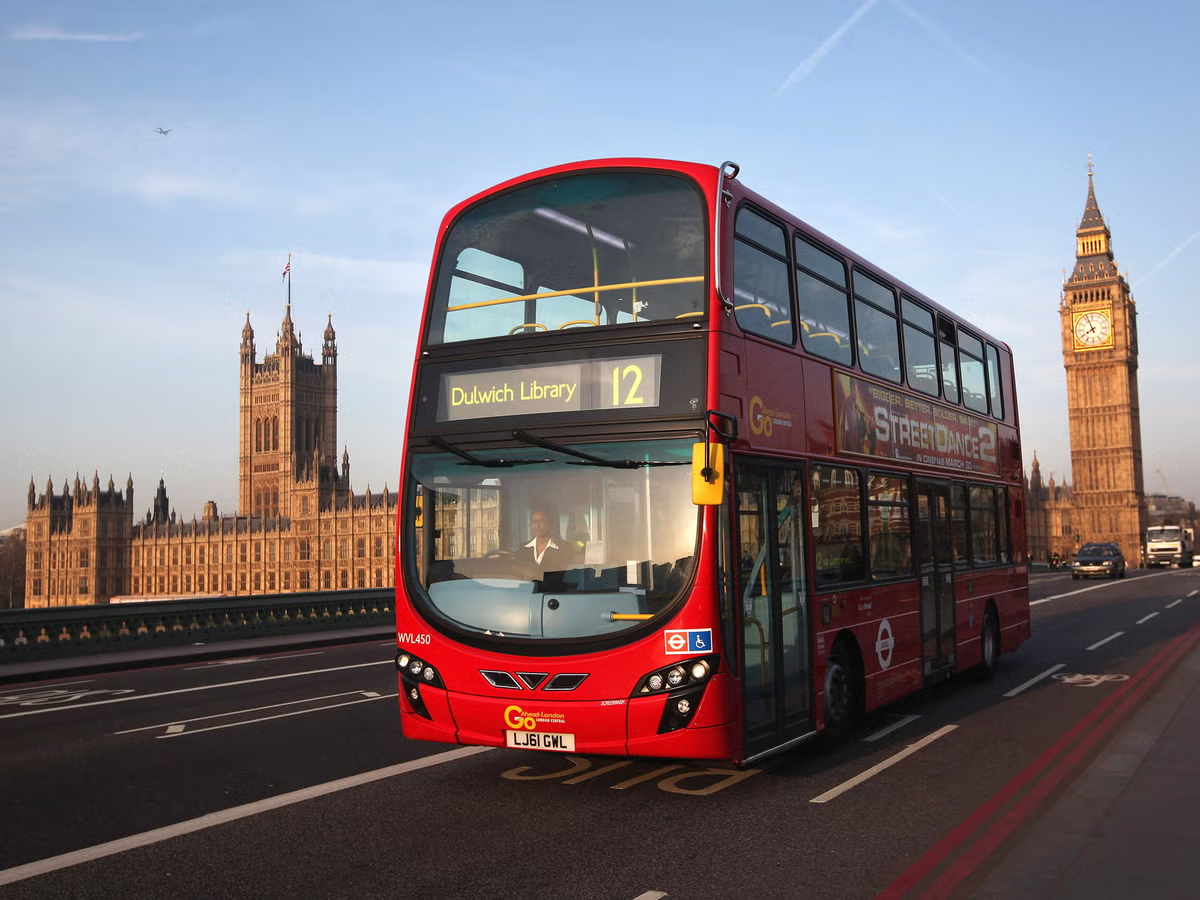
London currently has the highest monthly long-term public transport cost among the capitals examined, at EUR 162. Amsterdam follows at EUR 107, while Paris comes in at EUR 77.
The increases since 2023 are particularly striking in several cities. Nicosia recorded the largest rise, with long-term ticket prices increasing by 67 percent. Amsterdam followed with a 55 percent increase, while Madrid recorded a 50 percent rise. Bratislava’s prices increased by 32 percent.
Berlin and Vienna also saw substantial increases, of 29 percent and 26 percent respectively. Copenhagen, Bucharest, Vilnius, Brussels and London recorded increases of at least 10 percent during the same period.
The study points to taxation as one factor contributing to the cost of public transport. Across the EU, tickets are subject to an average VAT rate of 11 percent, while seven countries have increased VAT on public transport since 2023.
But the picture is not uniformly one of rising prices. Four European capitals have actually become cheaper for long-term public transport users since 2023.
Dublin recorded the largest reduction, with prices falling by 42.5 percent. Oslo, despite its reputation as one of Europe’s most expensive cities, saw long-term transport prices fall by 11.5 percent. Bern recorded a 6.6 percent reduction, while Budapest’s prices declined by 5.8 percent.
In 12 other capitals, long-term public transport prices have remained unchanged since 2023.
The differences become even clearer when national transport systems are taken into account. Spain and Slovenia have introduced forms of nationwide public transport tickets since 2023, but only eight of the 30 countries included in the research currently offer either free public transport or affordable universal long-term tickets.
Luxembourg, Malta and Slovenia perform particularly strongly on the availability and affordability of national transport passes. Finland, Greece and Norway are at the other end of the comparison, with the study identifying weaker affordability and availability of nationwide tickets alongside above-average VAT rates on domestic public transport.
At city level, Tallinn, Luxembourg City and Valletta share the top position in Greenpeace’s assessment of long-term public transport. The ranking takes into account not only price, but also how broadly tickets can be used and whether they are accessible to different groups of passengers.
The findings form part of Greenpeace’s wider campaign for affordable “climate tickets”, which the environmental organisation argues could make public transport more attractive while helping reduce emissions from road and air travel and Europe’s reliance on fossil fuels.
For travellers, however, the numbers offer a more immediate lesson. The price of a transport pass can vary dramatically between European capitals, and the cheapest option is not necessarily determined by the price of a single ticket. How long a pass lasts, how far it allows passengers to travel and which transport networks it covers can make just as much difference.
That makes public transport an increasingly relevant part of the cost of visiting a European city. For tourists planning longer stays, the difference between capitals is no longer simply a matter of convenience. It can have a direct effect on the overall cost of a trip.