
Bob Dylan’s meeting with Pope Leo XIV at the Vatican has brought together two influential figures from very different worlds, with music, faith and peace forming the connection between them. The American singer-songwriter was received by the Pope at the Apostolic Palace on Wednesday afternoon, ahead of his scheduled concert in Rome on Thursday evening.
The 85-year-old Nobel Prize-winning musician was accompanied by Jesuit priest Father Antonio Spadaro and Andrea Monda, editor of the Vatican newspaper L’Osservatore Romano. Spadaro later shared two photographs of the meeting on social media, describing the experience as an encounter with a sense of history.
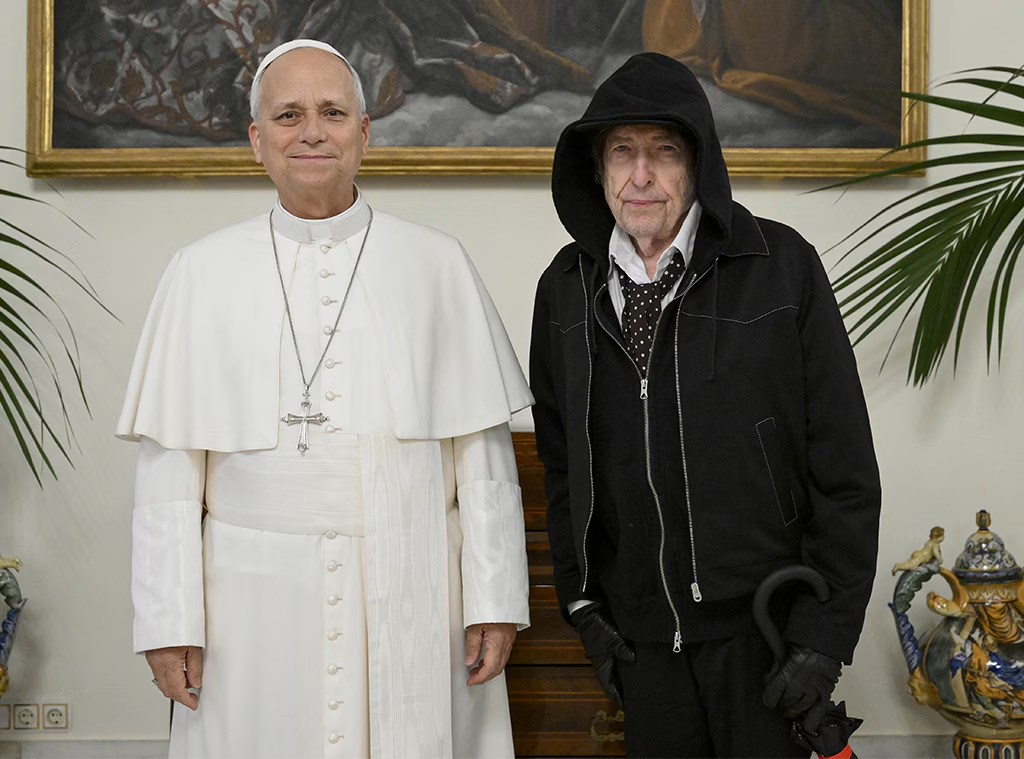
Dylan, who was in Rome as part of his tour, appeared in his familiar understated style, wearing a black sweatshirt with the hood pulled over his head. The audience was brief, involving greetings and a short exchange between the two men. Pope Leo XIV presented Dylan with a rosary, while the musician gave the Pontiff a copy of his autobiography, Chronicles: Volume One.
The meeting was particularly notable given Dylan’s long association with songs addressing war, human rights, spirituality and the search for peace. His music has reached beyond the traditional boundaries of popular culture, attracting attention from religious leaders and political figures over several decades.
There was also a direct connection between the musician and Pope Leo before Wednesday’s audience. In July, the Pope quoted Dylan’s protest song “Go Away You Bomb” in the preface to Disarmata e disarmante. La pace è un dono, a book published by the Vatican publishing house, Libreria Editrice Vaticana, and edited by journalist Alessandro Banfi.
Written in 1963 during the Cold War, the song challenges the destructive power of nuclear weapons and the human responsibility behind their creation. Its lyrics include the words: “I hate you because man made you and man owns you and man handles you”.
Despite its subject, “Go Away You Bomb” has remained relatively unknown compared with Dylan’s better-known protest songs. It was never officially recorded or released on his albums, and the original manuscript was discovered in 2013.
Pope Leo XIV drew on the song’s message in his warning about the dangers of rearmament and the possibility of renewed nuclear escalation. The reference highlighted how Dylan’s writing from the 1960s continues to feature in contemporary discussions about war and international security.
Dylan’s protest music became particularly influential during the 1960s, when songs such as “Masters of War” and “Blowin’ in the Wind” became closely associated with anti-war demonstrations and the civil rights movement. However, his views on conflict have not always fitted neatly into the image of an absolute pacifist. In 2001, he said he did not consider himself a pacifist and defended the right to self-defence.
The Vatican meeting also recalled Dylan’s previous encounter with a Pope. In 1997, he performed at the National Eucharistic Congress in Bologna, Italy, where he appeared before Pope John Paul II and an audience of approximately 300,000 young people.
Dylan performed three songs, including “Knockin’ on Heaven’s Door”, before removing his cowboy hat, walking up the steps to the papal stage and shaking John Paul II’s hand. The encounter became a memorable moment in the relationship between popular music and the Catholic Church.
John Paul II also made a reference to Dylan during his address to the young audience. Quoting the opening question from “Blowin’ in the Wind”, the Pope asked how many roads a man must travel before he can be considered a man. He then offered a Christian interpretation, saying that there was only one road for humanity: Jesus Christ.
Dylan’s relationship with religion has also been an important part of his personal and musical history. Raised in a Jewish family, he underwent a significant religious transformation towards the end of the 1970s, following what he described as a spiritual experience that brought him closer to Christianity.
This period had a direct influence on his music. In 1979, he released Slow Train Coming, an album that openly explored Christian beliefs. It was followed by Saved in 1980 and Shot of Love in 1981. All three records featured strong gospel influences and religious themes, marking a distinct period in his musical career.
Although Dylan later returned to a broader musical repertoire, religious references continued to appear in his work. In a more recent interview, he also spoke about his faith, saying that he reads the Scriptures, meditates and prays.

Music has similarly featured in Pope Leo XIV’s public expression of faith. During his first year as pontiff, he has repeatedly spoken about the importance of music in religious life and its ability to communicate emotions and spiritual experiences. His public appearances have included singing the Regina Caeli and the Pater Noster in Latin, as well as showing an interest in the musical performances of communities he has encountered during his travels.
At the Jubilee for Choirs and Choral Groups in November 2025, Leo described music as a gift of great civilisations and a means of expressing feelings that are difficult to put into words. He also referred to the writings of Saint Augustine, recalling the Latin phrase “Cantare amantis est”, meaning that singing is characteristic of someone who loves.
For Dylan, whose songs have explored faith, doubt, conflict and human responsibility throughout his career, the Vatican audience offered another meeting point between music and religious thought. His exchange of gifts with Pope Leo XIV also recalled his earlier appearance before John Paul II, almost three decades ago, when his music became part of a conversation between a rock musician and the Catholic Church.


