
A winter holiday in Finnish Lapland does not have to involve hiring a car, but choosing the right place to stay can make the difference between an enjoyable Arctic break and a trip spent worrying about transport. For travellers arriving from abroad, the most practical accommodation is often found in destinations with direct airport connections, organised transfers, accessible ski resorts and winter activities that can be reached without driving.
Lapland covers a vast area of northern Finland, and its popular winter destinations are spread across considerable distances. Rovaniemi, Levi, Yllas, Saariselka and Pyha each offer a different kind of holiday, from city-based Christmas experiences to remote wilderness accommodation and established ski resorts. However, they are not equally convenient for visitors without a vehicle.
The first decision should therefore be where to base the holiday, rather than which hotel or cabin looks most attractive. A secluded lakeside property might offer the Arctic scenery many visitors imagine, but if it requires a private taxi every time guests want to eat, shop or join an excursion, the total cost and inconvenience can quickly outweigh the appeal.
For visitors who want the simplest arrival, Rovaniemi is one of the strongest options. The city has its own airport and railway station, a walkable centre, restaurants, shops and a range of accommodation within relatively short distances of one another. Travellers arriving by train can reach the city centre without arranging a long-distance transfer, while those flying can use the Airport Express or Santa’s Express services during the winter season.
Staying in central Rovaniemi is particularly practical for visitors who want to combine sightseeing, restaurants and organised winter excursions. Many tour operators offer transfers or hotel pick-ups for activities such as reindeer visits, husky safaris, snowmobiling and Northern Lights excursions. This means visitors can arrange individual experiences without needing to find their own way to remote activity locations. Pick-up arrangements should still be confirmed with each operator before booking.
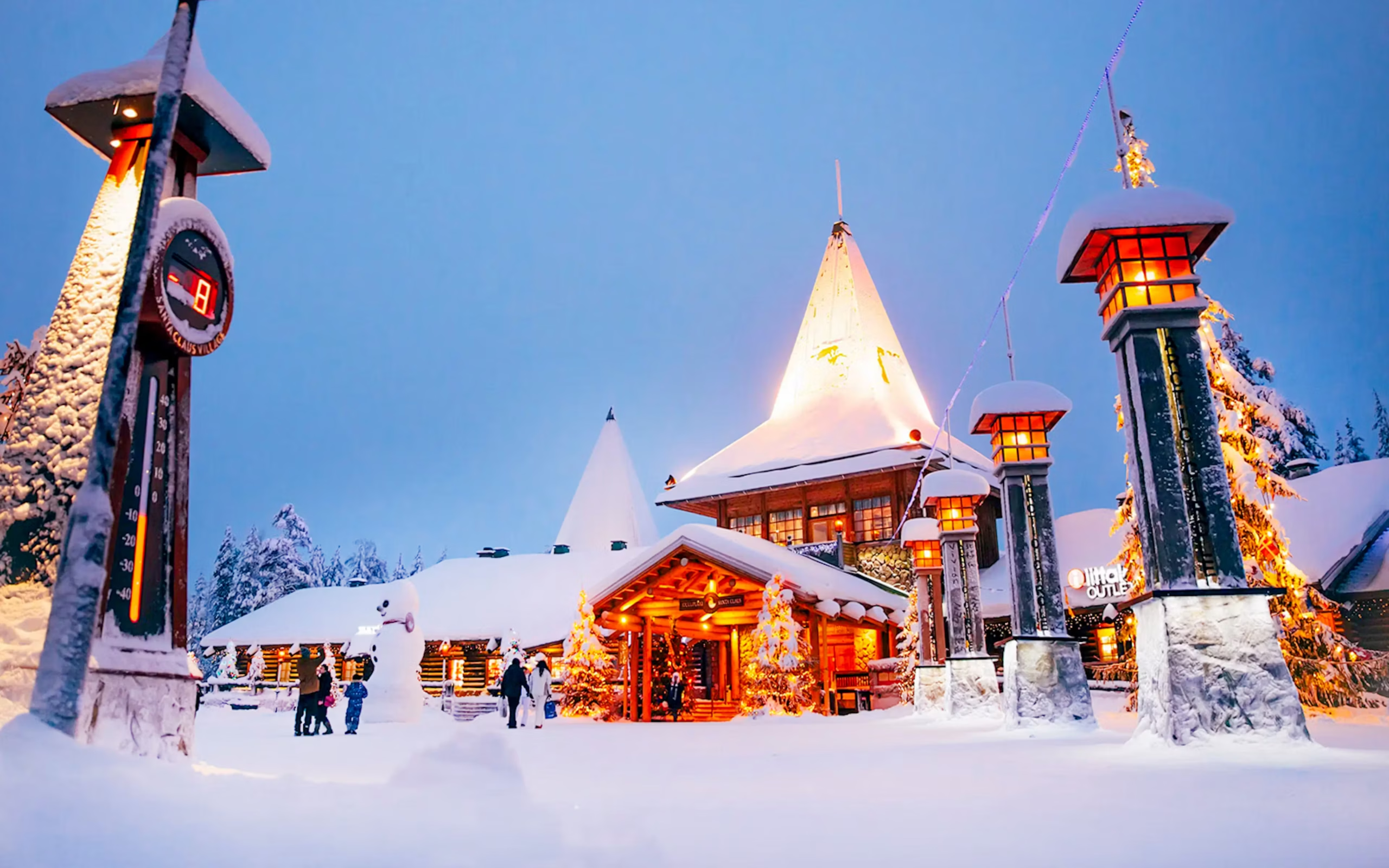
The city centre also provides a useful base for visiting Santa Claus Village, one of the region’s best-known attractions. Local bus number 8 connects the railway station, city centre and Santa Claus Village, while Santa’s Express offers another connection. Travellers who want to spend most of their holiday visiting attractions around Rovaniemi may find this arrangement more convenient than staying in a remote forest cabin outside the city.
There is, however, a difference between staying in Rovaniemi and staying at Santa Claus Village itself. The village is several kilometres outside the city centre, so visitors booking accommodation in that area should check the bus timetable, the availability of evening transport and whether their chosen hotel or resort provides transfers. A property can appear close to an attraction on a map without necessarily being convenient for someone travelling on foot in deep snow.
For a more traditional ski-resort holiday, Levi is among the most practical choices. Located near Kittila Airport, Levi has a concentrated resort centre with restaurants, supermarkets, hotels, holiday apartments, ski facilities and winter activity providers. Visitors staying close to the village centre can walk to many everyday services rather than depending on taxis.

Levi is particularly suitable for travellers who want to combine skiing with other winter experiences. Its accommodation ranges from hotels and apartments to larger holiday houses, while the resort’s main services are concentrated around the village and the slopes. The location of the property remains important, however. A cabin on the outskirts may provide more privacy and a quieter setting, but it can create additional transport requirements.
The resort’s Ski Bus system helps address this problem. During the winter season, two routes connect the main slopes with major accommodation areas, with services operating approximately every half hour between 9am and 7pm. For the 2026-2027 season, Ski Bus travel is included in Levi ski passes and Leevilandia Family Park area tickets. Visitors without those tickets can purchase a separate day or season pass.
Getting to Levi without driving is also possible. Kittila Airport has bus connections to the resort, with airport services arranged around flight schedules. Travellers arriving by overnight train can also use the connecting bus from Kolari railway station. VR lists the journey from Kolari to Levi at approximately 80 kilometres, with a connecting bus journey of around one hour and 15 minutes.
For visitors who want a quieter setting and direct access to Arctic landscapes, Saariselka is another destination worth considering. Located in northern Lapland, Saariselka is known for its fell scenery, winter trails, skiing and access to Urho Kekkonen National Park. It has hotels, apartments, cabins, restaurants and activity providers, with many essential services concentrated around the village.

The main advantage for car-free travellers is that the village is relatively compact. Visitors staying near the centre can reach restaurants, shops and several activity meeting points without having to organise private transport for every outing. Some tour operators also collect guests from their accommodation, making it easier to book experiences such as husky safaris, reindeer activities and guided excursions into the surrounding wilderness.
Saariselka is served by Ivalo Airport, approximately 25 kilometres away. Airport transfer buses operate in connection with flights, providing an alternative to hiring a car. Eskelisen Lapin Linjat operates connections between Ivalo Airport, Saariselka and Kiilopaa. These services are linked to flight arrivals and departures, so travellers should check the timetable for their particular travel dates rather than assume that a bus will be available at any time.
What You Missed: New Places to Stay in Finnish Lapland for Winter 2026-2027: Glass Igloos, Sky Villas and Luxury Wilderness Retreats
The Ski Bus provides another way to explore the area during winter, connecting Saariselka with nearby locations including Kiilopaa. This is useful for visitors who want to spend time outside the village without booking a private transfer for every journey. However, travellers considering accommodation further along the road, particularly in isolated wilderness properties, should establish exactly where the nearest bus stop is and whether the accommodation provides its own transport.
Pyha offers a different balance between accessibility and a quieter natural setting. Located near Pyha-Luosto National Park, the resort attracts visitors interested in skiing, snowshoeing, winter scenery and outdoor activities. Compared with Rovaniemi, it has a more resort-focused atmosphere, with accommodation and services arranged around the fell.

One of Pyha’s strongest advantages is its direct bus connection from Rovaniemi. Winter services operate between Rovaniemi Airport, Rovaniemi railway station and Pyha, with four daily connections listed for the winter season. The journey takes approximately one hour and 45 minutes, depending on the service. This gives travellers the option of flying into Rovaniemi or arriving by train before continuing to the resort by bus.
Accommodation close to the main resort facilities is the sensible choice for visitors without a car. Staying within walking distance of the ski area, restaurants and activity providers reduces the need for additional transfers, particularly during the evening. Some properties are more secluded, so travellers should check whether activities include collection from their accommodation.
Pyha also has a useful connection with neighbouring Luosto. A local bus links the two resort areas, allowing visitors to explore more of the region without arranging a private journey. However, visitors should plan around the published timetable, as the service does not operate like an urban bus network with constant departures throughout the day.
Another option is Yllas, particularly for travellers who prefer a village atmosphere and access to extensive outdoor activities. Yllas is different from some of Lapland’s more compact resorts because its services are divided between two villages, Akaslompolo and Yllasjarvi, which sit on opposite sides of Yllas Fell.

Both villages have accommodation, restaurants and local services, but the choice of which side to stay on can influence the experience. Akaslompolo has a village-centred atmosphere, with shops, restaurants and access to nearby trails. Yllasjarvi is closer to the southern ski resort facilities and has accommodation around the slopes. Neither is automatically the better option for everyone, but visitors should consider where their preferred activities and accommodation are located before making a reservation.
The winter Ski Bus connects the two villages and the ski resort, making it possible to move around Yllas without a rental car. The service runs from November until early May, according to the destination’s transport information, and also provides access to selected cross-country skiing trails and activity starting points. Some departures cover only part of the route, so checking individual stops and operating times is important.
Travellers arriving by train can reach Yllas through Kolari railway station, where a connecting shuttle bus operates to the resort. Kittila Airport is another arrival option, with airport bus services connecting the area. The main consideration is that Yllas is spread across two villages, so accommodation close to a ski bus stop or within walking distance of the services a visitor intends to use is especially valuable.
For those comparing these destinations, the difference is not simply the scenery or the type of accommodation available. It is how much of the holiday can be organised without arranging additional transport. Rovaniemi is a strong choice for travellers who want a town environment, a railway connection and easy access to major visitor attractions. Levi offers an established ski-resort setting with a developed internal bus network. Saariselka suits visitors seeking northern wilderness experiences while retaining access to village services. Pyha provides a practical connection from Rovaniemi alongside a quieter resort atmosphere, while Yllas offers two distinct villages connected by a seasonal ski bus.
The accommodation itself deserves as much attention as the destination. A hotel room in the centre of a resort may be more convenient than a larger cabin several kilometres away, even if the latter appears more attractive in photographs. Visitors should look beyond descriptions such as “close to nature” or “peaceful location” and establish the actual distance to restaurants, supermarkets, bus stops and activity departure points.
It is also important to distinguish between an airport transfer and transport throughout the holiday. A hotel may arrange collection from the airport but offer no regular shuttle to the village centre. Similarly, a tour company may collect guests for a husky safari but not provide transport for independent sightseeing. These arrangements should be checked individually, particularly for visitors travelling with children or arriving during the busiest weeks of the winter season.
Winter conditions make this planning more important. Walking distances that appear manageable during summer can become less comfortable when temperatures fall, daylight is limited and snow covers pavements and pathways. Visitors should also remember that public transport in Lapland is designed around particular routes and seasonal demand. Services may be less frequent than those in larger Finnish cities, and a missed connection can leave travellers with limited alternatives.
Booking activities with accommodation pick-up, choosing a property near the resort centre and arranging airport transfers before departure are three practical ways to avoid unnecessary transport problems. Travellers should also check whether their accommodation has a restaurant or kitchen, particularly if it is outside a village centre. Having somewhere to eat without travelling every evening can make a noticeable difference to both convenience and holiday expenses.
There is no single best destination for every car-free winter holiday in Finnish Lapland. The right choice depends on whether visitors prioritise Christmas attractions, downhill skiing, Northern Lights excursions or time in the wilderness. What matters most is choosing accommodation that fits the transport network rather than expecting transport arrangements to compensate for an inconvenient location. With the right base, visitors can experience much of what makes Finnish Lapland attractive in winter without taking the wheel.


