Sweden’s Social Democrat leader Magdalena Andersson has abandoned her attempt to form a government after failing to find an agreement among the centre-left parties that won a narrow majority in the country’s parliamentary election.
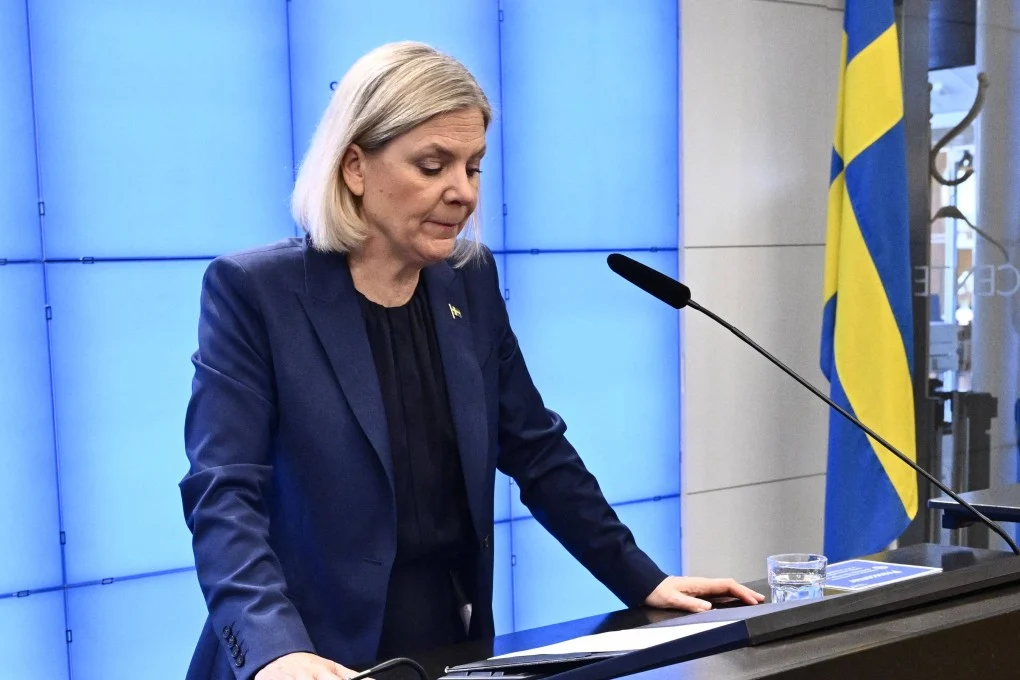
“I can conclude that there is currently no possibility for me to form a government,” Andersson told reporters on Monday. She said she would inform parliament’s speaker that she was returning the mandate she had been given to try to form a government.
The decision leaves Sweden’s government formation process open, with outgoing Prime Minister Ulf Kristersson now expected to be given an opportunity to seek parliamentary backing.
Andersson was given the task on 18 September by Andreas Norlen, the speaker of the Riksdag, after the election produced a closely divided parliament. Norlen was re-elected as speaker on Monday and said he would hold talks with the leaders of Sweden’s political parties on Wednesday before deciding how to proceed.
“I envision that after those deliberations, I will be able to return with new information on how the process will move forward,” Norlen said.
The centre-left alliance that backed Andersson won 176 of the Riksdag’s 349 seats, giving it a three-seat majority over Kristersson’s right-wing bloc, which secured 173 seats. The Social Democrats emerged as the largest individual party, with 99 seats.
Despite the numerical advantage, the centre-left parties have been unable to reach an agreement that would allow Andersson to assemble a government capable of winning parliamentary approval. Sweden’s parliamentary system requires a proposed prime minister to secure enough support, or at least avoid being rejected by an absolute majority of lawmakers.
Kristersson resigned following the election defeat but remains prime minister in a caretaker capacity. His next attempt at government formation could bring renewed attention to the Centre Party, which has previously been part of the right-wing bloc but has since positioned itself more firmly in the political centre.
Centre Party leader Elisabeth Thand Ringqvist has said her party will maintain its centrist policies and will not support a government that gives political influence to parties at the edges of the political spectrum. That position could make negotiations difficult for Kristersson as he seeks to build enough parliamentary support.
After the election, Kristersson called for what he described as “constructive openness” between the country’s political parties, arguing that negotiations would be necessary to overcome the deadlock.
“Discussions will need to be held with all parties to find ways around these impasses and create the conditions for a stable and capable government,” he said.
The coming talks will therefore determine whether Kristersson can find a workable parliamentary arrangement or whether Sweden will face another round of political negotiations. The process has a constitutional limit: if the speaker’s proposed candidate for prime minister is rejected by the Riksdag four times, a snap election must be held.
For now, Norlen will continue consultations with the parties before deciding who should receive the next mandate to attempt to form a government.