Oulu is worth a stop because it offers something that is increasingly difficult to find in northern Finland: a city where everyday life, coastal nature, cycling, technology and culture sit close enough together to experience without turning the visit into a logistical exercise.
For travellers moving through Finland, Oulu can easily become the city between destinations. It sits far north of Helsinki, on the edge of the Bothnian Bay, and is often treated as a gateway to further adventures in northern Finland. But spending a little time here reveals a city with its own character, and 2026 gives that character an especially strong cultural backdrop.
Oulu is this year’s European Capital of Culture, a title that has brought an unusually broad cultural programme to the city and the surrounding region. The official Oulu2026 programme involves around 750 productions across Oulu and its partner municipalities, ranging from exhibitions and performing arts to public art, food, music and projects that connect culture with technology and the environment.
That matters because Oulu has never been a city that fits neatly into the usual Finnish travel picture. It is not Helsinki, Turku or Tampere scaled down. Its identity has been shaped by the sea, the Oulujoki River, a long history of tar trading, a strong university presence and a technology sector that has given the city a reputation well beyond northern Finland.
Yet one of the most interesting things about Oulu is how little effort is required to move between those different sides of the city.
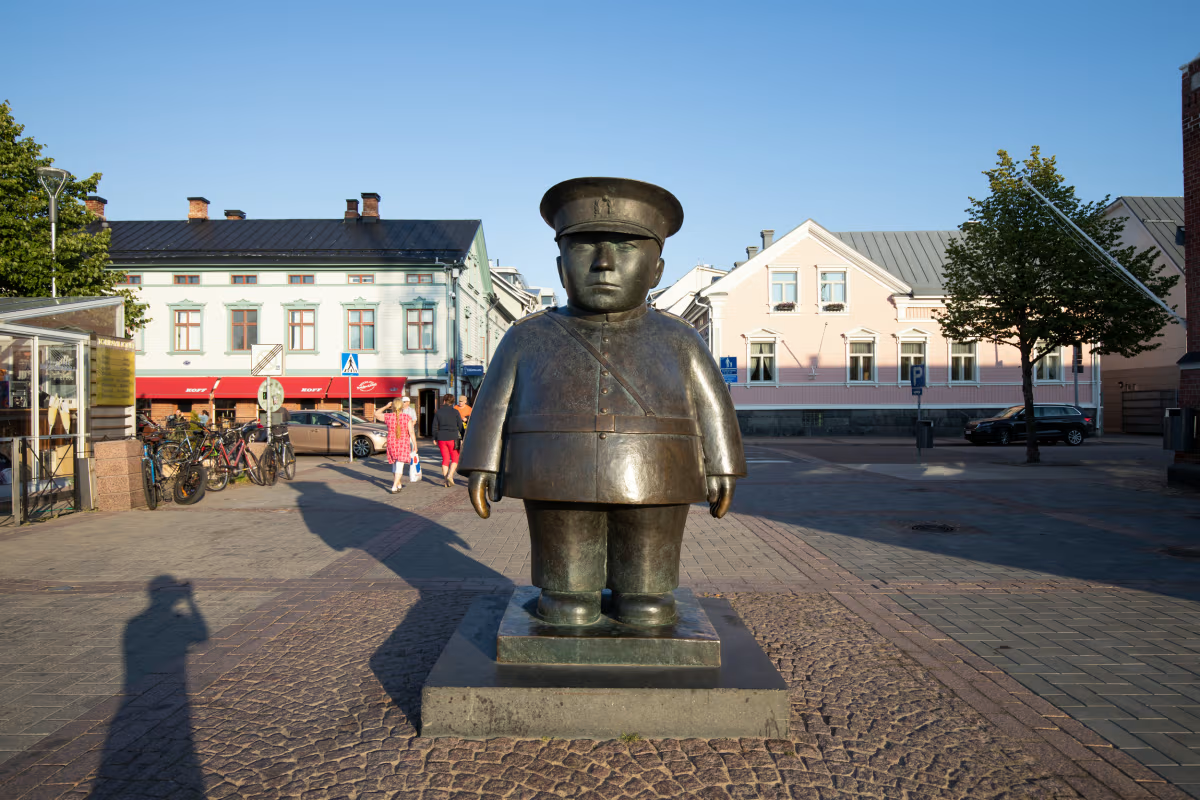
You can begin at the Market Square, where the familiar Toripolliisi statue stands near the waterfront, walk through the historic Market Hall and then cross towards Pikisaari, an old wooden district on an island in the river. From there, the landscape changes again as paths lead towards parks, waterways and the coast. The city’s compact centre makes this kind of movement unusually easy.
For a visitor, that proximity is part of the attraction. Oulu does not demand that you spend the day moving from one isolated attraction to another. Much of the experience comes from seeing how the city fits together.
Cycling is perhaps the clearest example.
Oulu has more than 900 kilometres of pedestrian and cycle paths, many of them maintained throughout the year. Cycling is not simply presented as a tourist activity. It is part of how people move around the city, including during winter. Some of the busiest routes are broad cycling highways designed to make everyday journeys faster and more direct.
For travellers, this changes the scale of the city. A bicycle can connect the centre with Pikisaari, the riverbanks and Nallikari without making the journey feel like a separate excursion. A route from the city centre towards Nallikari takes you from an urban environment towards the coast, with nature appearing gradually rather than suddenly.
Nallikari is Oulu’s best-known beach and one of the clearest reminders that this is a coastal city. Its long sandy shoreline faces the Bothnian Bay, while walking and cycling routes connect it with the centre through Pikisaari and Hietasaari. The beach is nearly a kilometre long and has become one of the city’s major summer destinations.
That combination is important to understanding Oulu. Nature here does not always require a long drive into the wilderness. The sea can be part of a city day. A park can be part of a bicycle route. A historic wooden neighbourhood can be reached on the same journey as the beach.
Pikisaari deserves particular attention because it provides a different view of Oulu from the modern technology-driven city often associated with the region. The island contains historic wooden buildings, cultural spaces, restaurants and nature along its shores. It also retains links to Oulu’s older history, making it a place where the city’s past and present sit unusually close together.
Then there is the food.
Oulu’s culinary identity is closely tied to northern ingredients and the surrounding region, something that has received greater attention during the European Capital of Culture year through Arctic Food Lab. The programme brings together restaurants and other food businesses around northern flavours, local ingredients and contemporary interpretations of regional food culture.
This is one of the reasons a stop in Oulu works particularly well for travellers who prefer to understand a place rather than simply photograph it. Food, architecture, public spaces and everyday habits often reveal more about a city than a list of conventional attractions.
The same is true of Oulu’s relationship with technology. The city has developed a reputation as one of northern Finland’s major technology centres, but the interesting part for visitors is not necessarily the technology itself. It is the way Oulu repeatedly brings technology, art, education and public life into the same conversation. The Oulu2026 programme, for example, includes projects built around media art, art and technology, science and culture.
That makes the city particularly interesting in 2026. The European Capital of Culture programme is not confined to traditional galleries and concert halls. It stretches into public spaces, neighbourhoods, universities, nature areas and the wider region. Some projects explore climate and sustainability, while others use light, digital art and technology to change how people experience familiar places.
For a visitor arriving this autumn, the programme continues into the darker months with exhibitions, festivals, light art and cultural events. Oulu2026 describes autumn as a period of contrast between light and darkness, nature and technology, with projects including Lumo Art & Tech and other installations and events across the city and region.
But Oulu should not be reduced to its capital-of-culture year. That would make the city less interesting, not more.
The stronger reason to stop is that Oulu already has a rhythm of its own. It is large enough to have the cultural and urban life of a major Finnish city, but compact enough that the relationship between the centre, river, islands and coast remains visible. It is northern without being isolated, modern without abandoning its older character, and urban without putting nature behind a long list of transport connections.
That makes it particularly useful for travellers who are trying to understand a different side of Finland.
A short visit can give you the Market Square and Market Hall, a walk through Pikisaari, a bicycle ride beside the river and a trip to Nallikari. A longer stay opens the door to the wider Oulu region, where the landscape expands into forests, coastline, islands and other northern destinations. The city’s tourism authorities also promote cycling and nature routes that extend well beyond the immediate centre.
There is also something revealing about visiting Oulu in winter. The city does not simply wait for better weather. Cycling continues. Winter swimming remains part of local life. The coastline takes on a completely different character, and the relationship between darkness, snow, light and public space becomes part of the experience. Oulu’s culture programme has deliberately embraced those contrasts rather than treating winter as a problem to be overcome.
That may ultimately be what makes Oulu worth a stop. It is not trying to compete with Finland’s better-known cities by offering a longer list of attractions. Its appeal comes from how ordinary parts of city life become part of the travel experience.
You notice it while cycling instead of taking a taxi. You notice it when the sea is within reach of the city centre. You notice it in the wooden streets of Pikisaari, in the Market Hall, in the parks along the river and in the way cultural events spill into public spaces.
Oulu rewards travellers who give it more than a passing glance. In 2026, there is an especially strong reason to go, but the more lasting discovery is the city itself: northern Finland experienced not as a distant wilderness beyond the map, but as a living, modern place where the coast, culture and everyday life meet.
That is what makes Oulu worth stopping for.