
US investment in Central Asia is set to feature more prominently in Washington’s foreign policy, with Secretary of State Marco Rubio signalling plans for new commercial agreements in Uzbekistan and closer cooperation on critical minerals.
Speaking to Euronews reporters in Samarkand on Monday, Rubio said American companies were preparing to announce agreements following meetings with Uzbek officials and business leaders. He described the visit as the beginning of a broader effort to strengthen US economic ties with the region.
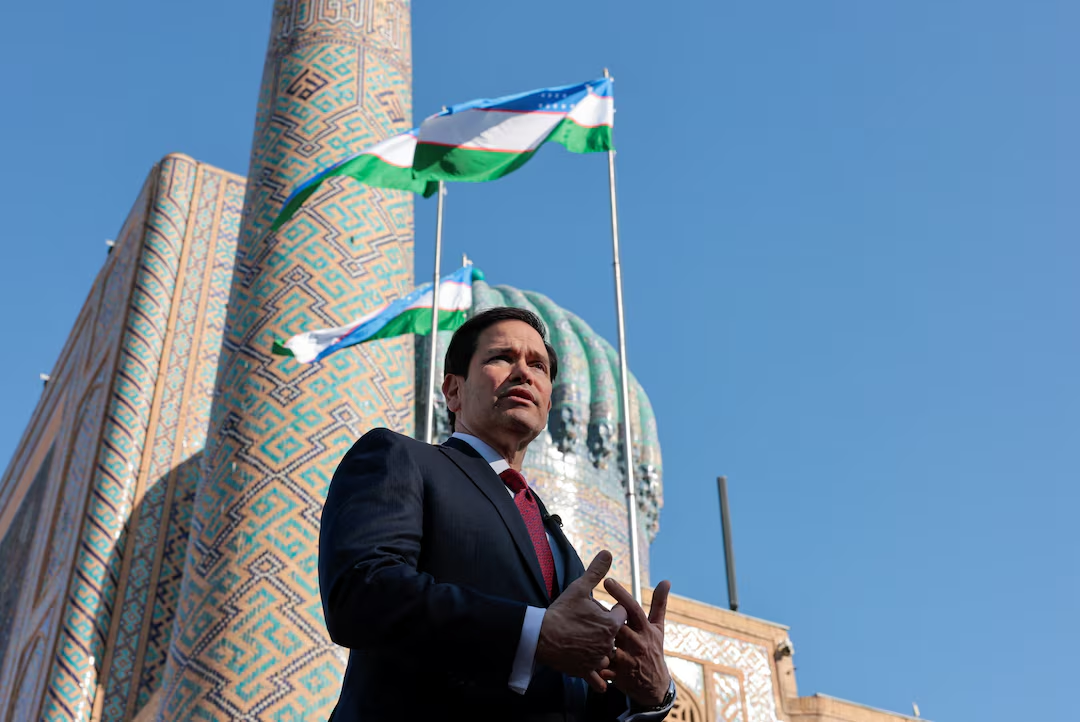
“I think we’ll have some concrete deals to announce,” Rubio said when asked what Uzbekistan could expect from his visit and the accompanying American business delegation.
He stressed that the discussions were intended to establish a lasting commercial presence rather than produce a single round of announcements. “This is not the end. This is the beginning,” he added.
Rubio said nearly 300 American businesses were represented in Samarkand, where discussions included potential agreements worth billions of dollars. The US State Department had previously said that more than 200 American business leaders were accompanying the secretary of state. However, a final list of agreements and their confirmed financial values had not been released at the time of his remarks.
The proposed deals come as Washington seeks to expand its commercial relationships across Central Asia, a region rich in natural resources and positioned between major economic powers. For Uzbekistan, attracting American investment could bring additional capital, technology and business partnerships as the country seeks to develop its economy and resource industries.
Critical minerals featured prominently in Rubio’s remarks. These minerals are important to a range of modern industries and technologies, and governments are increasingly looking to reduce their dependence on a limited number of suppliers.
“It’s not smart just for the whole world to depend on one place for 100% of anything,” Rubio said, adding that his argument was not directed at any particular country.
He said the industries expected to shape the 21st century would depend heavily on critical minerals. Developing alternative sources, he argued, was therefore an issue for the wider international economy, not just the United States.
For Uzbekistan and other resource-rich countries in the region, the opportunity extends beyond extracting minerals. Investment in processing facilities, technology and responsible development could help them capture more economic value from their natural resources.
“We’re obviously going to explore that and I think we have a chance to do that here,” Rubio told Euronews.
The discussions build on wider diplomatic efforts to strengthen US ties with the five Central Asian countries: Uzbekistan, Kazakhstan, Kyrgyzstan, Tajikistan and Turkmenistan. Critical minerals and commercial cooperation were also discussed at the C5+1 summit hosted by US President Donald Trump in Washington in November 2025.
The United States and European countries are seeking to diversify supply chains, while Central Asian governments are looking for investment and technical expertise to develop their industries. The interests overlap, creating opportunities for new commercial partnerships, although the scale and timing of individual projects will depend on the agreements reached and their implementation.
Rubio also sought to address concerns about China’s growing economic influence in Central Asia. He described the US approach as competition for economic opportunities, rather than an attempt to force regional governments to choose between Washington and Beijing.
“This is not about coming here to say, stop talking to somebody else or stop working with some other country,” he said.
Rubio praised Uzbekistan’s economic growth and said the country was open to building relationships with different international partners. His comments suggested that Washington wants to strengthen its position in the region without demanding that Central Asian governments abandon their existing commercial relationships.

During his visit to Samarkand, Rubio toured Registan Square alongside Saida Mirziyoyeva, head of Uzbekistan’s Presidential Administration. The historic square, known for its monumental Islamic architecture, once stood at the heart of a city that connected trading routes across Asia. Rubio described Samarkand as a centuries-old centre of trade and commerce.
His programme also included talks with Uzbek Foreign Minister Bakhtiyor Saidov, a document-signing ceremony and meetings with senior officials from across Central Asia. He was scheduled to meet Kazakhstan’s Foreign Minister Mukhtar Tileuberdi and participate in a C5+1 ministerial meeting involving the five Central Asian countries.
Rubio was also due to meet Uzbek President Shavkat Mirziyoyev and attend events connected to the Uzbekistan-US Business and Investment Council. Co-chaired by Mirziyoyeva and US Special Envoy Sergio Gor, the council was established to encourage commercial partnerships and investment between the two countries.
The visit follows the C5+1 summit held at the White House in November 2025, where more than $25 billion, approximately 22 billion euros, in commercial agreements and commitments were announced. The commitments involved several Central Asian countries and were at different stages of implementation, meaning the announced total did not necessarily represent completed investments.
Away from the economic agenda, Rubio also faced questions about tensions between Washington and Kyiv over Russia’s war in Ukraine.
Asked about Ukrainian claims that the United States had temporarily suspended intelligence sharing used to warn of Russian missile attacks, Rubio denied that any interruption had taken place.
“There has been no pause,” he told reporters.
Ukrainian President Volodymyr Zelenskyy had said on Sunday that intelligence sharing resumed after a three-day suspension. The conflicting statements left the accounts of Washington and Kyiv at odds.
Rubio urged both Russia and Ukraine to concentrate on ending the war, which began with Russia’s full-scale invasion in February 2022. He said Washington remained focused on finding a way to bring the conflict to an end.
“What he should be focused on and what we want to be focused on is bringing an end to this war,” Rubio said.
US President Donald Trump had criticised Zelenskyy a day earlier, accusing him of lacking the will to end the conflict. Trump also blamed Ukrainian attacks on Russian oil refineries for contributing to disruption in global diesel markets and defended temporary relief from some sanctions affecting Russian energy exports, arguing that it could support diplomatic efforts.
Rubio acknowledged that US attempts to broker an end to the war had made less progress than the administration wanted. He nevertheless said Washington would continue looking for opportunities to bring the sides towards negotiations.
The immediate commercial outcome of Rubio’s Central Asia visit remained to be confirmed. His remarks, however, made clear that Washington intends to pursue a broader economic relationship with Uzbekistan and its neighbours, with business investment and critical mineral supplies among its priorities.


