Universities in Lappeenranta and Lahti are beginning major change negotiations that could lead to up to 160 job losses at LUT University and LAB University of Applied Sciences. The negotiations cover almost 1,300 employees across the two institutions and come as both organisations face pressure to reduce costs.
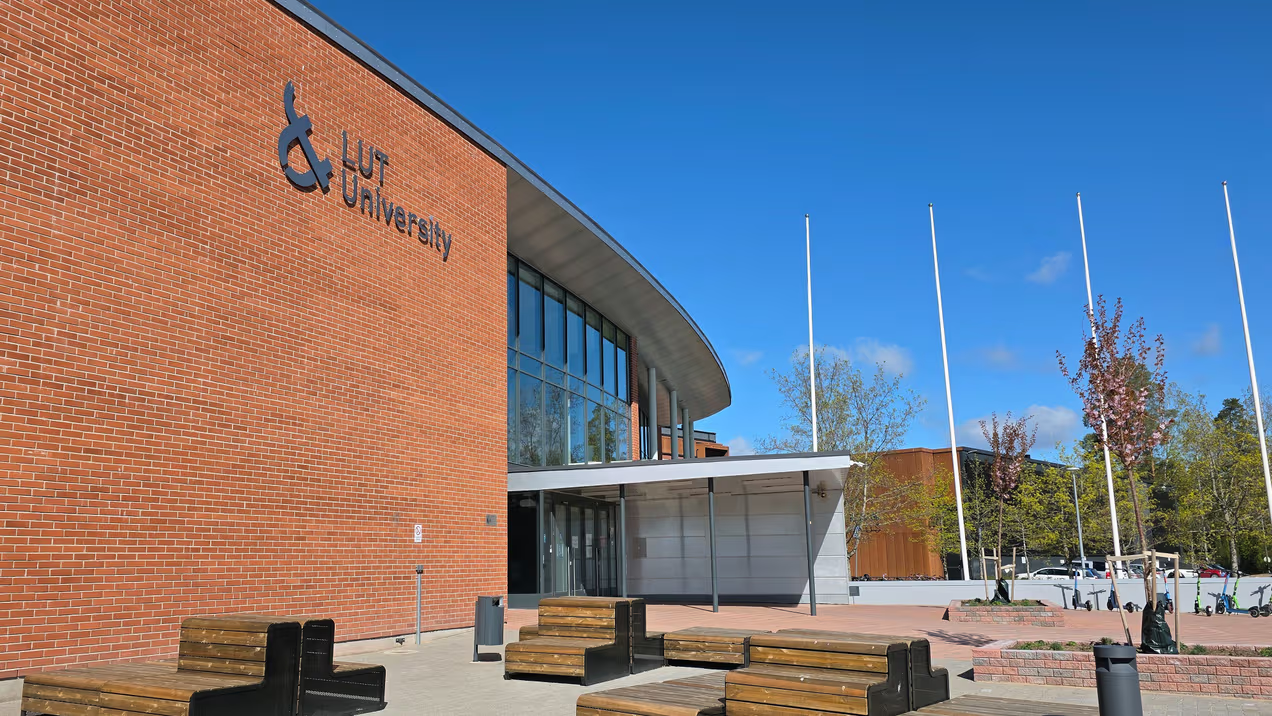
The financial situation at LAB has deteriorated particularly quickly, according to information released by the university. Its negotiations cover the entire staff and could result in both teaching and support positions being cut. Part-time work and temporary layoffs are also possible.
At LUT, the negotiations concern higher education services shared by the two institutions, along with university management and faculty personnel. Researchers and staff working directly in research and teaching positions are not included in the LUT negotiations.
Together, the two institutions face an estimated need to reduce costs by 10.5 million euros. LUT is seeking savings of 4.5 million euros, while LAB needs to cut its costs by 6 million euros.
The negotiations are scheduled to begin on October 7 and will continue for eight weeks. Their outcome is expected to become clearer before Christmas.
LAB estimates that its negotiations could result in up to 70 redundancies. Of these, around 30 could involve teaching staff and 40 could affect experts and support personnel. The negotiations cover all 722 employees at the university of applied sciences.
LAB says several sources of income have fallen short of expectations. Tuition fee income from international students and funding for research, development and innovation activities have not developed as planned.
At LUT, the maximum number of potential redundancies is 90, while up to 30 employees could be moved to part-time work. The negotiations involve 573 employees.

LUT says the process has been prompted by the rising cost of higher education services compared with the turnover of the wider group. The university says its administrative costs cannot increase faster than the research and teaching workforce.
Rector Juha-Matti Saksa said the announcement came as a surprise to some administrative employees, who learned about the negotiations during an online information session.
One factor behind the financial pressure is the number of funding applications being processed by LUT, which has not grown as expected. At the same time, the cost of providing services has risen faster than the group’s turnover.
“The administration cannot grow faster than the research and teaching staff,” Saksa said.
LUT has also seen a decline in the number of international students. The university says the number has fallen by more than 100 compared with last year, resulting in a loss of almost one million euros in funding.
Saksa linked part of the decline to changes affecting international students seeking to study in Finland. He said the introduction of an application fee and difficulties some students face in entering Finland have affected the number of students coming from outside the European Union and European Economic Area.
“They are talented students from outside the EU and EEA, but they cannot enter Finland,” Saksa said.
For Saksa, the current situation carries echoes of an earlier period of financial uncertainty. He recalled 2008, when the future of LUT University itself was under serious threat. The current negotiations are taking place in a different environment, but he said the university must now make decisions about its own operations.
The broader financial outlook for the public sector also remains uncertain, adding to the pressure on higher education institutions. Saksa said LUT’s priority is to protect its core work while improving the services supporting education and research.
“Higher education services must function even better. And we must enable researchers to succeed in their work even better,” he said.
The eight-week negotiation process will determine which activities and costs can be reduced and which areas the university will seek to protect. Saksa said the institution is examining different ways to address the financial situation.
“We are trying to find all possible solutions to get out of this,” he said.
At LAB, the financial pressure is particularly visible in its international student income. The university says it is three million euros below the tuition fee target it had set for international students. That target was 9.5 million euros.
LAB CEO Turo Kilpeläinen said the gap between income and expenditure could become increasingly difficult to manage if action is not taken now.
“The ratio of income to expenditure would be torn and threaten to grow even more in the future if the matter is not addressed now,” Kilpeläinen said.
The beginning of the negotiations did not come as a complete surprise to everyone at LAB. During the online information session, employees asked questions about how potential reductions would be assessed and what criteria would be used when decisions are eventually made.
Kilpeläinen said the eight-week process should be used to examine the organisation’s operations carefully rather than focusing only on immediate cuts.
“We want to spend eight weeks truly understanding how to adapt operations and what affects what,” he said.
LAB also says it wants to strengthen its international competitiveness, partnerships and networks despite the current financial pressure. Kilpeläinen argued that a stronger international position would benefit not only the institution but also the surrounding region.
“If we are internationally competitive, we will also help this region become stronger,” he said.
Kilpeläinen has previously been involved in change negotiations during his career and said he believes the current process should be handled openly. The negotiations will now determine where savings can be made and how the two institutions adjust their operations to the financial pressures they are facing.
For employees in Lappeenranta and Lahti, the process could ultimately mean significant changes to the local higher education workforce. The final number of redundancies, part-time arrangements and other measures will not be known until the negotiations are completed.