Hotel Skeppsholmen offers a distinctive way to experience Stockholm, combining waterfront accommodation, contemporary Swedish design and more than three centuries of history in buildings that once served the Swedish military. Located on the island of Skeppsholmen, close to the capital’s cultural attractions, the hotel occupies a pair of historic buildings constructed between 1699 and 1702. Their transformation into a modern hotel has preserved an important part of Stockholm’s architectural heritage while giving the former military premises a new purpose.

The setting is central to the hotel’s character. Skeppsholmen sits within Stockholm’s network of islands and waterways, offering a quieter environment than the busy streets of the mainland while remaining connected to the city. From the waterfront, views extend towards Stockholm’s inner-city skyline, creating a contrast between the historic buildings, the surrounding water and the urban landscape beyond. It is this combination of proximity and relative calm that distinguishes the hotel from accommodation located directly along the capital’s busiest commercial streets.
The story begins with a royal military project. The two buildings, commonly associated with the name Långa Raden, were designed by Nicodemus Tessin the Younger, the architect also known for his work on Stockholm Palace. Commissioned during the reign of King Charles XII, they were intended to house the monarch’s elite personal guards. Construction took place between 1699 and 1702, using materials that included reclaimed bricks from older buildings and castle ruins. According to the hotel’s historical account, the intended occupants largely failed to return from the wars, meaning the buildings were not used as originally planned when construction was completed.
Their subsequent history was far removed from the hospitality business they accommodate today. In 1710, the buildings began serving as a poorhouse for people affected by plague. They were later used for a variety of military and administrative purposes, including court-martial proceedings, accommodation, storage and naval offices. During the nineteenth century, they became associated with official residences for military and civilian personnel, before serving largely as office premises during the twentieth century. In 1935, the buildings received protected historic monument status, establishing their importance as part of Sweden’s architectural and military heritage.
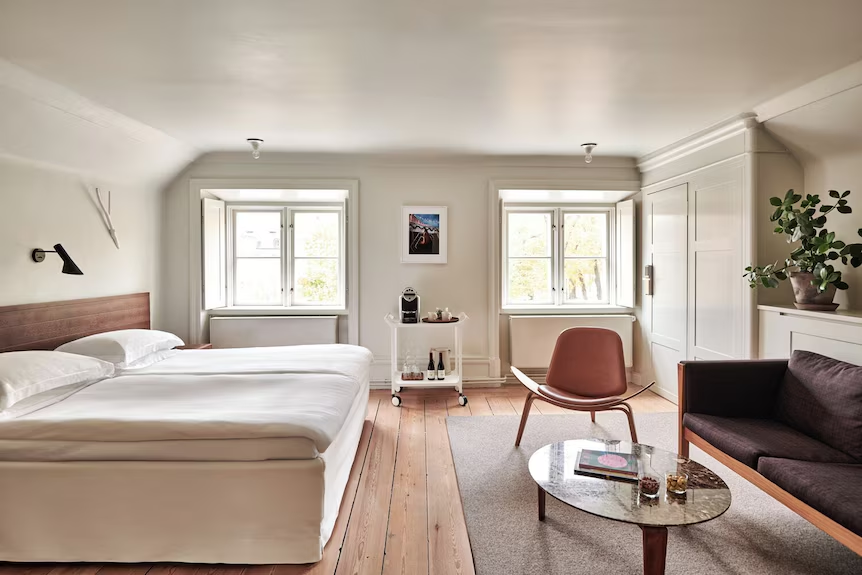
That history is not simply a backdrop to the hotel’s identity. It shapes the physical spaces in which guests stay. The conversion into a hotel, completed in 2009, required a careful approach to buildings whose historic character could not be treated as an obstacle to be removed. Architects and designers from Claesson Koivisto Rune worked with Erséus Arkitekter on the project, seeking to introduce the facilities required by a contemporary hotel while retaining significant original features.
The renovation involved practical compromises. Historic interiors had to accommodate modern services, including heating, ventilation and lifts, without unnecessarily sacrificing the buildings’ original structure. The hotel’s account of the restoration describes efforts to preserve existing surfaces and structural details, with new additions designed to be reversible wherever possible. In some rooms, bathrooms were inserted as separate structures so that older wall panels and finishes behind them could remain intact. Original floorboards were also carefully removed, cleaned and reinstalled where appropriate. Such decisions reveal the complexity of adapting a protected historic building for modern use.
The resulting design brings the buildings’ older character into conversation with a more contemporary interpretation of Swedish interiors. Rather than relying on a replica of an eighteenth-century setting, Hotel Skeppsholmen presents its historic architecture alongside modern furnishings and a restrained design approach. The aim is to allow the age and proportions of the buildings to remain part of the experience without compromising the comfort expected of a hotel today. Its appeal therefore rests as much on the relationship between old and new as on the age of the property itself.
Hotel Skeppsholmen has 78 rooms, alongside a restaurant, bar and facilities for meetings and private events. Restaurant Långa Raden places Swedish food traditions at the centre of its offering, connecting the hotel’s hospitality with a wider interest in local culinary culture. The property also holds the Nordic Swan Ecolabel, a recognised Nordic environmental certification, and is a member of Design Hotels. These affiliations form part of its stated approach to design, quality and more conscious hospitality, although an individual traveller’s experience will still depend on the room, services and facilities used during a stay.
The hotel’s position also makes it relevant to visitors interested in Stockholm beyond its best-known shopping streets and central squares. Skeppsholmen has a strong cultural identity, with Moderna Museet, the city’s museum of modern and contemporary art, among the institutions on the island. The neighbouring island of Kastellholmen and the surrounding waterfront provide additional opportunities to explore Stockholm on foot, while the wider area reflects the city’s longstanding relationship with maritime activity, architecture and public cultural spaces. The island’s former military character has gradually given way to a more open environment in which heritage buildings, museums and visitor facilities share the landscape.

For travellers choosing a hotel, the distinction is meaningful. A property can offer a convenient address without giving guests much connection to the place around it. Hotel Skeppsholmen offers a more specific sense of location: a stay in historic military buildings on an island that remains closely linked to Stockholm’s cultural and maritime past. Its waterfront setting provides a change of pace, while its proximity to museums and the central city keeps sightseeing practical.
There is, however, a difference between staying in a historic building and experiencing history as it was lived. The hotel’s rooms and services belong to the present, even where elements of the original architecture survive. Its achievement lies in making that distinction work, preserving the physical traces of earlier uses while allowing the premises to function as a contemporary place to stay, eat and meet.
Hotel Skeppsholmen ultimately offers more than a waterfront address. It demonstrates how buildings shaped by royal ambition, military administration and centuries of changing urban life can be adapted for a new audience without erasing their past. For visitors seeking a Stockholm hotel with architectural character, a strong connection to Swedish design and a setting close to both water and culture, its appeal is rooted in the unusual combination of historical substance and modern hospitality.