A Finnish residence permit application begins with one essential decision: identifying the legal basis on which you intend to live in Finland. Whether you are moving for a job, a university degree, family reunification or another qualifying reason, the application process depends on your circumstances, the documents you can provide and the requirements set by the Finnish authorities.
For people planning their first move to Finland, the process can seem more complicated than simply completing a form and waiting for approval. Different residence permits have different eligibility rules, income requirements and supporting documents. Applying under the wrong category, submitting incomplete evidence or misunderstanding when you must visit a Finnish mission can create delays at a time when accommodation, employment or studies may already be arranged.

The Finnish Immigration Service, known as Migri, is the main authority responsible for processing residence permit applications. Its website provides the official application routes, eligibility criteria and instructions for different permit types. Applicants should use these instructions as the starting point rather than relying solely on advice from friends, social media groups or people who have previously moved to Finland. Immigration rules can change, and a requirement that applied to another applicant may not apply to someone with a different nationality, family situation or reason for moving.
The first step is to establish whether you need a residence permit at all. Citizens of EU member states, Iceland, Liechtenstein, Norway and Switzerland generally follow different rules and do not apply for a Finnish residence permit in the same way as citizens of countries outside these groups. EU citizens who stay in Finland for more than three months generally need to register their right of residence. For many non-EU nationals planning to stay longer than 90 days, a residence permit is required, although the rules and exceptions depend on the person’s situation.
For applicants who do need a permit, the reason for moving determines which application to make. Someone who has secured a qualifying job must follow the rules for a work-based permit, while a person accepted to study at a Finnish educational institution should use the student application route. Those joining an eligible spouse or another qualifying family member must apply under the relevant family-ties provisions. Researchers, entrepreneurs and people moving on other grounds may have separate requirements. Finland does not offer one universal residence permit that covers every reason for relocating, and choosing the correct application is therefore more important than simply getting the paperwork started. Migri’s online Application Finder can help applicants identify the appropriate route.
Once the correct permit type has been identified, applicants should read its individual eligibility conditions before paying a fee or submitting documents. A job offer, for example, does not automatically guarantee a residence permit. The applicant must satisfy the conditions for the specific work-based category, and the employer may have responsibilities in the process. A student must demonstrate admission to an eligible course and meet the financial requirements that apply to the permit. Applicants using family ties must establish the qualifying relationship and meet any applicable income or other conditions. These are different legal routes, not interchangeable versions of the same application.
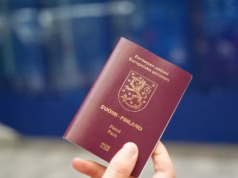
The next stage is gathering evidence. A valid passport is fundamental, and applicants should check its expiry date before starting the process. Depending on the permit category, supporting documents may include an employment contract, confirmation of admission to a Finnish educational institution, evidence of sufficient funds, or official documents establishing a family relationship. Some applications require additional information from the person living in Finland or from an employer or educational institution. The exact checklist provided by Migri for the chosen application should determine what is submitted.
Document preparation deserves particular attention when records have been issued in another language. Migri instructs applicants to arrange official translations into Finnish, Swedish or English when required. Certain foreign documents may also need to be legalised or authenticated before they can be accepted. Requirements vary according to the document and the country in which it was issued, so applicants should check the official guidance rather than assume that an ordinary photocopy or informal translation will be sufficient. A missing certificate or a document that does not meet the applicable formal requirements can leave the authorities unable to assess the application fully.
For most applicants, the most straightforward way to submit the application is through Enter Finland, Migri’s online service. Applicants select the relevant permit, complete the form, attach the required documents and pay the processing fee. A paper application is also possible, but the online service allows applicants to follow the progress of their case and respond to requests for additional information through their account. Migri says online applications are almost always less expensive than paper applications and are the fastest way to apply. The fee depends on the type of permit and application method, and it should be checked against the current fee schedule before submission.
Submitting an online form does not, by itself, complete every step. Applicants generally need to prove their identity in person at a Finnish embassy or consulate, or at another designated location where the relevant service is available. They should follow the instructions associated with their application and check appointment arrangements for the country where they are applying. The visit may involve presenting the original passport and other requested documents, as well as providing biometric identifiers such as fingerprints where required. Applicants should not assume that uploading passport details online removes the need for this appointment.
A first residence permit must usually be applied for from outside Finland. There are specific exceptions, including certain applications by family members of Finnish citizens and some other defined circumstances, but simply entering Finland as a visitor does not generally create a right to apply for a first permit from inside the country. Nor should a person assume that submitting an application automatically extends a lawful visit or authorises them to remain in Finland while a decision is pending. Migri states that people who apply in Finland must be residing there legally when they submit the application. Anyone unsure whether an exception applies should confirm their position with the immigration authorities before travelling or allowing an existing period of lawful stay to expire.
Timing is another practical consideration. People moving for employment or studies should apply well in advance of their intended start date, allowing time to gather documents, secure an appointment and wait for the decision. Processing times vary by permit category and individual circumstances, so a general estimate found online may not accurately predict the outcome of a particular case. Applications can take longer when information is missing or the authorities need to request further evidence. Applicants should monitor their Enter Finland account, keep their contact details current and respond to official requests within the stated deadline.
The processing fee is not a guarantee of approval, and an application should not be treated as a formality after travel plans have been made. Finnish authorities assess whether the applicant meets the legal conditions for the permit being sought. If the application is refused, the consequences depend on the decision and the person’s circumstances. Anyone who receives a negative decision should read the instructions accompanying it carefully, including information about appeal rights and any obligation to leave Finland. Submitting another application does not automatically give someone permission to stay in the country.
Approval is also not the end of the process. A residence permit is granted for a specified period and on particular grounds, and the holder must continue to meet the applicable conditions. The duration of a first permit depends on the category and circumstances; it is not the same for every newcomer. Students may, for example, receive a permit covering the expected duration of their degree, while other applicants may receive a shorter period tied to the purpose or duration of their stay. Those who intend to remain in Finland must check the rules for extending their permit and submit an extension application before their existing permit expires.
For a first-time applicant, the most reliable approach is to treat the process as a legal application supported by evidence, rather than as a single online form. Confirm the correct permit category, read the current eligibility rules, prepare the documents, budget for the fee and identity-verification appointment, and allow sufficient time before the planned move. The official starting point is Migri’s first residence permit guidance, followed by the application-specific instructions and the Enter Finland service. These sources are especially important because fees, eligibility conditions and administrative procedures can change. A carefully prepared application cannot guarantee a positive decision, but it gives the authorities the information they need to assess the case and reduces the risk of avoidable problems during the process.