Finland’s bid for a seat on the UN Security Council for 2029-2030 was formally put before world leaders in New York as President Alexander Stubb called for renewed commitment to international law, deeper cooperation and major changes to the way the United Nations makes decisions.
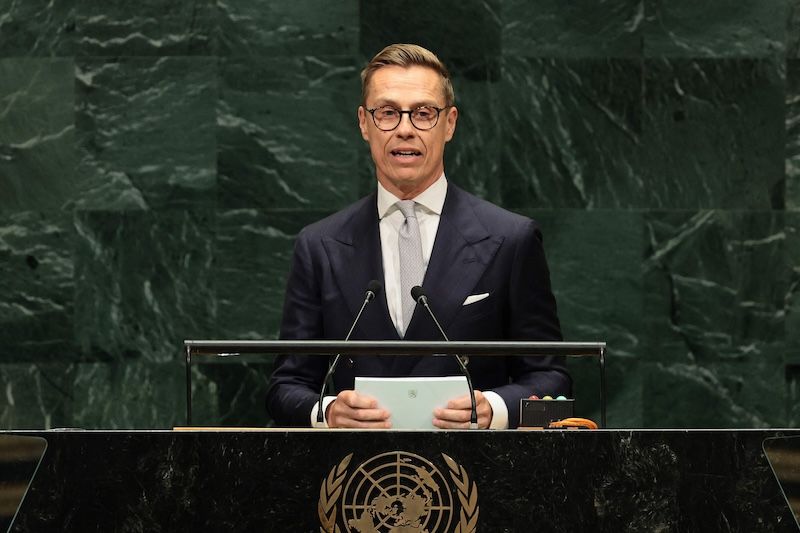
Addressing the General Assembly on September 22, Stubb presented the current international environment as a choice between cooperation and conflict. He argued that growing distrust, weakening institutions and disregard for international rules were making it harder for governments to manage competition without allowing it to develop into confrontation.
“Foreign policy is based on a choice between co-operation or conflict,” Stubb said, placing the defence of international rules at the centre of his speech.
He acknowledged that competition between states is inevitable, but said the problem arises when governments increasingly compete against the rules that underpin the international system. For Finland, he argued, cooperation remains particularly important for smaller states that rely on international institutions and partnerships to exercise influence.
Stubb outlined three broad responses to what he described as a world in disorder: a return to the basic principles of international law, stronger protection of humanitarian principles and more restrained political language. He warned that increasingly provocative rhetoric can deepen distrust and turn political competition into conflict.
His call for cooperation came as the 81st UN General Assembly met against the backdrop of wars in Ukraine and the Middle East, growing questions about the effectiveness of the UN and wider debate over how international institutions should adapt to a changing balance of power.
The Finnish president used the occasion to renew his call for reform of the Security Council, arguing that its structure still reflects the world of 1945 rather than the geopolitical realities of today. He proposed at least two additional permanent seats for Africa, two for Asia-Pacific and one for Latin America. He also called for an end to the veto power held by individual states and suggested that a Security Council member that violates the UN Charter should have its voting rights suspended.
Finland is seeking one of the non-permanent Security Council seats for the 2029-2030 term. The campaign was promoted during the high-level week in New York, where Stubb led the Finnish delegation alongside Foreign Minister Elina Valtonen and Minister for Foreign Trade and Development Ville Tavio.
The election will be decided by UN member states in 2028. Finland is competing for a seat allocated to the Western European and Others Group, with Australia also campaigning for the 2029-2030 term.
Stubb linked Finland’s candidacy to a broader argument that the UN should remain central to international diplomacy even as countries increasingly form regional and issue-specific coalitions. He pointed to cooperation around Ukraine as an example of countries working together when wider agreement is difficult, while stressing that such coalitions should strengthen rather than replace the UN system.
The president also argued that regional organisations and partnerships have a growing role in a more fragmented international environment. He referred to organisations including the African Union, ASEAN, the European Union, the Gulf Cooperation Council and Mercosur as examples of institutions that can help build trust and cooperation among states.
Ukraine remained an important part of the discussion. Stubb described Russia’s war as an unlawful act of aggression and said efforts to end the conflict must remain consistent with the UN Charter. His comments reflected Finland’s broader foreign-policy emphasis on support for Ukraine and the preservation of international rules.
The war in Gaza also featured prominently during the General Assembly. Stubb described the humanitarian situation as one of the world’s gravest crises, referring to displacement, destruction of infrastructure and shortages of basic services. He called for greater resources for conflict prevention and human rights.
The wider debate in New York exposed some of the tensions surrounding the international system Stubb was defending. US President Donald Trump used his own General Assembly address to warn Iran that the United States could take further action if no agreement was reached, while also criticising international institutions including the International Criminal Court.
Outgoing UN Secretary-General Antonio Guterres, delivering his final General Assembly address before leaving office at the end of the year, also called for stronger international action on conflicts and reform of global institutions. He described the destruction and loss of life in Gaza as reaching a scale he had not witnessed during his decade as secretary-general and again argued for a functioning multilateral system.
Stubb also placed artificial intelligence within his wider argument for international cooperation. He said Finland and Norway, together with other countries, had launched a call for governments, companies, regional organisations and the UN to develop mechanisms for governing advanced AI models. Finland had already identified AI governance as one of its priorities during the UN high-level week.
For Finland, the Security Council campaign therefore extends beyond a bid for a seat. Stubb used the UN platform to present the country’s candidacy as part of a wider effort to reinforce international cooperation, support peace and preserve a rules-based system at a time when the authority and effectiveness of global institutions are under increasing pressure.
He closed his speech by invoking the 1945 San Francisco conference that established the UN Charter. Stubb called for what he described as a “new San Francisco moment”, in which governments would come together to renew their commitment to the principles of the international system. He suggested that the process should begin under the next UN secretary-general.
Quoting former UN Secretary-General Kofi Annan, Stubb ended with a warning that reflected the central message of his address: countries may disagree on how the world should be governed, but their ability to address common problems ultimately depends on their willingness to cooperate.