European leaders have backed a stronger European Union role in the Arctic after meeting in Rovaniemi, where Finland pushed for greater investment in icebreakers, transport infrastructure, satellite capabilities and other projects designed to strengthen the region’s security.
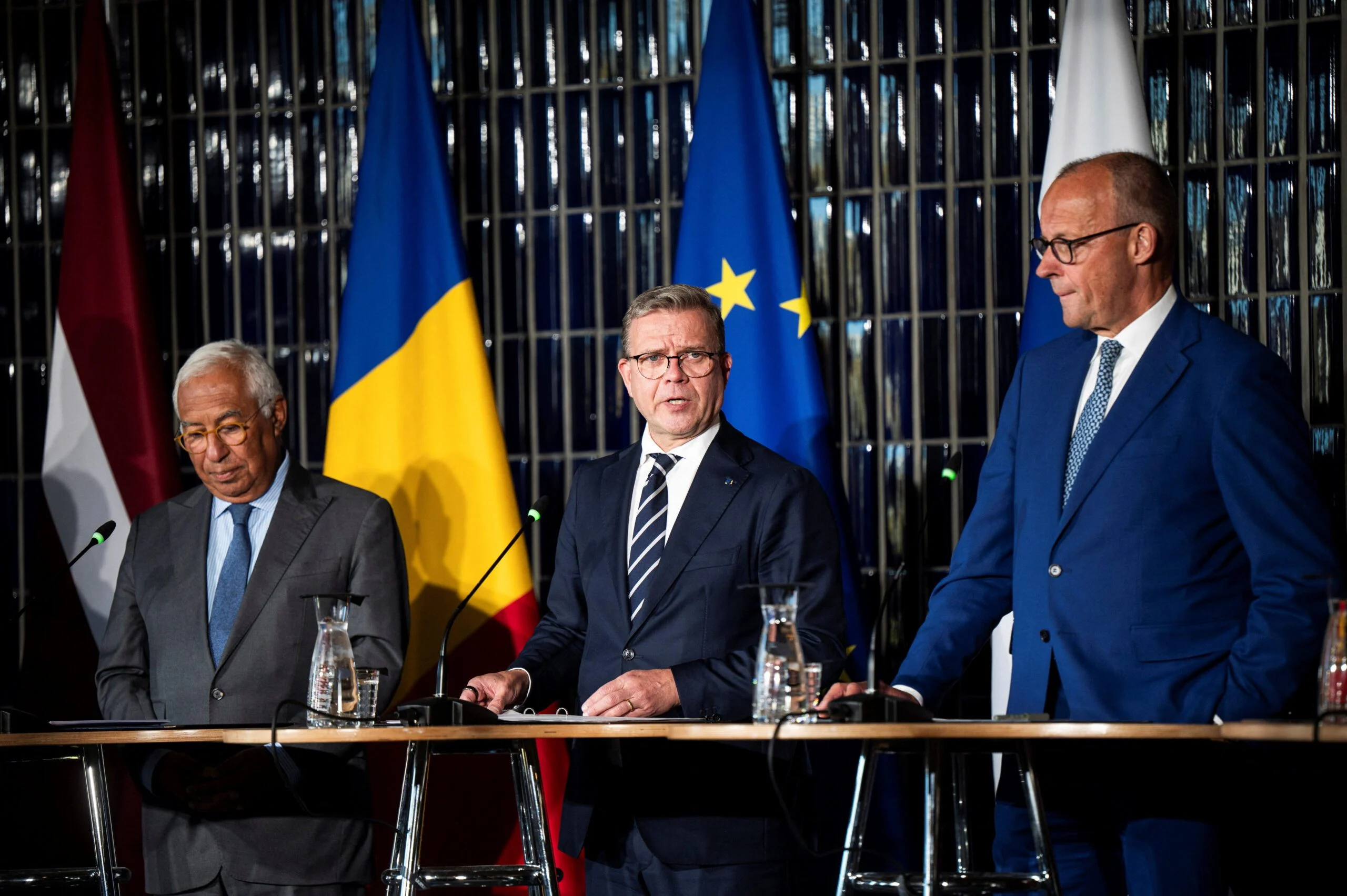
The European Arctic Summit, hosted by Finnish Prime Minister Petteri Orpo on September 13 and 14, brought together senior political leaders and EU officials as governments prepare for a new EU Arctic strategy. Twelve EU member states ultimately signed a joint statement calling for a more strategic and proactive European role in the Arctic.
For Finland, one of the most concrete proposals was the development of additional icebreaking capacity. German Chancellor Friedrich Merz backed the idea, arguing that the ability to operate in northern waters should no longer be viewed as an issue limited to Finland or other Arctic and Nordic countries.
“This is not just an issue for Finland, for Norway, for Sweden,” Merz said at the summit. “This is something for the entire European Union.”
EU foreign policy chief Kaja Kallas also said Europe needed more icebreakers as climate change alters Arctic conditions and maritime routes become increasingly accessible. The discussion included the possibility of developing icebreaking capacity jointly, but the summit did not produce a decision on the number of vessels, their cost or how they would be financed. Any future procurement would also have to comply with EU procurement rules.
That distinction matters for Finland, which has extensive experience in designing and building icebreakers and has been seeking a larger European role in Arctic infrastructure. The Finnish government has argued that EU investment in the north should cover more than military capabilities, including logistics, energy, critical minerals, transport connections and security of supply.
The Rovaniemi meeting reflected a wider change in how European governments are approaching the Arctic. The region has traditionally been discussed largely through the lens of climate, environmental protection and cooperation among Arctic states. Increasingly, European governments are treating it as a security and economic issue as well.
The summit’s joint statement cited Russia’s efforts to increase its influence in the Arctic and what it described as hostile and hybrid activity against Europe. The signatories said these developments required the EU to strengthen its Arctic policy. They also pointed to China’s growing interest in the region and the broader strategic changes caused by climate change.
For Finland, the shift is particularly significant. The country shares a long border with Russia, and its northern territory forms part of the European Union’s Arctic frontier. Orpo told the summit that Arctic security could not be separated from economic security, infrastructure, energy, critical minerals, trade routes, logistics and climate change.
The leaders therefore discussed a broader package of investment priorities. Military mobility and dual-use transport networks were among them, alongside space and satellite capabilities, energy infrastructure, critical raw materials and the resilience of infrastructure in northern areas. The proposals are intended to connect civilian and security needs rather than treat them as separate questions.
The timing of the summit also gave the security discussion an immediate European context. A Russian drone struck a passenger train near the Ukrainian-Polish border on September 13, shortly before the Rovaniemi meeting. Kallas said the incident was intended to frighten Western countries and argued that Europe should respond by maintaining its support for Ukraine.
The Arctic discussions also intersected with tensions surrounding Greenland, the self-governing Danish territory that has become an increasingly sensitive issue in relations between Denmark, the European Union and the United States. Danish Prime Minister Mette Frederiksen said negotiations with Washington were continuing through a high-level working group and that she remained optimistic about finding a peaceful solution. European Council President António Costa reiterated the EU’s support for Denmark.
The summit was not intended to settle all of these questions. Its larger purpose was to help shape the direction of the European Commission’s forthcoming Arctic strategy. Kallas said the new strategy would place security at its core and was expected later in the year, with concrete projects also to be identified.
That leaves the next stage less about declarations and more about implementation. Political support for stronger Arctic involvement has now been expressed by a broad group of EU countries, but major questions remain over funding, procurement and which projects should receive priority.
For Finland, the Rovaniemi summit offered an opportunity to put the country’s northern interests at the centre of a wider European discussion. For the EU, it marked a clearer recognition that the Arctic is no longer simply a distant environmental concern. It is becoming increasingly connected to Europe’s borders, infrastructure, energy supplies, trade routes and wider security calculations.
The challenge now is translating that recognition into policy and investment. The forthcoming EU Arctic strategy and negotiations over the bloc’s long-term budget will show how far the political commitments made in Rovaniemi are reflected in actual resources for Europe’s northern regions.