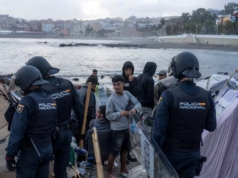
Donald Trump pauses Strait of Hormuz operation at a moment when global markets, shipping companies, and governments are trying to understand whether the Middle East is moving toward de-escalation or drifting into a wider conflict.

US President Donald Trump announced that Washington would temporarily suspend “Project Freedom”, the naval mission launched to escort commercial vessels through the Strait of Hormuz after days of regional instability and military confrontation involving Iran, Israel, and the United States.
The decision came less than 24 hours after the operation began.
Trump said the pause followed diplomatic requests from Pakistan and several other countries, while also claiming that negotiations with Iran had made “great progress” toward what he described as a “Complete and Final Agreement”. Iran has not publicly confirmed that such an agreement exists.
Even with the temporary suspension, the United States said restrictions and pressure measures against Iran would remain in place. American officials also insisted that military readiness in the region had not changed.
The Strait of Hormuz is one of the most strategically important waterways in the world. Roughly one fifth of global oil and gas supplies move through the narrow passage connecting the Persian Gulf to international shipping routes.
Any disruption there immediately affects global energy prices, shipping costs, insurance rates, airline operations, and investor confidence.
That reality explains why even a short military confrontation in the area has already rattled international markets.
Oil prices dropped slightly after Trump’s announcement, signaling cautious optimism among traders that the immediate threat of a full blockade may be easing. Brent crude reportedly fell to around $108 per barrel, while US crude also declined.
Still, many companies remain unconvinced that the crisis is over.
Several major shipping operators continue to avoid the route entirely, fearing sudden escalation or attacks on commercial vessels.
Project Freedom was introduced as an emergency response after hundreds of ships became stranded in Gulf waters during the conflict.
The operation was designed to provide armed naval escorts through the Strait of Hormuz after rising attacks and fears of maritime disruption.
Yet according to reports, only two merchant ships had successfully passed through the protected corridor before Trump halted the operation.
That abrupt reversal has created uncertainty across diplomatic and military circles.
US Secretary of State Marco Rubio attempted to draw a distinction between the broader military campaign against Iran and ongoing naval activity in the Gulf. Speaking at the White House, Rubio said the main US-Israeli offensive, known as “Operation Epic Fury”, had completed its objectives.
According to Rubio, that phase of the conflict had ended.
At the same time, American officials emphasized that US naval forces would still defend shipping lanes if attacked.
Defense Secretary Pete Hegseth also insisted that the ceasefire with Iran remained active, though he acknowledged Washington was monitoring the situation closely.
The mixed messaging reflects a broader problem facing the White House. Officials are trying to present the conflict as contained while military tensions and regional instability continue to spread.
Iranian leaders responded to the American announcement with skepticism and defiance rather than celebration.
Iran’s parliamentary speaker Mohammad Bagher Qalibaf portrayed the US decision as evidence that Washington was struggling to sustain pressure.
He argued that the situation was becoming more difficult for the United States than for Tehran.
Iranian President Masoud Pezeshkian also rejected the idea that Iran would submit to external demands under pressure. He accused Washington of continuing its long-standing strategy of coercion while expecting Iran to accept unequal terms.
Iran’s position appears carefully calculated.
Tehran wants to avoid appearing isolated internationally while also refusing to project weakness domestically. That balancing act has shaped much of Iran’s diplomatic language since the conflict intensified.
One of the most important developments in the crisis may not be happening in Washington or Tehran, but in Beijing.
Iranian Foreign Minister Abbas Araghchi traveled to China for talks with Chinese Foreign Minister Wang Yi as diplomatic efforts intensified.
China openly criticized military actions carried out by the United States and Israel against Iran, describing them as illegitimate. Beijing also called for a full ceasefire and secure maritime passage through the Strait of Hormuz.
The meeting highlighted China’s growing role in Middle East diplomacy.
Over the past several years, Beijing has steadily positioned itself as a strategic alternative to Washington in regional negotiations. China has strengthened ties with Gulf states while deepening cooperation with Iran in trade, infrastructure, and energy.
For Tehran, Chinese support offers economic and diplomatic breathing room at a time of mounting Western pressure.
For Washington, China’s growing involvement complicates an already fragile geopolitical landscape.
Despite political statements about progress, many businesses operating in the region remain cautious.
Shipping firms, insurers, and logistics companies are waiting for clear proof that commercial transit through the Strait of Hormuz is genuinely secure.
German shipping giant Hapag-Lloyd said its vessels were still avoiding the route because its internal risk assessment had not changed.
That hesitation matters.
Global shipping companies do not base decisions on political speeches alone. They respond to measurable risks, including missile threats, drone activity, naval confrontations, and insurance exposure.
One reported strike on a cargo vessel in the strait, along with claims from shipping company CMA CGM that one of its vessels had been targeted, reinforced concerns that commercial operators remain vulnerable.
Even if governments declare progress, businesses will likely demand weeks of stability before normal operations resume.
While attention remains focused on Iran and the Strait of Hormuz, the wider regional conflict continues to grow.
Fighting between Israel and Hezbollah in Lebanon has intensified despite earlier ceasefire announcements.
Israeli forces ordered evacuations in several towns in southern Lebanon, claiming Hezbollah had violated ceasefire conditions. Hezbollah responded by saying it had targeted Israeli troops with drones.
The humanitarian cost has been severe.
Large parts of southern Lebanon have suffered extensive destruction, and mass displacement continues across the region. Earlier strikes in Beirut also caused heavy civilian casualties and forced more than a million people from their homes.
This broader regional instability complicates any attempt to present the Iran situation as fully contained.
The Trump administration is also facing criticism at home.
Several lawmakers argue that the White House is downplaying the scale of continued US military involvement in the region.
Democratic Congressman Raja Krishnamoorthi accused Trump of misleading Congress by claiming hostilities had effectively ended while military confrontations in and around the Strait of Hormuz continued.
The criticism comes amid ongoing debate over presidential war powers and the legal limits of executive military action without broader congressional approval.
Trump himself has offered few details about what would constitute a violation of the ceasefire or what specific conditions could trigger renewed escalation.
When asked directly by reporters, he responded vaguely: “You’ll find out because I’ll let you know.”
That uncertainty continues to unsettle allies, markets, and military observers alike.
The temporary suspension of Project Freedom may reduce immediate tensions, but it does not resolve the deeper issues driving the crisis.
Iran remains under intense economic pressure. Israel continues military operations across multiple fronts. The United States is trying to avoid another prolonged Middle East conflict while still projecting strength.
Meanwhile, global markets remain highly sensitive to any disruption in the Strait of Hormuz because the economic consequences reach far beyond the region itself.
For now, diplomacy appears to have created a narrow opening.
Whether that opening leads to a durable agreement or simply delays another round of confrontation remains uncertain.
The biggest unanswered question is whether international shipping can safely return to normal operations through the Strait of Hormuz without sustained military protection.
At the moment, the answer appears to be no.
Political announcements may temporarily calm markets, but shipping companies, insurers, and energy traders are still responding to the hard reality of risk. Until stability is visible on the water itself, caution will continue to define global maritime activity in one of the world’s most critical trade corridors.