African American history is not confined to museums or textbooks. In cities across the United States, it survives in churches where activists organized, neighborhoods that produced writers and musicians, streets where protesters marched, homes where influential figures lived, and buildings that witnessed turning points in the country’s struggle over freedom and equality. For travelers trying to understand the United States through the experiences of its Black citizens, some cities offer a particularly powerful connection between place and history.
Washington, D.C., is perhaps the most comprehensive place to begin because African American history is woven directly into the story of the American capital. The National Museum of African American History and Culture, part of the Smithsonian Institution, opened on the National Mall in 2016 after decades of efforts to establish a national institution devoted to Black history and culture. Its collections span slavery, emancipation, segregation, the civil rights movement, military service, music, art, politics and everyday life. The museum says it has collected nearly 45,000 artifacts, with thousands incorporated into its exhibitions.

But Washington’s Black history extends far beyond the National Mall. In southeast Washington, Cedar Hill preserves the home of Frederick Douglass, the formerly enslaved man who became one of the country’s most influential abolitionists, writers and advocates for equal rights. Douglass purchased the estate in 1877 and lived there during the final 17 years of his life. His Washington story places the city firmly within the history of emancipation and the long political struggle that followed the Civil War.
New York offers a different view of the African American experience. The city’s history reaches back to the colonial period, long before Harlem became internationally associated with Black culture. In Lower Manhattan, the African Burial Ground National Monument marks the site where more than 15,000 free and enslaved Africans were buried between the 1690s and 1790s. The burial ground was later covered by urban development and rediscovered during construction in 1991. Archaeological work uncovered the remains of 419 Africans along with hundreds of artifacts, providing evidence of the lives of Africans and African Americans in early New York.

Further north, Harlem tells a story of migration, creativity and intellectual life. The neighborhood became one of the major centers of the Harlem Renaissance in the 1920s and 1930s, when Black writers, musicians, artists, photographers and scholars transformed American culture. At the heart of that history is the Schomburg Center for Research in Black Culture, founded in 1925 and now part of the New York Public Library. Its collections contain more than 11 million items documenting African American, African Diasporic and African experiences.
The significance of Harlem is not simply that famous Black Americans lived or worked there. The neighborhood became a place where Black intellectual and artistic life could develop on its own terms, shaped by the Great Migration and by the communities that arrived in northern cities from the American South. Walking through Harlem today therefore offers a different kind of historical encounter. The story is not only about oppression. It is also about publishing, theater, music, literature, political thought and the creation of institutions that helped shape modern Black identity.
Atlanta brings the history of the modern civil rights movement into an unusually concentrated area. Along Auburn Avenue, visitors can encounter the neighborhood where Martin Luther King Jr. was born, raised and later worked as a minister. The Martin Luther King Jr. National Historical Park includes his childhood home, Historic Ebenezer Baptist Church, the King Center and the places associated with his family and ministry. The National Park Service describes the area as a once-thriving center of Atlanta’s African American community.

King’s Atlanta story is particularly significant because the city was not simply the birthplace of one of the most recognizable figures of the civil rights era. It was also an environment in which Black institutions, churches, businesses and civic organizations had developed over generations. Ebenezer Baptist Church, where King preached alongside his father, became part of that larger network. His childhood home and the surrounding streets provide a more intimate perspective than a monument alone can offer. They show the family and community that existed before King became a national figure.
Montgomery, Alabama, carries a different weight. The city was the setting for the Montgomery Bus Boycott, one of the defining campaigns of the civil rights movement. The protest followed Rosa Parks’ arrest on December 1, 1955, after she refused to surrender her seat to make room for white passengers. Black residents organized quickly, and the Montgomery Improvement Association was formed at Dexter Avenue Baptist Church, where Martin Luther King Jr. was then the minister.

The boycott lasted for more than a year. According to the National Park Service, Montgomery City Lines lost between 30,000 and 40,000 fares each day during the boycott, while many Black residents walked long distances or relied on organized carpools. The city’s streets and churches therefore represent more than a famous episode in a history book. They reveal how an organized local community turned a protest over segregated transportation into a sustained challenge to the racial order of the American South.
Birmingham, also in Alabama, provides an even more difficult encounter with the violence of segregation and the determination of those who opposed it. In 1963, images of police dogs and high-pressure fire hoses being used against civil rights protesters, including children, circulated nationally and internationally. Kelly Ingram Park became one of the central sites associated with the Birmingham campaign.
The Birmingham Civil Rights National Monument now brings together several places connected to that history, including Kelly Ingram Park, the 16th Street Baptist Church, the A.G. Gaston Motel and other churches and buildings. The 16th Street Baptist Church was bombed in September 1963, killing four girls who had been preparing for Sunday school. The tragedy became one of the most enduring symbols of the brutality of segregation and helped intensify national pressure for civil rights legislation.
Birmingham also complicates the familiar narrative of civil rights history because the movement was sustained not only by nationally recognized leaders but by local churches, business owners, students and ordinary residents. The A.G. Gaston Motel, built by African American businessman Arthur G. Gaston, became a headquarters for civil rights leaders during the Birmingham campaign and provided a base from which strategy and organizing could take place.
New Orleans tells the story through culture as much as through political struggle. The city’s African American history is deeply connected to the development of music, particularly jazz. The National Park Service traces important influences to the African and Caribbean traditions preserved in Black communities, including the gatherings that took place at Congo Square, where enslaved and free people of African descent gathered for music, dancing, socializing and commerce.
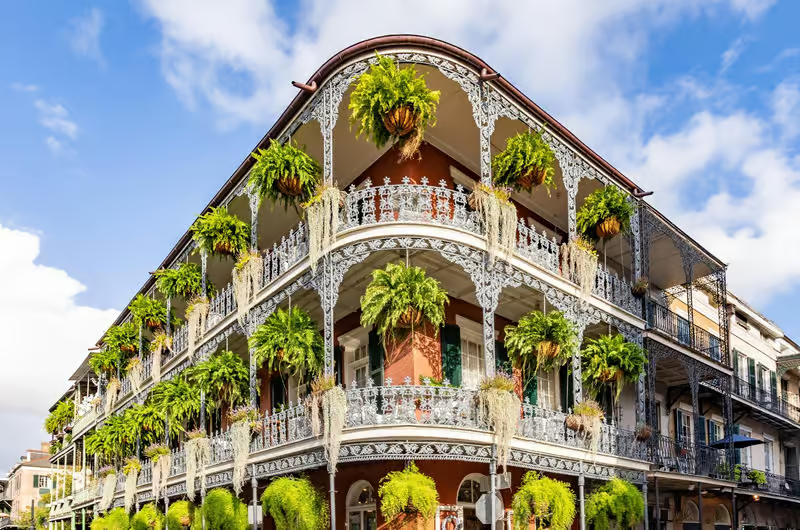
The significance of Congo Square reaches beyond the origins of a musical genre. It represents the survival and transformation of African cultural traditions under slavery and in the generations that followed. New Orleans became a place where African, Caribbean, European and American influences met, creating an environment in which new musical forms could emerge. The city’s Tremé neighborhood, one of the historic centers of Black and Creole life, remains closely associated with this cultural history.
Memphis, Tennessee, brings together music, Black business and the civil rights movement. Beale Street became an important center of African American commercial and musical life, while the Lorraine Motel became inseparable from the final chapter of Martin Luther King Jr.’s life. King was assassinated at the motel on April 4, 1968, while in Memphis to support striking sanitation workers. The site is now home to the National Civil Rights Museum.
The Lorraine was itself part of Black history before King’s assassination. During segregation, it was one of the Memphis establishments where African American travelers could obtain accommodation. Its guest list included musicians and entertainers, and its importance to the city’s Black community made it a natural gathering place for visitors and activists. The National Civil Rights Museum uses the motel and surrounding buildings to place King’s assassination within the much wider history of the civil rights movement rather than treating it as an isolated event.
Chicago offers another essential perspective because its African American history is closely tied to the Great Migration. Beginning in the early 20th century, millions of African Americans left the South for cities in the North and West in search of greater economic opportunity and an escape from the restrictions and violence of Jim Crow. Chicago became one of the most important destinations, and its South Side developed into what became known as the Black Metropolis or Bronzeville.

Bronzeville’s significance extends across business, politics, journalism, music, art, sports and community life. The National Park Service describes the area as a place that represents African American achievements across many fields and notes that the Bronzeville-Black Metropolis National Heritage Area was designated by Congress in 2023. The district offers an important reminder that African American history is not solely a history of resistance to discrimination. It is also a history of institution-building, entrepreneurship and cultural production.
Boston provides yet another dimension, reaching back to the Black communities that existed before the Civil War. The city’s Black Heritage Trail runs through Beacon Hill, where a free African American community organized around abolition, education, civil rights and the Underground Railroad. The trail includes homes, churches, schools and gathering places associated with that community.

Among its most important sites is the African Meeting House, which opened in 1806 and served as a religious, cultural and political center. The nearby Abiel Smith School was built specifically for Black students and now forms part of the Museum of African American History. The neighborhood also connects visitors to the history of the Massachusetts 54th Regiment, one of the first Black regiments to serve in the Union Army during the Civil War.
Taken together, these cities reveal why African American history cannot be reduced to a single timeline or a handful of famous names. Washington shows the political and institutional struggle for citizenship. New York reveals the depth of Black life in an American city from the colonial era through the Harlem Renaissance. Atlanta and Montgomery connect visitors to the civil rights movement through the homes, churches and streets where it developed. Birmingham confronts the violence that movement faced. New Orleans demonstrates the power of culture and musical inheritance. Memphis connects civil rights to labor and Black commercial life, while Chicago shows how the Great Migration transformed American cities and helped create new centers of Black political and cultural power. Boston reaches further back into the history of abolition, education and free Black communities.
Why New Orleans Remains One of America’s Most Distinctive Cities
The National Park Service now preserves a broad network of African American heritage sites across the country, including places associated with slavery, emancipation, the Underground Railroad, military service, civil rights, migration and cultural history. Its national African American heritage program makes clear that these stories are not separate from American history. They are part of the country’s central historical record.
For travelers, that distinction matters. A visit to these cities is not simply an opportunity to see a museum or photograph a monument. The most meaningful experiences often come from understanding how individual places connect to the people who lived there, organized there, worshipped there, created there and fought there. African American history becomes more immediate when the geography is understood alongside the events.
That is ultimately what makes these American cities so important. Their streets preserve evidence of a past that was often contested, suppressed or violently resisted, but they also preserve evidence of creativity, community and ambition. The history is not behind glass. In many places, it is still embedded in the neighborhoods themselves.