The Ngorongoro Conservation Area in northern Tanzania offers a safari experience that goes beyond watching wildlife in a protected landscape. Established in 1959, the conservation area was created around a different approach to land management, one intended to accommodate wildlife conservation alongside the traditional pastoral activities of the Maasai people. This arrangement gives Ngorongoro an identity that separates it from the conventional national park safari experience, bringing together wildlife, human history, cultural heritage and some of East Africa’s most remarkable landscapes.

At the centre of the area is the Ngorongoro Crater, an enormous volcanic caldera formed when a volcano collapsed after a major eruption. Measuring approximately 20 kilometres across, it is widely recognised as the world’s largest intact volcanic caldera. Its steep walls surround a landscape of grasslands, woodland, swamps and a shallow salt lake, creating a range of habitats within a relatively compact area. The crater floor supports a remarkable concentration of wildlife, making it one of Tanzania’s most recognisable safari destinations.
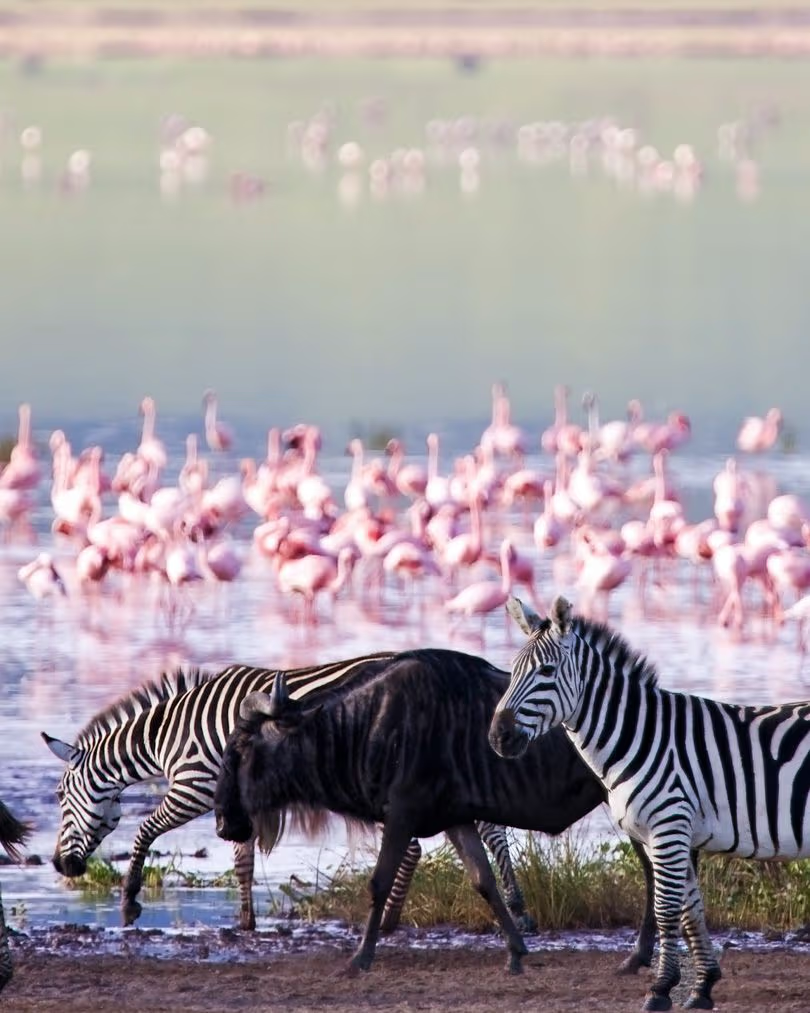
Lions, elephants, buffaloes, zebras, wildebeest, hyenas and several other species inhabit the crater. The area is also an important refuge for the endangered black rhinoceros, one of the animals that visitors hope to encounter during a game drive. The concentration of wildlife means that visitors can often observe several species during a single excursion, although sightings are never guaranteed.
The crater is an important part of the experience, but it does not represent the entire conservation area. The wider landscape extends across highland plains, savanna, forests and volcanic features, connecting the Serengeti ecosystem with the eastern arm of the Great Rift Valley. This geographical variety is one reason Ngorongoro has significance beyond its reputation as a wildlife destination.
What makes the conservation area particularly different, however, is the way its original management framework recognised the presence of people within a protected wildlife landscape. Unlike many national parks, where permanent human settlement and traditional livestock grazing are generally restricted, Ngorongoro was established as a multiple land-use area. Its founding approach sought to allow wildlife to coexist with semi-nomadic Maasai pastoralists, whose livelihoods have historically depended on raising cattle and moving livestock across grazing land.
The arrangement is central to understanding the destination. Maasai communities have a longstanding relationship with the landscape, and livestock remains an important part of their traditional way of life. Cattle, goats and sheep are not simply an occasional sight around the conservation area; they are part of the wider human and ecological environment that visitors encounter.
This creates a different perspective on a safari. A journey through Ngorongoro is not exclusively about searching for animals or moving between wildlife viewing points. Visitors may also see Maasai settlements, herders moving livestock and evidence of a pastoral way of life that has shaped the region for generations. The presence of people is part of the area’s identity, rather than something entirely separated from the wildlife experience.
That relationship should not, however, be mistaken for a straightforward or conflict-free conservation model. Balancing the needs of wildlife, livestock, local communities and tourism is a continuing management challenge. Population pressures, grazing requirements, environmental protection and the future of resident communities have all become important questions in discussions about the area’s management. UNESCO has also stressed that conservation decisions must respect the rights and dignity of the Maasai people, including the need for meaningful participation in decisions affecting their lives.
ALSO READ: The Road Between Johannesburg and Kruger Has a Story of Its Own
The area’s cultural significance extends well beyond its living pastoral traditions. Ngorongoro is also internationally recognised for archaeological discoveries that have contributed to the understanding of human evolution. Within the wider conservation area lies Olduvai Gorge, one of the world’s most important archaeological and palaeoanthropological sites. Research conducted there has uncovered fossils and stone tools that provide evidence of early human ancestors and the development of human societies over millions of years.
Nearby, the Laetoli site is known for fossilised hominin footprints dating back approximately 3.6 million years. These footprints offer remarkable evidence of early bipedal movement and have made the region an important destination for researchers interested in the history of human evolution.

This combination of natural and cultural heritage is reflected in the area’s UNESCO World Heritage status. It was first inscribed on the World Heritage List in 1979 for its natural significance, with its cultural value formally recognised through an additional inscription under cultural criterion in 2010. The designation acknowledges that Ngorongoro is not simply a place of exceptional wildlife, but also a landscape containing evidence of the long relationship between humans and their environment.
For visitors, the practical experience also differs from a safari focused entirely on extensive game drives across open plains. The Ngorongoro Crater is one of the main attractions, and descending to its floor provides an opportunity to explore a concentrated wildlife habitat surrounded by the crater walls. The conservation area also offers opportunities to visit other landscapes and heritage sites, including Empakaai Crater and Olduvai Gorge.
The Ngorongoro Conservation Area Authority identifies photographic safaris, birdwatching and visits to natural and historical attractions among the activities available in the area. Its visitor guidance also makes clear that off-road driving is prohibited, an important consideration for photographers and travellers accustomed to safari destinations where vehicle movements may be less restricted. Visitors should also respect rules concerning photography of local communities, as photographing Indigenous residents requires appropriate permission.

Ngorongoro’s position beside Serengeti National Park further strengthens its appeal. The two protected areas form part of the wider Serengeti ecosystem, where seasonal wildlife movements connect different habitats and grazing grounds. The annual migration of wildebeest, zebras and gazelles is one of the most significant natural spectacles in East Africa, with animals moving across the ecosystem in response to rainfall, fresh grass and water availability. The conservation area therefore offers access to a wider ecological story rather than an isolated wildlife attraction.
For travellers planning a safari in Tanzania, the distinction is worth considering when choosing destinations. Someone primarily interested in seeing large numbers of animals in a relatively short period may find the crater particularly rewarding. A visitor interested in landscapes, archaeological heritage and the relationship between conservation and traditional livelihoods may find the wider conservation area equally compelling.
Ngorongoro also challenges the familiar idea that an African safari must be defined entirely by wildlife sightings. Its significance comes from the combination of a dramatic geological formation, an unusually rich concentration of animals, a living pastoral landscape and archaeological evidence that reaches deep into human history.
That combination is what separates the Ngorongoro Conservation Area from a traditional safari destination. It is a place where the experience extends beyond the boundaries of a game drive, offering a closer look at how wildlife, people, history and conservation intersect within one of Tanzania’s most distinctive landscapes.