
Visa bank statements can reveal much more about an applicant’s financial circumstances than the amount of money sitting in an account. When assessing a visa application, immigration officials may examine whether the applicant can realistically afford the proposed trip, where their money comes from, how regularly they receive income and whether the financial information supports the circumstances described in the application.
For many travellers, preparing bank statements is one of the most confusing parts of applying for a visa. Some believe that having a large balance will significantly improve their chances of approval, while others worry that a relatively low balance will automatically lead to rejection. Neither assumption tells the whole story. The way an applicant earns, receives and manages their money can be just as important as the final figure displayed on a statement.
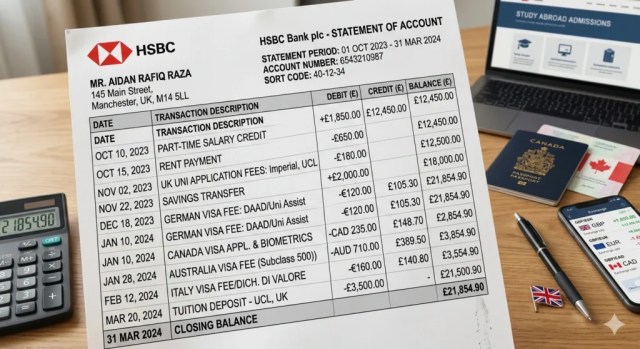
The requirements vary depending on the destination, visa category and individual circumstances. However, financial documents are commonly used to help immigration authorities determine whether an applicant has sufficient and accessible funds for the purpose and duration of their intended stay.
For a short-term visitor visa, an officer may want to establish whether the applicant can afford accommodation, meals, local transport, activities and the cost of returning home. The financial assessment may also consider expenses for family members travelling with the applicant. Under the UK’s visitor immigration rules, for example, applicants must demonstrate that they can cover the reasonable costs of their visit, including their return or onward journey, without working or accessing public funds.
The first thing an officer may examine is the account balance in relation to the proposed trip. An applicant planning a five-day holiday with modest accommodation expenses will have different financial requirements from someone intending to spend three weeks travelling across several cities. The amount available should make sense when compared with the expected cost of the journey.
There is no single bank balance that guarantees a visa approval across all countries. Some destinations publish minimum financial requirements for particular visa categories or nationalities, while others assess an applicant’s overall financial circumstances. For example, Sweden currently requires visitors to demonstrate access to SEK 700 for each day of their stay, although exceptions and adjustments may apply in certain circumstances. Other Schengen countries have their own applicable financial reference amounts and assessment procedures.
An applicant should therefore avoid relying on a figure circulated on social media or advice given to someone applying for a different country. A financial requirement that applies to one visa application may not apply to another.
The movement of money through an account can also attract attention. Regular salary payments, business income, pension payments or other identifiable sources of earnings can help establish how an applicant supports themselves. When these transactions correspond with the employment, occupation or income information provided in the application, they can make the financial picture easier to understand.
For someone employed full-time, an officer may compare salary deposits with an employment letter, payslips or other supporting documents. A self-employed applicant may need to provide additional evidence, such as business registration documents, invoices or records of business income. This is particularly relevant for people whose earnings do not arrive in the same amount or on the same date every month.
A bank statement showing a healthy balance but no clear explanation of how the money was obtained may raise questions. This does not mean that every applicant must have a perfectly predictable income pattern. Freelancers, entrepreneurs, seasonal workers and people working on contracts often have fluctuating earnings. The important issue is whether their financial circumstances can be explained and supported with appropriate evidence.
CHECK THIS | How to Apply for a Tourist Visa When You Are Self-Employed: Documents, Financial Evidence and What to Expect
Large deposits made shortly before a visa application deserve particular attention. An account that normally holds a relatively small amount but suddenly receives a substantial transfer may require further explanation. An officer may want to establish whether the money represents genuine earnings, savings transferred from another account, proceeds from a legitimate transaction, a gift or financial assistance from another person.
A large deposit is not automatically evidence of wrongdoing, and there is no universal rule that prohibits applicants from receiving money shortly before applying. However, unexplained transactions can make it difficult to establish whether the funds genuinely belong to the applicant or are available for the intended journey.
If the money comes from selling property, receiving a family gift, withdrawing savings from another account or receiving financial support, supporting documents can help explain the transaction. The applicant should be able to describe the source of the funds accurately rather than leave an officer to guess.
The history of an account can also provide useful context. Some visa authorities request statements covering a particular period, allowing them to examine income, expenditure and changes in the account balance over time. For example, France-Visas identifies personal bank statements covering the previous three months among the documents that may be used to demonstrate financial resources for a Schengen visa. Applicants should nevertheless follow the specific document requirements of the embassy or consulate handling their application.
Regular financial activity may help demonstrate that an account is actively used. Salary payments, ordinary household expenses, rent, utility payments and other transactions can provide a broader picture of an applicant’s financial situation. An account that contains savings but shows little activity is not necessarily a problem, particularly if it is a dedicated savings account. Its purpose and the origin of the money should simply be clear.
Visa officers may also consider whether an applicant’s declared income is consistent with their spending and remaining savings. Someone who reports earning a modest monthly salary but claims to have accumulated an unusually large amount in a short period may need to explain how that was possible. Similarly, an applicant with substantial monthly financial commitments may have less disposable income available for travel than their account balance initially suggests.
Existing debts, loan repayments and other financial obligations can therefore form part of the wider picture. A person might have considerable money in an account but also face significant regular commitments. The relevant question is not simply how much money is present, but how much is realistically available to finance the proposed journey.
Another important consideration is whether the funds are accessible. Money held in a bank account, a fixed deposit, an investment or another financial product may not always be immediately available for everyday expenses. If an applicant relies on savings that cannot easily be withdrawn, they may need to explain how those funds will cover the costs of the trip.
The name on the bank statement matters too. Financial documents should make it clear whose account is being presented and whether the applicant has access to the money. Using another person’s statement without explaining the relationship or financial arrangement can create confusion.
This becomes particularly relevant when a parent, spouse, relative, friend or other person agrees to finance a trip. Some visa systems allow third-party financial support, but the applicant may need to demonstrate the relationship, the sponsor’s ability to provide the promised assistance and the arrangements for covering the expenses.
The UK’s visitor guidance, for instance, allows another person to provide financial support where there is a genuine personal or professional relationship and the sponsor can and will provide the promised assistance. In the United States, applicants for visitor visas may also present evidence that another person will cover some or all of their travel costs if they cannot pay for the trip themselves.
However, financial sponsorship does not automatically resolve every concern about an application. Depending on the destination and visa category, officers may also examine the applicant’s own circumstances, the purpose of travel and whether the applicant meets the relevant immigration requirements.
For a US visitor visa, the ability to pay for a trip is only one consideration. The US Department of State explains that applicants may be asked to demonstrate their travel purpose, intention to leave after their temporary visit and ability to cover the associated costs. Employment and family connections abroad can also help establish an applicant’s circumstances. This illustrates why a bank statement should not be treated as the only document determining the outcome of a visa application.
The relationship between the proposed journey and the applicant’s financial circumstances is equally important. An expensive holiday, a lengthy stay or a trip involving several destinations may require more financial resources than a short visit with accommodation already arranged. If another person is paying for accommodation or transport, that arrangement should be reflected accurately in the supporting documents.
Applicants should also pay attention to consistency. The income stated on the application form should correspond with the supporting financial documents. Employment details, salary information, business earnings and declared sources of support should tell the same financial story. Differences do not necessarily mean an application will be refused, but unexplained inconsistencies can make the evidence less convincing.
Submitting statements from several accounts is not automatically a problem. Some applicants keep their salary in one account, savings in another and money for everyday spending in a third. Providing relevant statements from these accounts can help demonstrate the complete financial position. However, the applicant should explain how the accounts relate to one another and avoid presenting a collection of documents that creates more questions than answers.
There is also a difference between having money and being able to demonstrate that the money is genuinely available. A screenshot showing an account balance may not provide the same level of information as an official bank statement. Depending on the embassy’s requirements, applicants may be expected to submit statements issued by their financial institution, showing the account holder’s details, transaction history and available balance.
Some applicants consider borrowing money temporarily to increase their account balance before submitting a visa application. Others transfer funds between accounts without providing an explanation, hoping that a higher closing balance will make their application appear stronger. These approaches can create problems if the transactions cannot be properly explained. A temporary deposit does not necessarily demonstrate that an applicant has the financial means to sustain a trip.
There is no need to make an ordinary bank account appear unusually wealthy. An applicant with a modest but consistent income, genuine savings and a realistic travel budget may be in a stronger position to explain their finances than someone presenting a large unexplained deposit. What matters is whether the evidence supports the application and satisfies the requirements of the particular visa category.
It is also important to remember that bank statements are not assessed in isolation. Immigration authorities consider the supporting documents and the applicant’s overall circumstances. Depending on the application, this may include employment records, proof of business activity, accommodation arrangements, travel plans, sponsorship documents and evidence of residence.
For some applicants, the biggest challenge is not the amount of money in their account but the difficulty of documenting irregular earnings. Freelancers, small business owners, commission-based workers and people paid in cash may need to provide additional records to establish their income. Business invoices, tax documents, contracts and other legitimate financial records can help explain how they earn their living.
Applicants should resist the temptation to submit altered statements, invented employment information or documents that misrepresent their financial position. False or misleading information can have serious immigration consequences, including refusal and possible restrictions on future applications, depending on the country’s laws and the circumstances.
Before submitting an application, it is sensible to review the bank statements alongside the visa form and other supporting documents. Check that the account holder’s details are correct, that the requested statement period is covered, that significant transactions can be explained and that the proposed travel budget is realistic. If the embassy requests certified or translated documents, those requirements should also be followed.
Ultimately, visa officers are not simply looking for applicants with the biggest bank balances. They need to assess whether the financial evidence is credible, whether the funds are available and whether the applicant’s declared circumstances support the purpose and duration of the proposed stay. A well-documented financial position can help make that assessment clearer, while a large balance without a convincing explanation may leave important questions unanswered.


