Arab airlines are forecast to record a combined net loss of $4.3 billion (€3.82 billion) in 2026, as rising fuel costs, geopolitical instability and operational disruptions put pressure on carriers across the Middle East and North Africa.
The projection comes from the Arab Air Carriers’ Organization (AACO), which presented its findings during its three-day annual general meeting in Doha, Qatar. The organization represents 39 Arab airlines, including major international carriers such as Qatar Airways, Emirates, Etihad Airways and Gulf Air.

The report points to a difficult financial year for the region’s aviation industry. Geopolitical uncertainty and changing economic conditions are affecting airline operations, with the impact expected to differ between carriers depending on the location of their main hubs and their exposure to markets affected by conflict.
AACO also forecasts a 5.2% decline in air cargo traffic among its member airlines in 2026. The figures reflect wider difficulties facing the global aviation industry, where net profit is expected to fall to approximately $23 billion (€20.5 billion). According to the report, this would be the industry’s lowest profit level in 12 years, excluding the COVID-19 pandemic and its aftermath.
Despite the expected losses among Arab carriers, the wider airline industry is still projected to remain profitable in 2026. However, higher energy prices and continuing operational disruptions are expected to reduce profit margins.
Fuel costs are a particular concern. The report estimates that fuel will account for 31.4% of total operating costs across the global airline industry in 2026. For AACO member airlines, the figure is expected to reach 37.3%, compared with 27.9% in 2025. This increase leaves regional carriers with less room to absorb other operating expenses while maintaining competitive fares and flight schedules.
Alongside financial concerns, the Doha meeting brought renewed attention to the European Union’s proposed changes to its Emissions Trading System (ETS), which could affect airlines operating flights between Europe and destinations outside the bloc.
AACO has raised objections to the proposed expansion, arguing that it could impose additional costs on Arab airlines and raise questions about national control over airspace. The organization is particularly concerned about plans to extend the system to flights departing from the European Economic Area (EEA) and arriving in third countries within a 5,000-kilometre radius of Frankfurt Airport by 2029.
Abdul Wahab Teffaha, AACO’s Secretary General, told Euronews Travel that the proposal raises concerns about sovereignty and the authority of individual countries over their airspace.
He acknowledged that the EU has the right to set its own environmental targets, even when they go beyond those agreed through the International Civil Aviation Organization (ICAO). However, he questioned whether the bloc should apply its regulations to flights that operate beyond European territory.
Teffaha argued that extending the ETS in this way would amount to interference in the sovereignty of other countries and could conflict with principles established under the Convention on International Civil Aviation, commonly known as the Chicago Convention.
Article 1 of the convention recognizes that every state has complete and exclusive sovereignty over the airspace above its territory. The proposed 5,000-kilometre coverage area would affect a wide geographical range, extending from Turkey and Iraq to the Gulf, North Africa and Morocco.
AACO has also warned about the possibility of airlines facing overlapping carbon charges. International aviation already operates under the Carbon Offsetting and Reduction Scheme for International Aviation (CORSIA), the global framework established through ICAO to address emissions growth from international flights.
According to Teffaha, if the EU’s ETS and CORSIA do not recognize or coordinate their respective requirements, Arab airlines could face additional financial obligations for emissions associated with the same flights. This could increase operating costs for carriers already dealing with higher fuel prices and regional instability.
During the AGM, AACO members adopted a Resolution on Aviation and the Environment opposing the proposed extension of the EU ETS to flights from the EEA to third countries within the specified distance of Frankfurt Airport. The resolution reflects the organization’s position on the potential financial and regulatory consequences for airlines outside Europe.
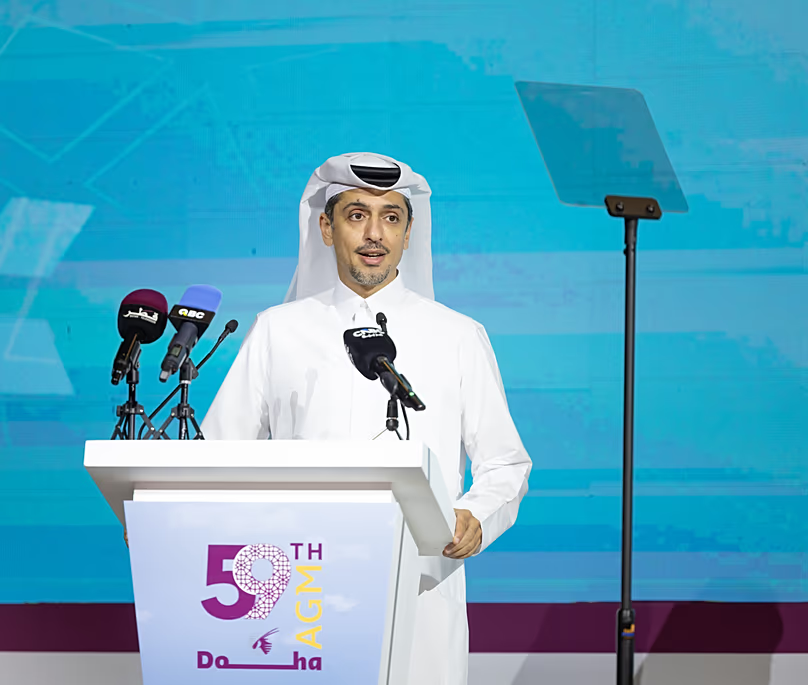
The meeting itself brought together more than 200 aviation executives and industry representatives. Hosted by Qatar Airways, the three-day gathering was chaired by Hamad Al-Khater, Qatar Airways Group Chief Executive Officer, and included representatives from member airlines, partner carriers and aviation technology companies such as Amadeus and SITA.
Al-Khater said cooperation between Arab airlines had become increasingly important as geopolitical developments continued to affect international air connections.
He also highlighted the aviation industry’s contribution to the Middle Eastern economy. According to figures presented during the meeting, the sector supports up to four million jobs across the region and contributes approximately $290 billion (€258 billion) to its economy. That contribution is projected to increase to $730 billion (€649.9 billion) by 2043.
Technology and baggage handling were also part of the discussions. During the meeting, AACO and SITA signed a memorandum of understanding that will make SITA’s WorldTracer Bag Mate service available to AACO member airlines. The system is designed to help airlines manage and trace mishandled baggage, an issue that remains an important part of passenger service and airline operations.
Despite the financial and regulatory challenges, European routes remain an important part of the commercial plans of major Arab airlines. Qatar Airways, in particular, continues to view Europe as a significant market for passenger traffic and connections through its Doha hub.
Sheikh Jassim Fahad Al-Thani, Qatar Airways’ Vice President of Aeropolitical and Corporate Affairs, told Euronews Travel that the airline was increasing services to European destinations, including London Heathrow and Frankfurt. The additional flights are intended to give passengers more travel options and improve connections through Doha to destinations across the airline’s international network.
He also pointed to increased services to destinations in Asia, Africa and Australia as part of the carrier’s wider expansion plans.
Emirates is pursuing a similar strategy in Europe. In October 2026, the Dubai-based airline launched its first flights to Helsinki, introducing a daily connection between the Finnish capital and Dubai. The route expands Emirates’ Nordic presence, which already includes Copenhagen, Oslo and Stockholm.
Adnan Kazim, Emirates’ Deputy President and Chief Commercial Officer, told Euronews that Europe remained central to the airline’s long-term strategy. He said the company intended to continue expanding into new markets while strengthening cooperation with European airlines.
Kazim also said that regional uncertainty and changing fuel prices had not altered Emirates’ investment plans. The airline is continuing its fleet refurbishment programme, supported by investments valued at $7 billion (€6.2 billion).
However, the expansion of international routes is taking place against a difficult security environment. Conflict and instability across parts of the Middle East have made operational planning more complicated, requiring airlines to pay closer attention to security assessments and developments that could affect flight routes.
Hany Bakr, Senior Vice President of Aviation and Maritime Security at MedAire, told Euronews that the region had experienced a highly volatile period, with direct security threats affecting the aviation industry. MedAire works with more than 250 airlines and cargo operators, providing health and security risk management services to support operational decisions.
Bakr said the organization was supplying airlines with intelligence to help them assess potential risks and make informed decisions about their operations.
For passengers, he advised remaining aware of developments while recognizing the security procedures and risk management systems used by airlines. He also noted that many regional events were outside the direct control of carriers, which had been working to strengthen their ability to maintain safe operations during periods of disruption.
The figures presented in Doha underline the difficult position facing Arab aviation in 2026. Airlines are attempting to protect profitability, maintain international connections and invest in expansion while dealing with higher fuel expenses, security concerns and potential changes to international environmental regulations.