Azerbaijan secured nearly $11 billion in investment agreements at this year’s Azerbaijan International Investment Forum, as the country sought to strengthen its position as a destination for international capital and expand its economy beyond its traditional dependence on oil and gas.
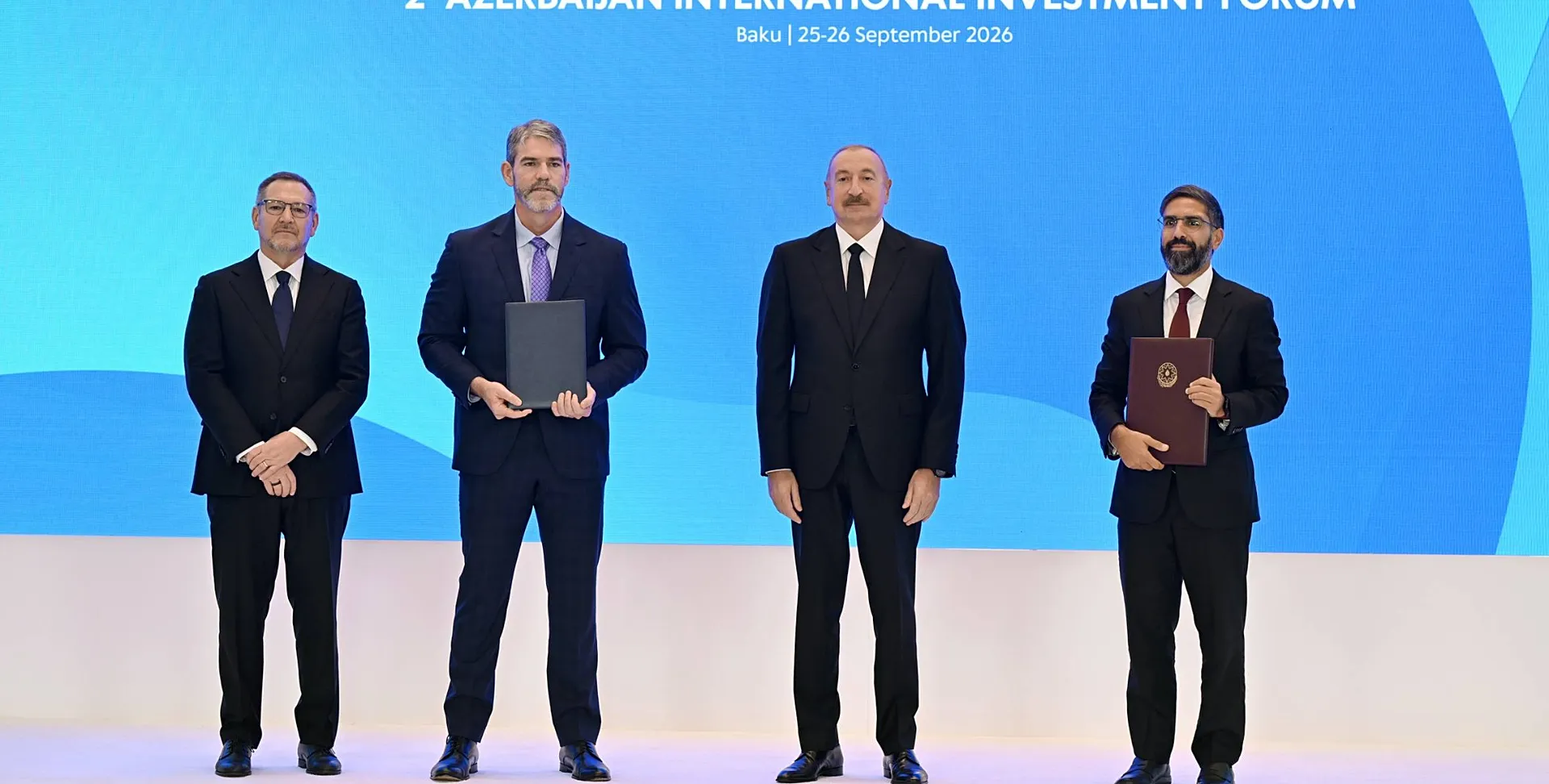
Mikayil Jabbarov, Azerbaijan’s Minister of Economy, told Euronews that 26 contracts worth a combined $10.8 billion had been agreed during the two-day forum in Baku. The deals cover a wide range of sectors, including artificial intelligence, energy, manufacturing and production, reflecting the government’s effort to broaden the country’s economic base.
Jabbarov said the agreements could create opportunities for investment both inside Azerbaijan and through partnerships involving Azerbaijani companies operating in foreign markets.
“We tend to look at opportunities not only within our geographical borders but also through partnerships,” he said, pointing to growing economic links with countries including the United States and Italy.
The latest figure builds on the momentum of the first Azerbaijan International Investment Forum in 2025, when more than $10 billion in investment agreements were signed. More than $7 billion of that amount was linked to the non-oil sector.
This year’s forum brought together some of the world’s largest investment managers. Companies represented at the Azerbaijan International Investment Forum and the parallel Azerbaijan Infrastructure Investment Dialogue collectively managed about $30 trillion in assets, according to information presented at the event. Among the major names attending were BlackRock, Global Infrastructure Partners and Brookfield Asset Management.
For Azerbaijan, the interest from global investment firms comes at a significant point in its economic development. Oil and gas have long been central to the country’s growth, and attracting capital into other industries has become an increasingly important part of its economic strategy.
President Ilham Aliyev told the forum that the non-oil sector accounted for 72% of Azerbaijan’s GDP in 2025. He also said real non-oil GDP had grown by an average of 5% a year since 2020.
The sectors being promoted include manufacturing, transport and logistics, renewable energy, digital technology, agriculture, tourism and infrastructure. Yet energy remains an important part of the investment picture.
Aliyev pointed to contracts signed in the oil and gas sector three decades ago as evidence of Azerbaijan’s approach to maintaining long-term agreements with investors. He argued that the stability of those contracts had helped establish the country as a reliable business partner.
The infrastructure discussion at this year’s forum showed how Azerbaijan is trying to widen that proposition. The Azerbaijan Infrastructure Investment Dialogue was held behind closed doors and hosted by Azerbaijan’s sovereign wealth fund, SOFAZ, together with BlackRock.
BlackRock reported managing $15.3 trillion in assets in July, while Global Infrastructure Partners, which has operated within BlackRock since 2024, manages about $170 billion. Brookfield Asset Management, another major investor represented at the forum, manages more than $1 trillion.
The scale of those firms gives some indication of the level of international capital Azerbaijan is seeking to attract. But the country’s own investment flows also show a more complicated picture.
According to the Central Bank of Azerbaijan, foreign direct investment into the country exceeded $3 billion during the first six months of 2026, an increase of 13.8% compared with the same period a year earlier. The main sources included the United Kingdom, Türkiye, Cyprus, Russia and Iran.
At the same time, Azerbaijan exported more than $5 billion in capital during the period, with Italy, Türkiye, the United Kingdom, the United Arab Emirates and Georgia among the principal destinations.
The government is therefore trying to position Azerbaijan not only as a recipient of international investment but also as a country whose companies and capital are increasingly active abroad.
The effort to raise Azerbaijan’s international investment profile is also being supported by private companies and major development projects.
Orkhan Mustafayev, founder and chairman of the board of Sabah Investment Group, said international marketing and overseas engagement were beginning to change the profile of investment in the country. He pointed to the growing share of international buyers in developments such as Sea Breeze.
According to Mustafayev, overseas buyers now account for about 30% of sales in a portfolio that was previously around 95% domestic.
He attributed part of the change to cooperation between the private sector and government, as well as international roadshows and presentations aimed at potential investors.
Sea Breeze, a major development on the Caspian coast, has become one of the most visible examples of Azerbaijan’s attempt to combine property, tourism, hospitality and urban development into a broader investment proposition.
Its founder, Emin Agalarov, a prominent Azerbaijani businessman and singer, said international collaboration had been central to the project’s development. He said around 20 companies from Israel and other countries were working on projects within its master plan.
For Agalarov, the involvement of multiple international companies brings expertise and allows projects to move faster.
Tourism is another area where Azerbaijan sees room for growth. The government is promoting investment in hospitality and tourism alongside broader infrastructure and urban development, while the Azerbaijan Tourism Board is working to increase demand and expand the country’s tourism offering.
Florian Sengstschmid, chief executive of the Azerbaijan Tourism Board, said a new state programme on tourism development was designed to address both sides of the market by stimulating demand while supporting the supply of tourism services.
He also pointed to Baku’s growing role as an international meeting destination, arguing that its position could create further opportunities for the tourism industry.
The wider investment strategy reflects Azerbaijan’s geographical position. Baku is presenting the country as more than an energy producer, instead promoting it as a link between Central Asia, the South Caucasus, Türkiye and European markets.
Transport corridors, ports, rail infrastructure, renewable energy, data infrastructure, tourism and industrial production are increasingly being presented as parts of the same economic proposition.
Jad Ellawn, managing partner and regional head of the Middle East at Brookfield Asset Management, said the quality of governance and the relationships his company had developed with Azerbaijani institutions had helped attract international interest.
Neuberger Berman chief executive George Walker also described Azerbaijan as a country undergoing continued economic and international development, while pointing to its growing importance as a partner.
The statements from investors and business leaders at the forum underline the scale of Azerbaijan’s pitch. But announced agreements are not the same as completed investments, and the next test will be whether the projects discussed in Baku translate into capital deployed, infrastructure built and businesses operating.
For Azerbaijan, that distinction matters. The country has already demonstrated its ability to attract investment into its energy sector. Its longer-term ambition is to persuade international investors that the same country can offer opportunities across technology, infrastructure, manufacturing, tourism, transport and other parts of the economy.
The nearly $11 billion in agreements announced at the forum gives that strategy considerable momentum. Turning those commitments into completed projects will determine how much of the investment story presented in Baku becomes a lasting part of Azerbaijan’s economic transformation.