Finland’s economy is expected to grow faster over the next three years, but the stronger recovery will not be enough to repair the country’s strained public finances, according to a new forecast from the Ministry of Finance.
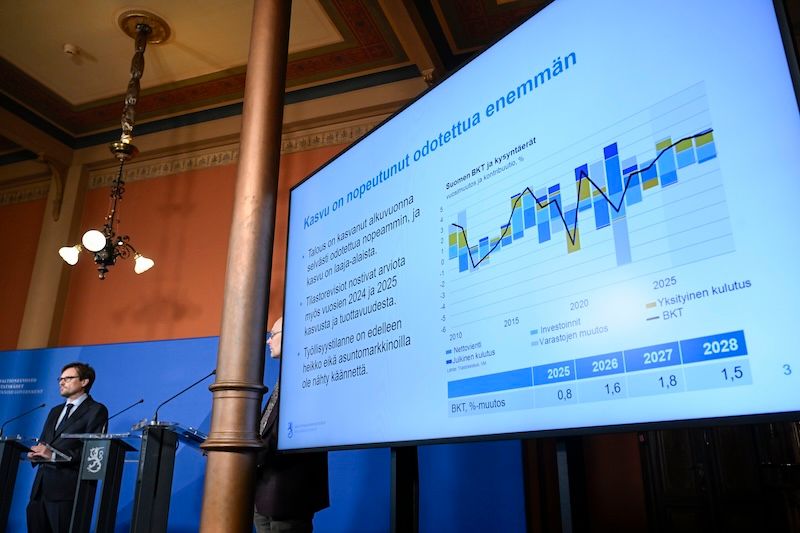
The ministry projects gross domestic product to expand by 1.6 per cent in 2026, followed by growth of 1.8 per cent in 2027 and 1.5 per cent in 2028. Revised national statistics also suggest that the recovery started earlier than previously thought, with economic output increasing through much of 2024 and 2025.
The improvement is becoming broader. Companies and households are reporting more positive expectations, while stronger activity is beginning to spread across different parts of the economy.
“The brake that prevented demand and output growing last year has lost some of its effect,” Mikko Spolander, Director General of the Ministry of Finance, said in the ministry’s statement.
But the better growth outlook comes with a difficult contradiction. Finland’s public finances are expected to remain deeply in deficit even as the economy expands.
The general government deficit is forecast to reach 4.2 per cent of GDP in 2026, with increased defence equipment purchases contributing to the deterioration. The deficit is then expected to widen to 4.5 per cent of GDP in 2027, partly because of a growing gap between revenues and spending in local government.
By 2030, the deficit is still projected to stand at 4.4 per cent of GDP.
Public debt is expected to reach around 90 per cent of GDP this year and continue rising, approaching 98 per cent by 2030. The figures underline the scale of the challenge facing Finland even as economic activity begins to recover.
“The upturn in general government finances is expected to remain weak because the economic recovery will be insufficient to correct the structural imbalance,” Spolander said.
The labour market is likely to take longer to respond to the improving economy. Employment continued to decline during the first half of 2026, and unemployment is forecast to reach 10.3 per cent this year before gradually falling below 10 per cent. The employment rate for people aged 20 to 64 is expected to stand at 75.5 per cent.
The ministry expects stronger economic output to begin supporting employment towards the end of 2026. Much of the improvement in the GDP forecast, however, is being driven by higher productivity rather than an increase in the amount of labour being used.
That distinction matters for the pace of the recovery. An economy can produce more without creating jobs at the same rate if productivity improves. For Finnish households, the benefits of stronger output may therefore take time to become visible in employment and incomes.
Exports are also beginning to benefit from improving international demand. Imports, meanwhile, are expected to increase more rapidly, partly because of deliveries of F-35 fighter aircraft and purchases of equipment for data centre projects.
Investment is being supported by data centres, defence spending and energy projects, helping construction activity recover in several areas. Housing construction remains a weak point. Residential building is not expected to begin a meaningful recovery until 2027.
The forecast also does not yet include one of the largest investment announcements made in Finland in recent years. The Ministry of Finance completed its projections before Google announced plans to invest at least 13 billion euros in the country. The projects are expected to lift investment in 2027 and 2028, although Spolander has warned that the demand for workers created by the projects could also compete with other investments for available labour.
Energy prices present another complication. Oil prices have risen above the level assumed in the ministry’s forecast, a development expected to weigh on Finnish economic growth in both 2026 and 2027.
Inflation has also picked up as energy prices have increased, although the ministry expects consumer prices to rise by roughly 2 per cent a year during the forecast period. Higher wages and a gradual improvement in employment are expected to strengthen household purchasing power next year.
There is some room for consumption to recover more strongly. Finnish households have accumulated savings, potentially giving them greater capacity to increase spending if confidence improves. At the same time, weaker global growth remains a risk for an economy that depends heavily on international trade.
The ministry says the impact of US trade policy and the crisis in the Middle East has so far been less severe than previously feared. That could provide some support for the recovery, but external conditions remain difficult to predict.
Finland’s public finances face a separate set of pressures. Higher defence spending and rising interest costs are adding to expenditure, while tax cuts are reducing government revenue. Economic growth and a one-off transfer from the State Pension Fund are expected to slow the increase in the debt ratio through 2027.
That relief is unlikely to last. From 2028, the debt ratio is expected to begin rising more quickly again.
The latest forecast therefore presents two different stories about Finland at the same time. The economy is moving out of a prolonged period of weakness, with growth expected to strengthen and investment gradually pick up. Yet the improvement is not expected to be strong enough to resolve the structural problems in public finances.
For Finland, the central challenge will be turning the emerging economic recovery into sustained growth in employment, investment and productivity while containing a debt burden that is still moving higher.