Steven Bartlett argues that businesses do not necessarily need a single brilliant strategy, breakthrough product or flawless plan to achieve lasting success. At Nordic Business Forum 2026 in Helsinki, the entrepreneur, investor and host of The Diary of a CEO made a different case: companies can build lasting advantages by thinking further ahead, experimenting constantly and treating failure as information rather than something to hide.

Speaking in a moderated session, Bartlett drew on his experience building and scaling businesses to explain how leaders can operate in an environment where technology, customer expectations and markets are constantly changing. His central argument was straightforward. Businesses that spend too much time trying to predict the future can become slower at responding to it. The alternative is to create organisations that learn quickly and make steady improvements over time.
For Bartlett, one of the biggest changes a leader can make is to extend the time horizon.
He illustrated the point with a simple example. If someone were given an unlimited supply of bricks and only one minute to build the tallest possible tower, the obvious response would be to stack the bricks as quickly as possible. The result might be tall, but it would also be unstable. Give that same person a year, however, and the approach would probably be different. Time would allow for foundations to be built before the structure rose.
“The only thing I changed was the time horizon. And in doing so, what changed is your behavior today,” Bartlett said.
The idea has practical consequences for businesses accustomed to quarterly targets and short-term performance measures. Bartlett suggested that leaders should think in terms of what he calls “incompletable goals”, ambitions that cannot simply be ticked off and declared finished. A revenue target, for example, can be reached and then replaced by another target. A long-term commitment to building something valuable creates a different set of daily decisions.
He pointed to The Diary of a CEO as an example. By treating the podcast as a 50-year commitment rather than a project built around immediate results, Bartlett said he became less interested in chasing celebrity guests simply because they were famous. Instead, the focus shifted towards conversations that he believed would remain meaningful to him and his audience over a much longer period.
That same long-term perspective changes how companies should think about failure.
In many organisations, failure carries a cost beyond the financial loss of an unsuccessful project. Employees may worry about how a failed idea will affect their reputation, promotion prospects or standing with management. That can create an environment in which people choose predictable ideas over potentially valuable experiments.
Bartlett argued that this approach can leave companies making decisions based on assumptions rather than evidence.
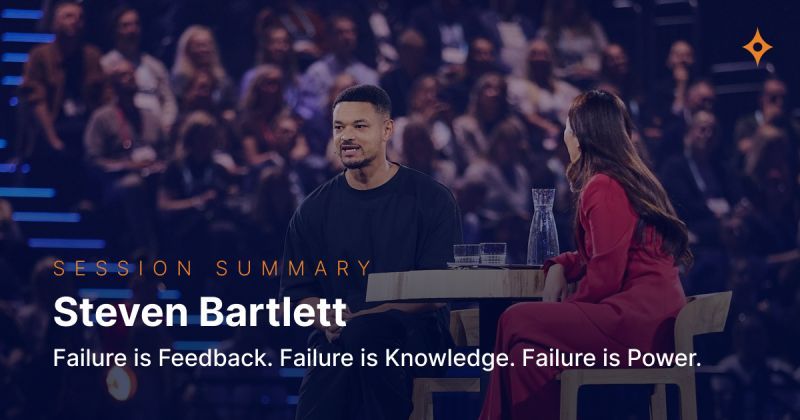
“Failure was my feedback. Feedback is knowledge. And knowledge is power. So really, failure is your power,” he said.
The principle is not that every failed experiment is automatically useful. The value comes from learning what the failure reveals and applying that information to the next decision. Companies that run repeated experiments can gradually replace speculation with evidence gathered from their own customers and markets.
Bartlett cited Amazon and Booking.com as examples of businesses that have used experimentation as part of their approach. Amazon has had products and ventures that failed, including the Fire Phone, while other bets became important parts of the company’s business. The broader lesson, in Bartlett’s framing, is that successful companies can afford some failed experiments when they create enough opportunities to discover something that works.
Booking.com’s approach similarly places significant emphasis on testing ideas against actual customer behaviour rather than relying entirely on internal debate. For companies operating in fast-changing markets, that distinction can be important. Information that was useful yesterday can lose its value quickly, while direct testing can reveal what customers are actually responding to now.
Bartlett also challenged the tendency to associate innovation only with major breakthroughs. Some competitive advantages, he argued, come from hundreds of small decisions that competitors overlook because they appear too minor to matter.
The Diary of a CEO provides an example of this philosophy. Bartlett described the detailed preparation behind the podcast, including attention to the studio environment and the personal preferences of guests. Even seemingly small details, such as understanding the music a guest listened to when they were younger, can be used to create a more comfortable environment for a conversation.
The point is not that any single detail transforms a business. It is that small improvements accumulate.
Bartlett connected this idea to what he described as the psychological effect of progress. Referencing cycling coach Sir David Brailsford and research discussed by Harvard Business Review, he argued that people are often motivated less by distant, enormous objectives than by visible evidence that they are moving forward.
For teams, that can mean recognising smaller achievements rather than waiting for an annual target to be reached before progress is acknowledged. A series of modest improvements can create momentum, and momentum can influence how willing people are to continue improving.
Building that kind of organisation, however, requires more than telling employees to “innovate”. Bartlett said corporate systems often send the opposite message. Fear, bureaucracy and hesitation can prevent people from testing ideas even when leaders publicly claim to support experimentation.
One problem is the way companies structure incentives. If employees receive bonuses and promotions only when projects succeed, they have little reason to take risks where the outcome is uncertain. Bartlett’s argument is that organisations should also recognise the quality and volume of experimentation itself: the hypotheses tested, the attempts made and the lessons produced.
In his businesses, he said, teams openly share hypotheses and failed tests on Slack, with a weekly trophy given to the person who failed the most. The purpose is not to celebrate poor performance, but to remove the stigma around intelligent experimentation.
The distinction between reversible and irreversible decisions is another part of the approach. Bartlett drew on Jeff Bezos’ well-known distinction between Type 1 and Type 2 decisions. Major decisions that are difficult or impossible to reverse deserve careful consideration. Decisions that can easily be changed should not be subjected to the same level of corporate delay.
A marketing test, for example, can often be stopped or adjusted if it produces poor results. A major structural change to a company is a different matter.
“The cost isn’t being wrong. The cost, as all of you will know, is the corporate procrastination where you waste nine months getting to the yes,” Bartlett said.
For leaders, the challenge is therefore not simply deciding whether an idea might fail. It is understanding the cost of waiting to find out.
Bartlett also placed considerable importance on how leaders communicate change. Rather than presenting new initiatives as instructions based solely on a leader’s personal opinion, he argued that leaders can begin with first principles: basic facts or assumptions that the people involved already accept.
From there, explaining the reasoning behind a decision and connecting it to a human story can make change easier to understand. The objective is to help people follow the logic themselves rather than simply asking them to comply with an order.
For Bartlett, all of these issues eventually lead back to one part of the business: the people who work in it.
His own view of entrepreneurship changed as he gained experience. Earlier in his career, he said, he believed business success depended heavily on his own intelligence and effort. He now sees the quality of the people inside an organisation as a much more fundamental factor.
“Everything in your business, all of those problems I was mentioning earlier, are downstream from a human being’s brain. That is the first foundation of business. It is the brains you assemble and the culture you bind them together with,” Bartlett said.
That makes hiring more than a recruitment exercise. It becomes part of the company’s long-term strategy.
Bartlett argued that attracting exceptional people is not simply a matter of offering the largest salary. He drew on conversations with intelligence officers to emphasise the value of listening, particularly during recruitment.
Most candidates are accustomed to being interviewed through a series of questions that require short answers. Giving someone more space to talk about their background, ambitions, doubts and personal motivations can reveal much more about what drives them.
For a leader, that information can help establish whether there is genuine alignment between the individual and the organisation. Bartlett’s approach is to understand what a person is trying to achieve in their own life and whether the company’s mission can give that ambition somewhere meaningful to go.
The argument running through Bartlett’s presentation was ultimately less about finding a perfect formula for business and more about building organisations capable of learning. Long-term thinking changes the decisions made today. Experimentation reduces dependence on assumptions. Small improvements accumulate. Visible progress can strengthen momentum. And hiring determines the quality of the people who will make those decisions in the first place.
None of those ideas eliminates uncertainty. Instead, they offer a way of operating within it. For businesses facing markets that refuse to stand still, Bartlett’s message was that the ability to learn may matter more than the ability to predict.