Sweden’s parliamentary election remained unresolved late Sunday as the opposition held a projected one-seat advantage over Prime Minister Ulf Kristersson’s governing bloc, leaving the country facing potentially difficult negotiations over who will form the next government.
Preliminary projections from SVT gave the opposition 175 seats in the 349-member Riksdag, compared with 174 for the four parties on the right. The margin is the smallest possible majority, and with votes still to be added, neither side could safely claim victory.
The Social Democrats, led by Magdalena Andersson, remained Sweden’s largest party with roughly 28 per cent of the vote. Kristersson’s Moderates were polling at about 20 per cent, while the Sweden Democrats were on approximately 18 per cent.
The projected opposition grouping consists of the Social Democrats, Left Party, Centre Party and Greens. On the other side are the Moderates, Sweden Democrats, Christian Democrats and Liberals, the parties that have formed the governing side’s parliamentary base.
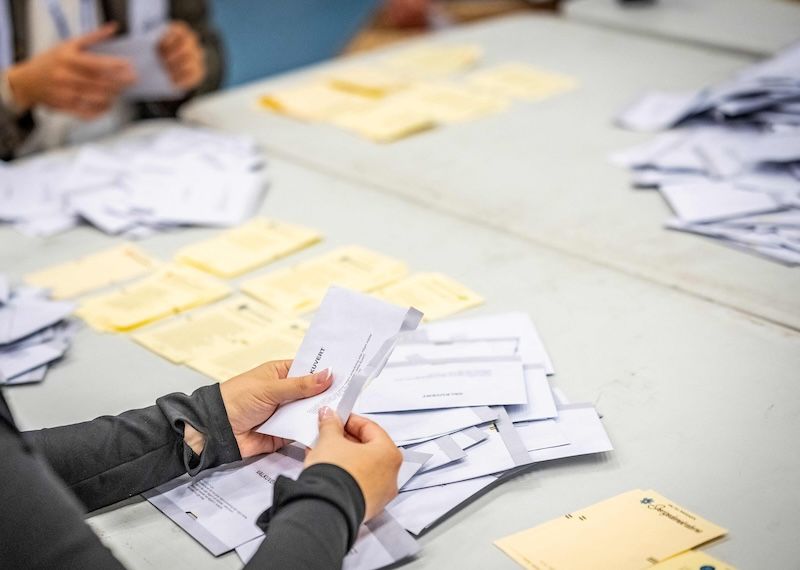
The apparent result may not be settled until Wednesday, when overseas ballots and other votes excluded from the initial election-night count are incorporated. More than 200,000 such ballots were counted after each of the previous two elections, meaning even a narrow lead on election night cannot be treated as final.
Kristersson has also resisted the idea that the race is already decided. Before the count was complete, he told Aftonbladet that the winner should only be determined once a prime minister has enough parliamentary support to govern.
That distinction matters because Sweden operates under a system of negative parliamentarism. A prime ministerial candidate does not need a majority of MPs to vote in favour. Instead, the candidate can take office as long as at least 175 MPs do not vote against them. A small shift in the final distribution of seats could therefore have consequences beyond simply deciding which bloc has more seats.
The opposition would also have to overcome differences within its own ranks if it eventually secures the numbers to form a government. The Centre Party has ruled out joining an administration that includes Left Party ministers, while the Left Party has called for representation in a government led by Andersson.
That makes the arithmetic particularly complicated. Even if the opposition finishes with 175 seats, reaching an agreement on the composition of a government could prove harder than the headline result suggests.
The right has a more established framework for cooperation through the Tidö arrangement involving the Moderates, Christian Democrats and Liberals, with parliamentary support from the Sweden Democrats during the outgoing term. The election, however, has exposed new questions about how that relationship might develop.
For the Sweden Democrats and their leader Jimmie Akesson, the result also represents a significant change. The party is heading towards its first electoral decline since Akesson became leader in 2005, with preliminary figures showing a fall of about 2.8 percentage points compared with its 2022 result.
The Sweden Democrats had entered the campaign seeking a more formal role in government after spending the previous four years supporting Kristersson’s administration from outside the cabinet. A weaker result could complicate that ambition even if the right ultimately retains enough parliamentary support to govern.
The Moderates, meanwhile, appeared set to reclaim second place nationally from the Sweden Democrats, while the Liberals looked likely to remain above Sweden’s four per cent threshold for parliamentary representation after months of uncertainty over their position.
The closeness of the final result was not reflected in the earliest election-night surveys. SVT’s Valu exit poll gave the opposition parties 51.3 per cent against 46.8 per cent for the right, while TV4’s initial figures pointed in a similar direction. As more votes were counted, however, the difference between the two blocs narrowed dramatically, eventually falling to around 20,000 votes in some projections.
The campaign itself focused heavily on issues with a direct impact on voters’ daily lives and on the country’s wider political direction. Healthcare, crime, immigration and household finances were among the dominant subjects, while the final weeks brought renewed arguments over migration policy, policing and the influence of the Sweden Democrats on a future government.
For now, the most significant number is not the vote share of any individual party but the projected 175-174 division in the Riksdag. With ballots still outstanding and political differences within both camps, Sweden’s election has produced no straightforward mandate.
The final result will determine the parliamentary numbers, but it may take political negotiations after the count to determine who can actually govern. Until those votes are counted and the parties begin testing their alliances, Sweden’s next government remains uncertain.