
Finnish MP Päivi Räsänen has taken her legal battle to the European Court of Human Rights after being convicted of ethnic agitation in Finland. The Christian Democrats lawmaker argues that the ruling violated her rights to freedom of expression and freedom of religion under the European Convention on Human Rights.
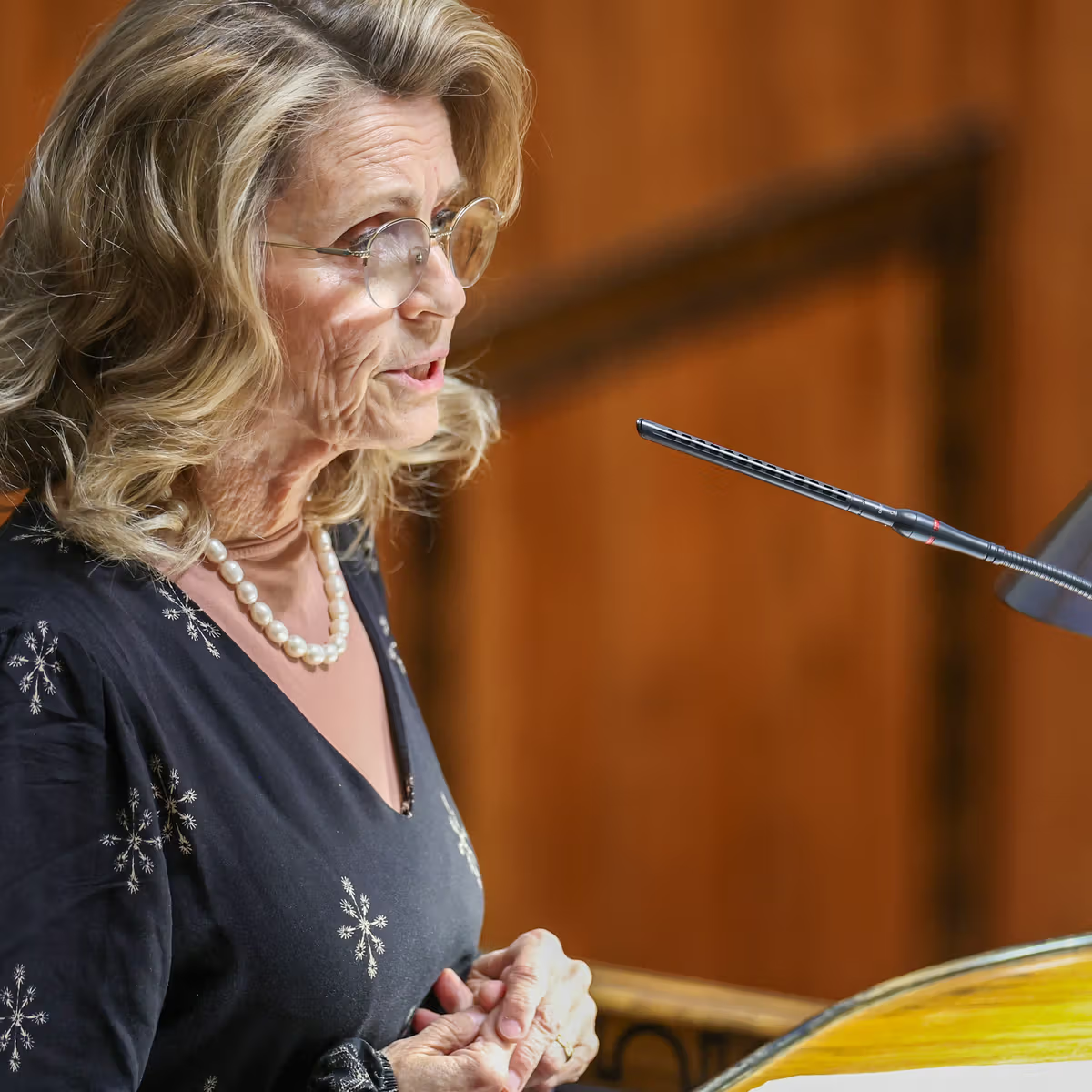
Räsänen confirmed that she has filed an application with the court in Strasbourg, asking it to review the decision made by Finland’s Supreme Court earlier this year. Her appeal marks the latest stage in a case that has drawn attention both inside Finland and internationally because it sits at the intersection of free speech, religious belief, and hate speech laws.
In March, Finland’s Supreme Court found Räsänen guilty of ethnic agitation over statements about homosexuality contained in a religious booklet that was first published in 2004 and later shared online in 2019. The court imposed a fine of EUR 1,800.
The booklet, titled Male and Female He Created Them: Homosexual Relationships Challenge the Christian View of Humanity, described homosexuality as a “psychosexual developmental disorder” and a “sexual deviation.”
According to the Supreme Court, parts of the publication insulted homosexual people as a group because of their sexual orientation. The judges ruled that the language crossed the legal threshold for ethnic agitation under Finnish law.
Räsänen strongly disagrees with the judgment. She argues that the booklet should be read in its entirety as an expression of Christian teaching rather than judged by isolated passages.
She says the European Court of Human Rights should find that Finland breached protections for freedom of speech and freedom of religion guaranteed by the European Convention on Human Rights.
“I hope that Strasbourg will conclude that the judgment issued in Finland is contrary to the freedoms of expression and religion protected by the European Convention on Human Rights and issue a judgment against Finland,” Räsänen said.
She has repeatedly maintained that expressing her Christian beliefs should remain legally protected, even when those views generate disagreement or criticism.
Räsänen also disputes the finding that her writings portrayed homosexual people as inferior. She says her book clearly states that every person has equal value.
“I have stated several times in my book that all people are equal,” she said.
She further argues that posting the booklet online in 2019 was intended to contribute to an ongoing public discussion after one of her social media posts became the subject of a police investigation.
According to Räsänen, police initially concluded there was no reason to investigate the booklet. She says the investigation only moved forward after the Prosecutor General ordered a review of the case.
The case has followed an unusual legal path through Finland’s courts.
Lower courts had previously cleared Räsänen of all charges. However, Finland’s Supreme Court later overturned those acquittals and convicted her in a decision reached by a narrow 3-2 majority.

The split decision highlights the legal complexity of balancing freedom of expression with protections against speech that courts determine to be discriminatory or harmful toward protected groups.
The European Court of Human Rights will now decide whether Finland applied its laws in a way that was consistent with the European Convention on Human Rights. Its ruling could influence how similar cases involving religious expression and hate speech are assessed across Europe.
The conviction has already had practical consequences for Räsänen beyond the courtroom.
According to Finnish newspaper Ilta-Sanomat, her appeal to the European Court of Human Rights is approximately 610 pages long, reflecting the scale and complexity of the legal arguments involved.
The conviction also affected her ability to travel to the United Kingdom. Earlier this month, British authorities denied her application for an Electronic Travel Authorisation (ETA) because of her criminal conviction.
The outcome of her appeal is likely to be closely watched by legal experts, religious organizations, free speech advocates, and human rights groups across Europe. Whatever the court ultimately decides, the judgment is expected to shape future discussions about where the legal boundaries lie between religious expression, freedom of speech, and protection from discriminatory speech.


