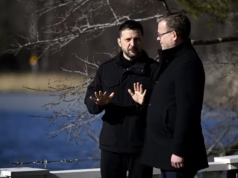
Mathieu Flamini net worth and business journey has moved back into the spotlight after the former Arsenal midfielder met King Charles III at Buckingham Palace during a bioeconomy-focused meeting with industry leaders.
The 42-year-old attended the gathering not as a former athlete, but as a business executive. Flamini is co-founder of GF Biochemicals, a firm developing alternatives to fossil-based chemicals used across global manufacturing.
Images from the meeting were shared publicly, with Flamini using the moment to highlight concerns about Europe’s position in the global industrial race.
In remarks shared after the meeting, Flamini pointed to a widening gap between major economies.
He warned that the United States is expanding production capacity while China continues to accelerate, leaving Europe at risk of falling behind. He noted that Europe’s share of the global chemicals market has dropped to around 13 percent.
His position reflects a growing concern within the sector. Cost competition alone is no longer seen as viable. Instead, the focus is shifting toward innovation and sustainability.
Flamini argued that green chemistry offers a realistic path forward, but only if supported by faster policy decisions and stronger industrial backing.
Mathieu Flamini retired from professional football in 2019, but his move into business began much earlier. He co-founded GF Biochemicals while still playing at the top level, building the company quietly over several years.
The firm produces bio-based compounds designed to replace petrochemicals in industrial processes. These materials are used across sectors such as manufacturing, packaging, and energy systems.
Unlike traditional athlete ventures, the business operates deep within supply chains rather than consumer markets.
Flamini is widely reported to have built a personal fortune estimated at around 10 billion pounds, placing him among the wealthiest former footballers globally.
His wealth is not tied to endorsements or short-term deals. It is linked to equity in a company positioned within a sector expected to grow as industries shift toward lower-emission production methods.
That distinction has drawn attention to his post-football career, particularly as climate-focused investment gains momentum.
Flamini began his professional career at Olympique de Marseille before moving to Arsenal in the early 2000s.
He made 246 appearances for Arsenal across two spells and was part of the squad that won the FA Cup in 2005. He later joined AC Milan, where he won the Serie A title during the 2010 to 2011 season.
A return to Arsenal followed in 2013, with two more FA Cup wins during his second stint. He later played for Crystal Palace and Getafe CF before retiring.
Since retiring, Flamini has taken on a more visible role in discussions around climate innovation and industrial transition.
His recent meeting with King Charles reflects growing links between business leaders and policymakers working on sustainability strategies. The conversation is no longer limited to environmental goals. It now directly affects trade, manufacturing, and economic competitiveness.
Flamini has called for clear targets, including increasing the use of bio-based materials and expanding regulatory frameworks that address carbon-intensive imports.
Flamini’s trajectory stands apart from most former players. Instead of media roles or brand partnerships, he has focused on building a company in a technically complex and capital-intensive industry.
His presence at Buckingham Palace signals how that shift is being recognised at higher levels of policy and economic discussion.
For now, his message remains direct. Europe has the tools to compete, but without speed and coordination, it risks losing ground in sectors that will define future growth.