
Paris has always rewarded the attentive visitor more than the hurried one. The city does not reveal itself through spectacle alone, nor through a checklist of monuments hastily photographed between metro stops. Its reputation rests on layers: imperial ambition, intellectual rebellion, artistic experimentation, and a civic culture that still treats public space as a stage for everyday life. The first journey to Paris, then, is not merely about seeing landmarks. It is about encountering the architecture of European history in physical form.

The Top Attractions in Paris for First-Time Visitors are often described in guidebooks as obvious choices. Yet the significance of these places extends beyond familiarity. Each location embodies a particular moment in the city’s evolution, from medieval power to modern cultural influence. Seen together, they form a map of how Paris became one of the most influential capitals in the Western world.
For the first-time visitor willing to slow down and observe closely, these sites provide more than visual appeal. They offer insight into how France understands itself.
The Eiffel Tower and the Politics of Modernity
Few structures have undergone such a dramatic shift in public perception as the Eiffel Tower. When Gustave Eiffel unveiled his iron lattice tower for the 1889 Exposition Universelle, many prominent Parisians considered it an industrial intrusion. Writers and artists complained that the structure would scar the skyline.

History, however, proved them wrong.
The Eiffel Tower now anchors the identity of the city. Rising 324 meters above the Seine, it remains one of the most visited paid monuments in the world, welcoming roughly seven million visitors annually. Its success lies partly in engineering audacity, but also in symbolism. Built to celebrate the centenary of the French Revolution, the tower marked France’s transition into the modern industrial age.
Visitors who ascend it quickly understand why the structure endured. From its platforms the city reveals its distinctive geometry: wide Haussmannian boulevards, carefully regulated building heights, and monuments aligned along historic axes of power.
The view demonstrates that Paris was not shaped randomly. It was planned with intent.
The Louvre: From Royal Fortress to Global Museum
The Louvre is often introduced as the largest art museum in the world, but that statistic alone does not capture its importance. The building itself traces the transformation of France from monarchy to republic.

Originally constructed as a fortress in the late twelfth century under King Philip II, the complex gradually expanded into a royal palace. After the French Revolution, the revolutionary government repurposed the palace as a public museum in 1793. The decision carried political meaning. Art that once belonged exclusively to kings would now belong to the nation.
Today the Louvre houses more than 35,000 works on display, ranging from ancient Mesopotamian sculpture to Renaissance painting. The Mona Lisa inevitably attracts attention, but the institution’s intellectual value lies in its breadth. Entire civilizations are represented through carefully curated galleries.
For first-time visitors, the Louvre is best understood not as a single attraction but as a historical archive in architectural form. Its courtyards, wings, and expansions mirror centuries of French political change.
Notre-Dame and the Endurance of Gothic Paris
Notre-Dame Cathedral occupies a position that is both geographic and symbolic. Built on the Ile de la Cite, the medieval island where Paris first developed, the cathedral has served as a religious and civic center since the twelfth century.
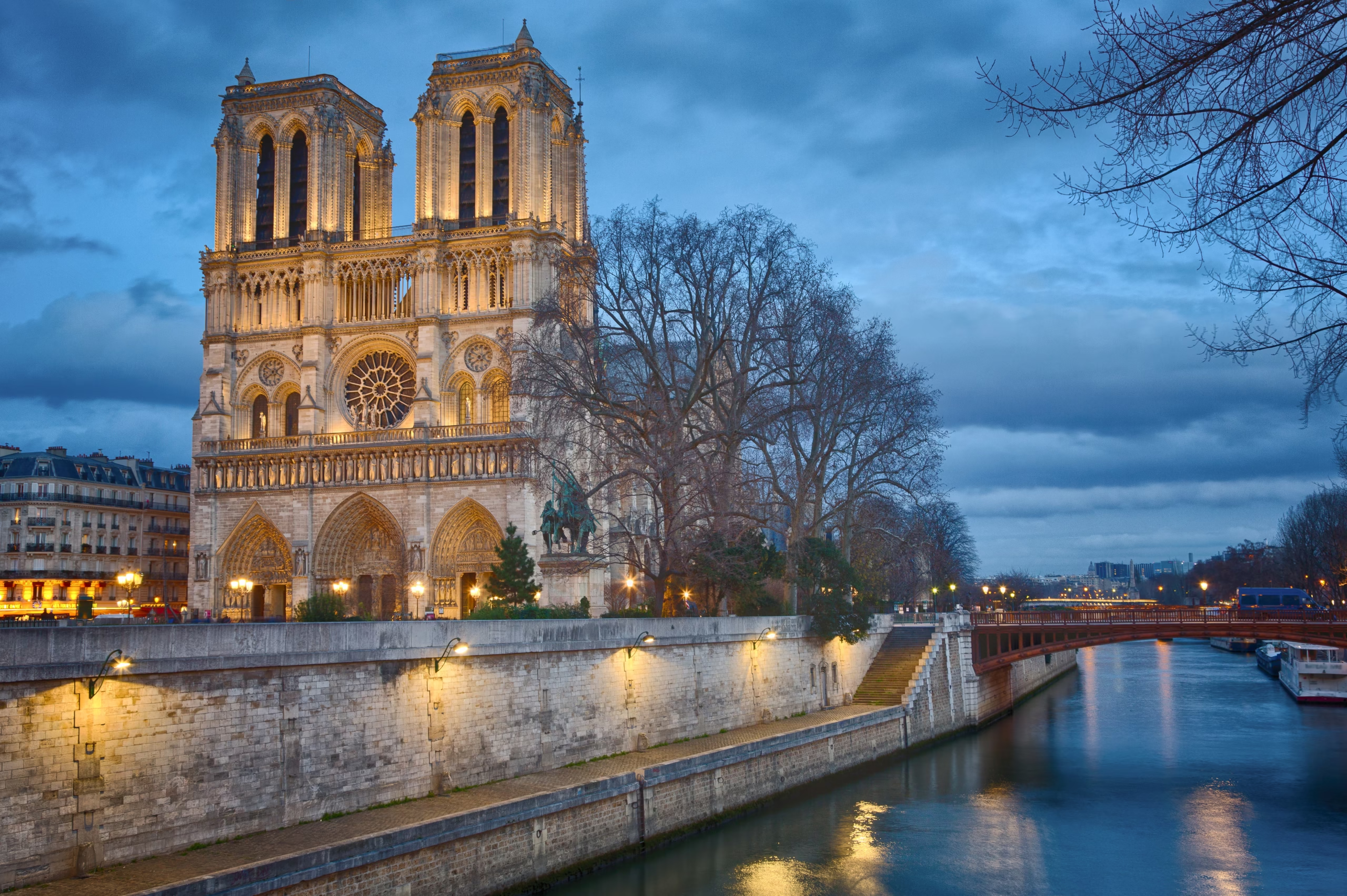
Construction began in 1163 and continued for nearly two centuries. The result is a masterpiece of Gothic engineering. Flying buttresses distribute the immense weight of stone vaults outward, allowing walls to dissolve into stained glass. Light became an architectural element.
The cathedral has survived revolution, war, and urban transformation. In April 2019, fire severely damaged the structure, collapsing the spire and destroying large portions of the roof. Yet restoration efforts quickly mobilized national and international support. The rebuilding process itself has become a demonstration of how cultural heritage is defended in the modern era.
Standing before Notre-Dame today, visitors witness not only medieval craftsmanship but also contemporary commitment to preservation.
Montmartre and the Geography of Artistic Rebellion
North of the Seine, Montmartre rises above the city on a steep hill crowned by the Basilica of Sacre-Coeur. The district’s quiet streets conceal a turbulent cultural history.
During the late nineteenth and early twentieth centuries, Montmartre became a refuge for artists priced out of central Paris. Low rents and relative independence attracted painters, writers, and performers who would eventually reshape modern art. Pablo Picasso, Amedeo Modigliani, and Henri de Toulouse-Lautrec all spent formative years here.

Cafes and cabarets once functioned as laboratories of experimentation. The famous Moulin Rouge nightclub opened in 1889 and quickly became associated with avant-garde performance and social satire.
Today Montmartre remains one of the most visited neighborhoods in Paris, yet traces of its rebellious spirit endure. Small studios, hidden staircases, and narrow streets reveal a district that once challenged cultural orthodoxy.
The Champs-Elysees and the Architecture of Power
No boulevard in Europe carries the same ceremonial weight as the Champs-Elysees. Stretching from the Place de la Concorde to the Arc de Triomphe, the avenue was designed to project grandeur.

The Arc de Triomphe itself was commissioned by Napoleon Bonaparte in 1806 following his victory at Austerlitz. Although completed decades later, the monument continues to function as a national symbol. Beneath it lies the Tomb of the Unknown Soldier, honoring those who died during the First World War.
The Champs-Elysees also hosts major national events. Military parades for Bastille Day proceed along the avenue, reinforcing its role as a public stage for French state identity.
Commercial development has transformed parts of the boulevard into a retail corridor, yet its symbolic meaning persists. Standing at the center of the avenue, one can trace the line of monuments that define Parisian urban planning.
The Seine River and the City as Landscape
Paris cannot be understood without the Seine. The river divides the city into the Right Bank and Left Bank while simultaneously connecting its most significant landmarks.
Bridges such as Pont Neuf and Pont Alexandre III serve not merely as crossings but as vantage points from which the city’s architecture can be read sequentially. Riverbanks lined with bookstalls and pedestrian promenades reinforce the idea that Paris is meant to be experienced outdoors.
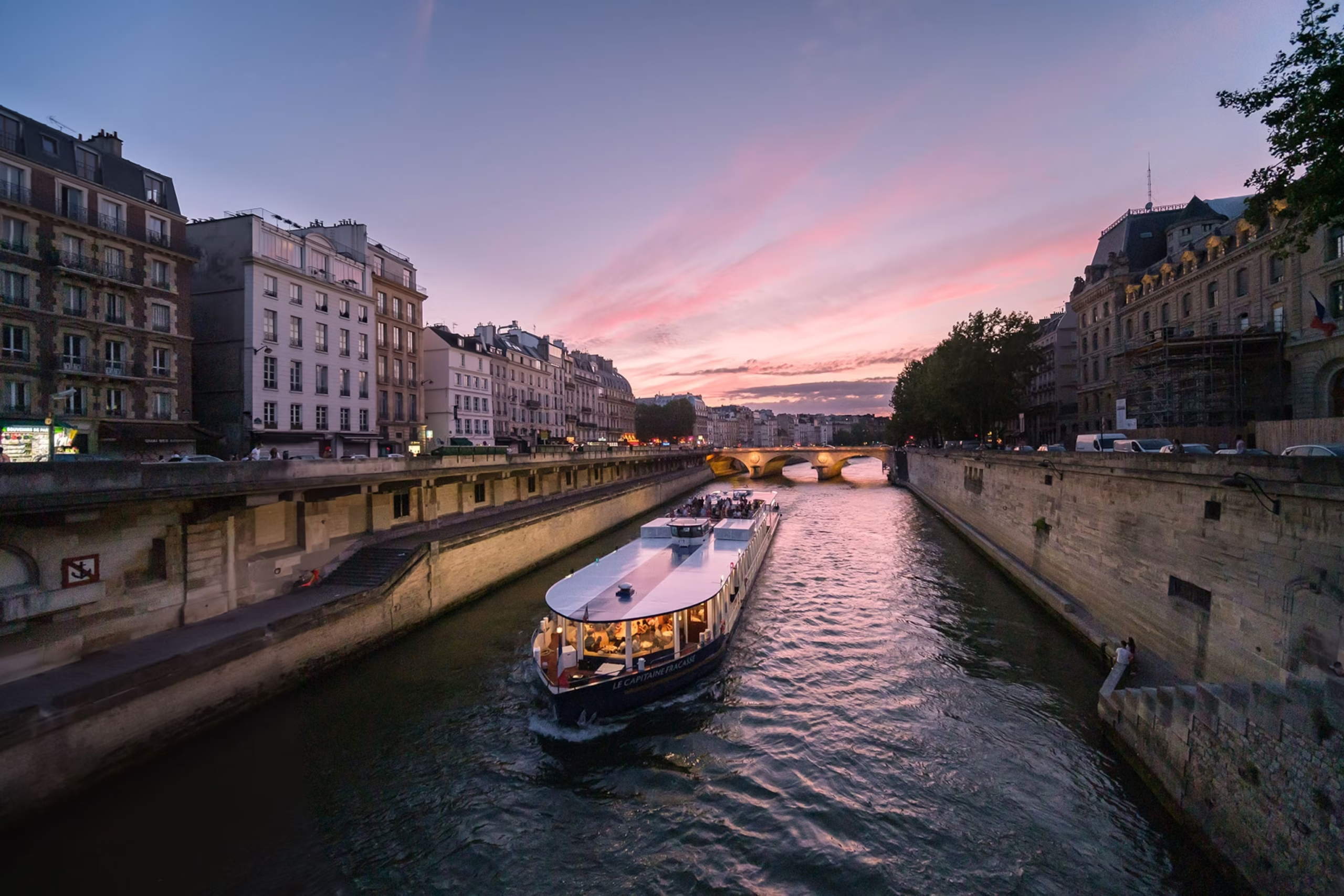
In 1991, large sections of the Seine riverbanks were designated a UNESCO World Heritage site. The designation recognized the unique concentration of historic monuments along a single waterway.
For first-time visitors, a walk along the Seine often proves more revealing than any museum visit. The city’s narrative unfolds block by block.
The Latin Quarter and the Intellectual Identity of Paris
On the Left Bank, the Latin Quarter reflects another dimension of Parisian history: education and debate. The name itself derives from the Latin language once used by scholars at the Sorbonne during the medieval period.
Universities, bookshops, and cafes have shaped the district for centuries. During the twentieth century it became a center for political activism and philosophical exchange. The student protests of May 1968 erupted here before spreading across France.

Today the neighborhood retains its academic atmosphere. Libraries, lecture halls, and secondhand bookstores create a dense intellectual environment rarely replicated in other European capitals.
For visitors interested in the cultural foundations of France, the Latin Quarter provides context that monuments alone cannot supply.
The enduring relevance of the Top Attractions in Paris for First-Time Visitors lies not simply in their popularity but in their narrative coherence. Each site contributes to a broader understanding of how Paris developed from a medieval trading settlement into a global cultural capital.
Monuments such as the Eiffel Tower represent technological ambition. Institutions like the Louvre reflect political transformation. Districts such as Montmartre reveal the creative turbulence that often accompanies social change.
Seen together, these places form a living archive of European history.
Paris rewards curiosity. Its attractions are not isolated landmarks but chapters within a much longer story.


