
Prepare for Long Queue If You Are Going to Europe for Summer.
Airports do not announce it, but the real entry point into Europe during summer is not passport control. It is the queue. It begins before sunrise at major hubs, stretches through museum courtyards by mid-morning, and hardens into a structural feature of the continent’s tourism economy by afternoon. Anyone arriving between June and August quickly understands that waiting is no longer incidental. It is part of the itinerary.
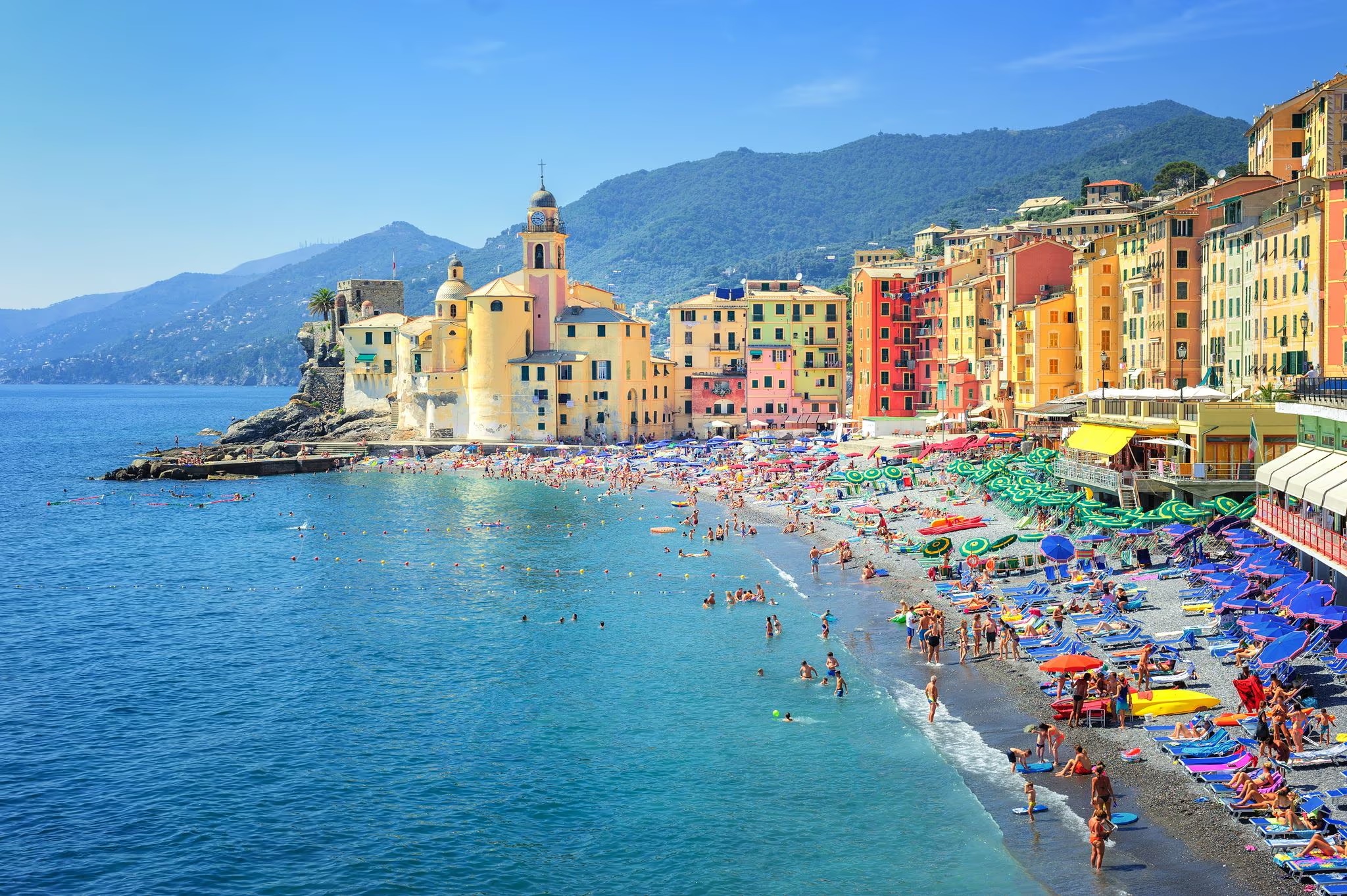
The scale is measurable. International arrivals across Southern and Western Europe consistently peak between late June and early September, with some destinations recording daily visitor numbers that outpace local populations several times over. The result is not simply crowding. It is a recalibration of how time functions within a trip. An hour lost to a line is not an inconvenience. It is a planning failure.
Queues in Europe are no longer confined to obvious landmarks. They have diffused into transit systems, ticketing platforms, and even digital spaces. Major railway stations now experience morning bottlenecks comparable to airports. Budget airlines, which once offered speed through volume, now contribute to longer boarding cycles and congested security lanes. The growth of low-cost carriers has widened access to European cities, but it has also compressed demand into narrower time windows.
Urban centers built centuries ago were not designed for contemporary visitor density. Narrow streets, limited entry points, and preservation regulations restrict expansion. In cities such as Rome, Paris, and Barcelona, capacity cannot scale with demand. Authorities respond with timed entry systems, visitor caps, and dynamic pricing, but these measures redistribute queues rather than eliminate them.
The consequence is spatial. Travelers are not only waiting longer, they are waiting in more places. Outside churches. At bus stops. In front of restaurants that do not take reservations. The queue has become mobile.
European infrastructure is sophisticated, but it is not elastic. Airports like Amsterdam Schiphol and London Heathrow have faced recurring staffing shortages in recent summers, leading to extended security wait times and baggage delays. Even well-managed systems encounter stress when passenger volume exceeds forecast capacity.
Rail networks, often praised for efficiency, face similar pressure. High-speed lines connecting major capitals operate near full capacity during peak weeks. Missed connections become more costly, as rebooking options shrink and standby queues lengthen. The margin for error narrows.
Museums and cultural sites illustrate the problem more visibly. The Louvre, the Vatican Museums, and the Sagrada Familia have all implemented timed entry, yet queues persist. Digital tickets reduce uncertainty but do not eliminate physical constraints at entry points. Security screening, group coordination, and crowd flow inside the sites create secondary bottlenecks.
Queues are not merely logistical failures. They are signals of economic imbalance. Tourism has become a primary revenue stream for many European cities, contributing significantly to local GDP and employment. Yet the distribution of that revenue is uneven. Central districts absorb the majority of visitors, while peripheral areas remain underutilized.
This concentration amplifies congestion. Popular landmarks become oversubscribed because they are marketed globally, while lesser-known sites struggle for visibility. The queue, in this sense, is a byproduct of narrative. Travelers are drawn to a curated version of Europe that emphasizes a limited set of experiences.
Pricing strategies reinforce the pattern. Peak-season rates for accommodation and attractions do not always deter demand. Instead, they shift the composition of visitors without reducing overall volume. Higher prices coexist with longer lines, creating a paradox where exclusivity and overcrowding operate simultaneously.
Travel behavior contributes to queue formation more than most visitors realize. Late arrivals to timed-entry slots create micro-surges that disrupt flow. Group travel, particularly large tour groups, introduces synchronization challenges that slow down entry processes. The widespread reliance on mobile ticketing can also backfire when connectivity issues arise at access points.
There is also a psychological dimension. Travelers tend to cluster around perceived peak hours, assuming that early morning or late afternoon offers relief. In practice, these periods often experience the highest density because they are widely recommended. Midday, traditionally avoided, can sometimes provide more consistent access, especially at secondary attractions.
Avoiding queues entirely during a European summer is unrealistic. The more practical approach is to manage exposure. This requires a shift from destination-first planning to time-first planning.
Arriving at major attractions before opening hours remains effective, but only when combined with pre-booked access. Without a reserved slot, early arrival simply relocates the wait. Similarly, late-evening visits can reduce pressure, particularly in cities that extend opening hours during peak season.
Transportation choices matter. Secondary airports and off-peak train departures can significantly reduce transit delays. Regional rail lines, often overlooked, provide alternatives to congested high-speed routes. The trade-off is time, but the gain is predictability.
Accommodation location also influences queue exposure. Staying outside central districts reduces immediate access to landmarks but can shorten daily wait times by avoiding peak inflows. Peripheral neighborhoods often offer faster transit connections during high-traffic periods.
The persistence of long queues has begun to shape local attitudes toward tourism. Cities such as Venice and Barcelona have introduced measures to control visitor numbers, including entry fees and restrictions on short-term rentals. These policies reflect a broader tension between economic dependence on tourism and the social cost of overcrowding.
Queues, in this context, become visible indicators of that tension. They signal not only demand but also resistance. Residents navigate the same spaces, often with diminished access to public infrastructure during peak periods. The friction is subtle but cumulative.
European tourism is unlikely to contract in the near term. If anything, demand is expected to grow, driven by increased global mobility and sustained interest in cultural travel. The question is not whether queues will persist, but how they will evolve.
Technological solutions, including dynamic ticketing and real-time crowd monitoring, will refine distribution. However, they cannot fully resolve physical constraints. Urban planning, policy interventions, and shifts in traveler behavior will play a more decisive role.
For the individual traveler, the implication is clear. Time must be treated as a finite resource, not an adjustable variable. A summer trip to Europe now requires the same level of logistical precision once reserved for complex itineraries. The queue is not an obstacle to be avoided at the margins. It is a central condition of travel that must be anticipated, measured, and managed.
Planning with the expectation of delays changes the structure of a trip. It forces prioritization. It reduces over-scheduling. It introduces buffers that absorb disruption rather than amplify it. Most importantly, it aligns expectation with reality.
The travelers who navigate Europe most effectively in summer are not those who move fastest. They are those who understand where time will be lost and account for it before departure.


