
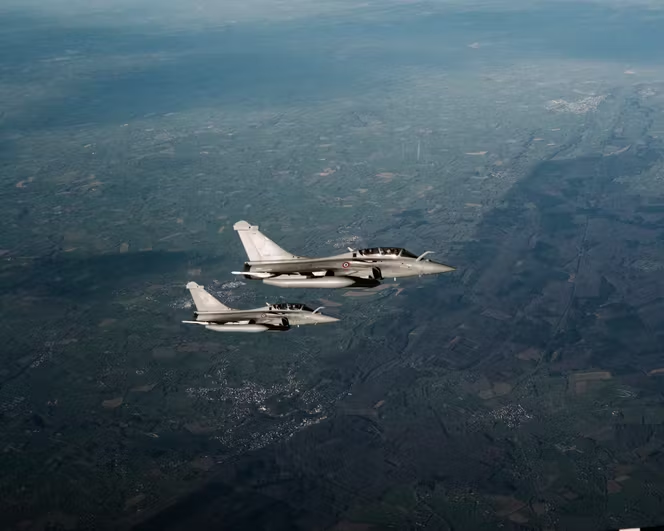
France deploys jets over UAE to protect its military bases at a moment when the Gulf has become one of the most volatile theaters of confrontation between Iran and Western allies. The decision to send Dassault Rafale fighter aircraft into active air patrols above French installations in the United Arab Emirates signals a shift from quiet deterrence to visible readiness.

On Tuesday, Foreign Minister Jean Noel Barrot confirmed that Rafale jets based at Al Dhafra air base near Abu Dhabi had been mobilized to secure French facilities. France maintains hundreds of naval, air force, and army personnel in the UAE. Their presence has long been part of a broader security arrangement between Paris and Abu Dhabi, designed to project stability in a region central to global energy flows and trade routes.
Barrot stated that the Rafales and their pilots were conducting operations to secure the airspace over French bases. His remarks followed reports that Iranian drones had been intercepted over the weekend. The language was measured, but the context was not. This was not a routine patrol cycle. It was a defensive posture taken amid open military exchanges.
A hangar at a French base in the UAE was struck by a drone on Sunday. The confirmation marks a significant escalation. Until recently, European military assets in the Gulf were seen as secondary actors, protected by US dominance in regional air defense. The targeting of a French installation suggests that Tehran is willing to broaden its range of pressure.
France’s presence in the UAE is neither symbolic nor temporary. Al Dhafra air base serves as a critical node for French operations across the Middle East. The Rafale jets stationed there are capable of air defense, reconnaissance, and strike missions. Their deployment for base protection underscores how quickly strategic platforms can be repurposed when threat levels rise.
Meanwhile, the French aircraft carrier Charles de Gaulle remains in the North Atlantic, participating in a previously scheduled multinational exercise. Barrot clarified that it had not altered its course toward the Mediterranean. That detail matters. Redirecting the carrier would have signaled a more expansive European involvement in the unfolding crisis. By keeping it on its planned trajectory, Paris appears intent on containing its response to defensive measures.
The broader regional context is tense. The United States and Israel conducted strikes inside Iran on March 1, killing Supreme Leader Ali Khamenei. Tehran has since responded by targeting US allies and assets across the Gulf. Drone activity has intensified, and infrastructure has not been spared.
Authorities in the UAE reported that debris from an intercepted drone caused a fire in an oil industry zone in Fujairah. In Abu Dhabi, a drone struck a fuel tank terminal, igniting a fire though operations continued. These incidents reveal the vulnerability of energy infrastructure even when interception systems succeed. The economic consequences of repeated attacks could ripple far beyond the Gulf.
The conflict has also reached civilian technology infrastructure. Amazon confirmed that two of its data centers in the UAE were directly struck by drones, disrupting cloud services across parts of the Middle East. In an era where digital networks underpin finance, logistics, and governance, such attacks carry consequences that extend well beyond physical damage.
France’s decision to deploy Rafales for protective air operations must be viewed within this layered threat environment. Military installations, oil terminals, and data centers now share a common risk profile. The Gulf has become a battlefield where conventional military strategy intersects with economic and digital vulnerability.
Paris is walking a narrow line. It seeks to protect its personnel and strategic interests without widening the conflict. European governments have historically relied on diplomatic leverage in Gulf crises, but the current escalation leaves little room for passive positioning. Protective deployments are no longer theoretical precautions. They are immediate necessities.
The presence of French forces in the UAE reflects longstanding defense cooperation agreements. Yet agreements alone do not guarantee security when regional power struggles intensify. Air superiority, surveillance capacity, and rapid response now define the credibility of those partnerships.
France deploys jets over UAE to protect its military bases not simply as a reactive measure, but as a statement that European interests in the Gulf are tangible and defendable. Whether this posture deters further attacks remains uncertain. What is clear is that the Gulf’s strategic landscape has shifted. Military bases once considered secure rear positions are now exposed nodes in a widening confrontation.
For France, the calculation is pragmatic. Safeguard personnel. Maintain alliance credibility. Avoid unnecessary escalation. In a region where symbolism can trigger real consequences, even the flight path of a single Rafale carries weight.


