Stephen Hawking seen with women in bikinis in new Epstein files photo has become the latest headline to emerge from the ongoing public release of documents tied to the late financier Jeffrey Epstein. The image, newly circulated within a broader trove of federal records, shows the celebrated British theoretical physicist seated and smiling alongside two women in swimwear. The photograph has prompted renewed scrutiny, speculation, and in some corners, careless insinuation.

The image was included among materials released by the US Department of Justice as part of a wider disclosure of documents connected to investigations into Epstein and his associates. The context surrounding the photograph remains limited. No official caption identifies the date, location, or circumstances under which it was taken. However, other images appearing in the same tranche of files appear to have been captured on Epstein’s private island, Little Saint James, in the US Virgin Islands.
That absence of detail is significant. In cases involving public figures and controversial archives, incomplete context can quickly distort public understanding.
Public records already established that Professor Stephen Hawking visited Little Saint James in March 2006. He was one of 21 scientists invited to attend a five day physics conference focused on gravity. At the time of the visit, Epstein had not been charged with any sexual offenses.
Photographs published years earlier showed Hawking attending a beachside barbecue in his wheelchair during that trip. He was also reported to have taken part in a brief submarine excursion exploring marine life near the island. The visit, at least in its publicly documented form, was framed as an academic gathering rather than a social retreat.
It is important to separate established fact from insinuation. The existence of a photograph does not establish wrongdoing. Attendance at a conference does not imply complicity in crimes later attributed to a host.
The broader release of the Epstein files contains millions of pages of emails, flight logs, contact directories, and legal materials. Hawking’s name reportedly appears more than 250 times within those documents. That number alone has circulated widely across social media platforms, often without clarification.
Being mentioned in investigative files does not equate to an accusation, nor does it imply guilt. Many names appear in the records simply because individuals were guests, correspondents, or tangential contacts. Professor Hawking was never charged with, nor formally accused of, any criminal conduct in connection with Epstein.
One email from 2015, attributed to Epstein and addressed to his associate Ghislaine Maxwell, references Hawking in a discussion about allegations made by Virginia Giuffre. In that message, Epstein suggested offering a financial incentive to individuals who could help refute claims that Hawking had participated in an “underage orgy” in the Virgin Islands. The email reflects Epstein’s attempt to counter allegations. It does not demonstrate that any such event occurred, nor does it establish evidence against Hawking.
Such references illustrate the messy, often reputationally damaging nature of high profile investigations. Once a name enters a scandal archive, nuance frequently disappears in public discourse.
Professor Stephen Hawking, who died in 2018 at age 76, was one of the most recognized scientists of the modern era. His work on black holes, singularity theorems, and quantum gravity reshaped cosmology. His 1988 book, A Brief History of Time, brought complex theoretical physics into mainstream conversation. He spent decades navigating life with motor neurone disease while maintaining an active research and public speaking career.
When archival material intersects with a figure of that stature, the reaction is rarely measured. Headlines are crafted for impact. Images circulate faster than explanation. The nuance that distinguishes presence from participation often collapses under the weight of scandal.
The current wave of attention surrounding the phrase Stephen Hawking seen with women in bikinis in new Epstein files photo illustrates how visual fragments can drive narrative. The image alone provides no evidence of misconduct. It documents a moment in time. Without verified context, interpretation remains speculative.
The release of government records serves an important public interest function. Transparency matters. So does restraint. When archival material involves individuals who are deceased and cannot respond, journalists and readers alike carry a responsibility to evaluate what is substantiated and what is implied.
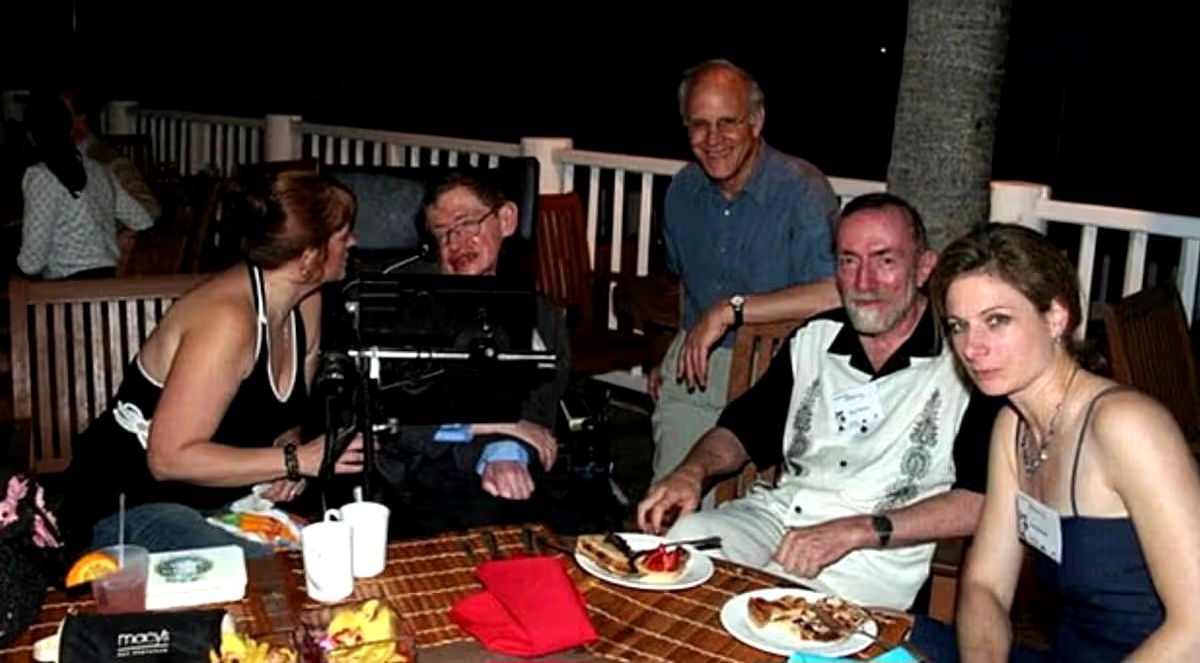
The Epstein case continues to expose networks of influence, power, and access. It also demonstrates how proximity to a disgraced figure can cast a long reputational shadow. For historians and legal analysts, the distinction between documented crime and associative presence is fundamental.
Stephen Hawking seen with women in bikinis in new Epstein files photo is a headline that draws attention. Whether it ultimately alters Hawking’s scientific legacy is less certain. His contributions to cosmology remain measurable, cited, and foundational. The historical record should be careful not to substitute insinuation for evidence.
In moments like this, perspective is not a defense. It is a necessity.