Why Iceland Feels Isolated is not a romantic question. It is a logistical one, a geographic one, and increasingly, a psychological one. Stand on the harbor in Reykjavik in February and the Atlantic does not look symbolic. It looks absolute. Flights leave. Ships arrive. Data cables hum beneath the seabed. Yet the sensation persists that this country sits slightly apart from the rhythms that shape the rest of Europe.

Isolation here is not an abstraction. It is visible in freight costs, in winter light, in population density figures, and in the way Icelanders speak about “going abroad” as if it were an extension of daily life rather than a vacation.
Geography That Refuses to Disappear
Iceland lies roughly 800 miles from mainland Norway and about 600 miles from Greenland. There are no bridges, no train corridors, no neighboring commuter zones. The North Atlantic is not a gentle divider. It is a weather system.
Reykjavik, the capital, sits closer to Nuuk than to Berlin. Even in the age of budget airlines and overnight shipping, that matters. When storms ground flights at Keflavik International Airport, it is not an inconvenience. It can delay medical supplies, fresh produce, and specialized parts needed for infrastructure.
The island’s interior reinforces the separation. The highlands are largely uninhabitable for much of the year, a landscape of lava fields, glaciers, and braided rivers. Route 1, the Ring Road, circles the coasts and connects most settlements, but drive inland and you quickly understand why most of the population hugs the shoreline.
This geography shapes more than scenery. It shapes mentality. You cannot ignore distance when you live inside it.
A Small Population on a Large Island
Iceland’s population is roughly 390,000 people. Nearly two thirds live in the capital region around Reykjavik. Outside that urban cluster, towns shrink quickly. Akureyri, often described as the capital of the north, has around 19,000 residents. Many coastal villages count their populations in the hundreds.
Low density changes daily experience. In much of Europe, a three hour drive crosses languages and political boundaries. In Iceland, it can carry you into a stretch of road with no fuel station and no visible farmhouse. The country feels open, but openness has a cost. Services are centralized. Specialized healthcare is concentrated in Reykjavik. Higher education options are limited compared to larger nations.
This scale affects the labor market. Many industries rely on small professional networks. It is common to know someone who knows the minister responsible for a policy decision. That intimacy can foster trust, but it also reinforces the sense that Iceland operates on its own terms, slightly outside the continental mainstream.
Economic Exposure and Self Reliance
For decades, fishing defined Iceland’s economic lifeline. Even today, seafood exports remain crucial. The cod wars of the 20th century, disputes with the United Kingdom over fishing rights, were not symbolic battles. They were existential.
After the 2008 financial collapse, Iceland experienced a sharp reminder of its vulnerability. Three major banks failed within days. The krona plunged. Imports became expensive overnight. The country did not simply experience a recession. It felt cut off from international credit markets, forced to renegotiate its position with external lenders and institutions.
Tourism later surged. Before the pandemic, annual visitors exceeded two million, far outnumbering residents. That influx connected Iceland more tightly to global flows of capital and culture. Yet it also underscored imbalance. A small society suddenly became a global destination. Infrastructure strained. Housing markets tightened. In peak summer months, Reykjavik could feel less like a remote capital and more like a transit hub for travelers chasing waterfalls and glaciers.
Economic integration has grown, but the underlying exposure remains. Iceland imports much of its food, machinery, and consumer goods. Disruptions in shipping or aviation resonate quickly. Isolation is measured not only in miles but in supply chains.
Political Distance and Strategic Relevance
Iceland is a member of NATO but not of the European Union. That choice reflects a long-standing ambivalence about sovereignty and resource control, particularly fisheries. The debate over EU membership has resurfaced periodically, often during economic stress, but it has never produced a decisive shift.

Strategically, Iceland occupies a critical position in the North Atlantic. During the Cold War, it hosted a US military base at Keflavik. After its closure in 2006, the island’s defense posture became lighter, though NATO presence has increased again in recent years due to renewed tensions in the Arctic region.
This duality contributes to the question of why Iceland feels isolated. It is geopolitically significant yet domestically small. It participates in Western alliances while guarding policy autonomy. It is both central to transatlantic security and peripheral to European political culture.
Climate and the Weight of Winter
Light shapes psychology. In December, Reykjavik receives roughly four hours of daylight. In June, the sun barely sets. The swing is not cosmetic. It affects sleep, mood, and social patterns.

Long winters can compress social life indoors. Cultural institutions, from literature festivals to music venues, thrive partly because people gather inside. Iceland has produced internationally known writers and musicians not despite its isolation, but in conversation with it. The landscape and the darkness provide material. The smallness of the audience sharpens ambition.
Still, seasonal isolation is real. In rural areas, winter storms can close roads for days. Communities prepare for self sufficiency. Snow removal, geothermal heating, and reliable local governance are not conveniences. They are necessities.
How Geography Explains Why Iceland Feels Isolated
The physical environment is not just background. It is an active force. Volcanic eruptions periodically disrupt air travel across Europe. Glacial floods reshape roads. Earthquakes are common enough that they rarely make international headlines unless they escalate.
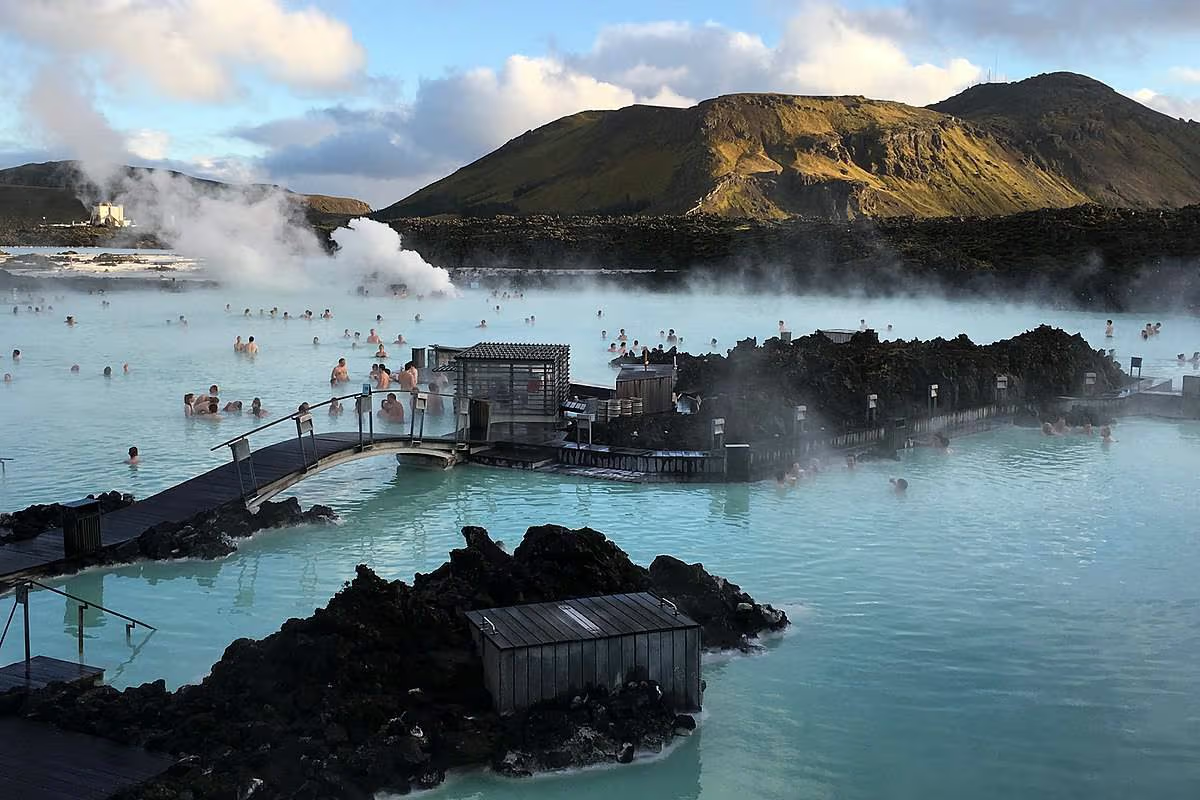
Living with that volatility cultivates resilience, but it also reinforces separateness. Iceland is geologically young and restless. The Mid Atlantic Ridge runs directly through it. Tectonic plates drift apart beneath residents’ feet. That awareness of instability contributes subtly to national consciousness. This is land in formation, not a settled continent.
Cultural Cohesion and Cultural Distance
Icelandic is closely related to Old Norse. It has changed relatively little over centuries. Schoolchildren can read medieval sagas in a form not drastically removed from modern usage. That linguistic continuity fosters cultural cohesion.

At the same time, it marks distance. While most Icelanders speak fluent English and often Danish, their native language is used by a population smaller than many European cities. Imported media dominates streaming platforms. Domestic production competes in a small market.
The result is a society that is globally literate yet locally rooted. Many young Icelanders study abroad in Copenhagen, London, or the United States. They return with broader networks, but also with a reinforced awareness of difference. The scale of other countries can be disorienting. So can the anonymity.
Isolation, then, is partly comparative. It sharpens when measured against larger systems.
Infrastructure at the Edge
Energy is one domain where Iceland defies expectations. Thanks to geothermal and hydroelectric power, electricity is largely renewable. Heavy industries such as aluminum smelting operate there because of abundant, relatively low cost energy.
Yet physical infrastructure still reflects remoteness. There is no rail network. Domestic air travel connects distant towns. Internet connectivity is strong, but undersea cables link the island to Europe and North America through limited routes. Redundancy exists, but not at continental scale.

Housing shortages in Reykjavik illustrate another constraint. Rapid tourism growth and internal migration have strained supply. Building materials are imported. Construction seasons are limited by weather. Even urban expansion is shaped by volcanic risk assessments and seismic data.
Isolation is not romantic in planning meetings. It appears in spreadsheets.
The Emotional Register
Ask Icelanders whether they feel isolated and responses vary. Some reject the premise. Flights to London take less than three hours. Social media erases distance. International news is consumed in real time.
Others acknowledge a subtler reality. Family networks are tight. Professional circles overlap. Privacy can be scarce. The island’s size magnifies reputation and rumor. For some, that closeness feels supportive. For others, it feels constraining.
There is also pride in standing apart. Iceland charted its own recovery after 2008. It preserved its language. It manages fisheries with strict quotas that many economists view as relatively sustainable. Isolation can translate into policy independence.
But independence is not insulation. The pandemic underscored how reliant Iceland remains on international travel and trade. Borders closed. Visitor numbers collapsed. The economy contracted sharply before rebounding.
Why Iceland feels isolated is therefore not a single story. It is an interplay of sea routes, tectonic plates, demography, economics, and identity. The island is connected, yet it remains unmistakably separate. The North Atlantic does not disappear simply because fiber optic cables cross it.
That tension defines daily life. Reykjavik cafes stream global playlists. Fishing vessels depart into cold water. Planes trace arcs toward Copenhagen and New York. Beneath all of it lies the fact of location, unaltered by modern convenience.
Isolation in Iceland is not about loneliness. It is about scale, exposure, and the awareness of edges. It is the understanding that beyond the runway and the harbor wall stretches a long expanse of ocean that still sets the terms.