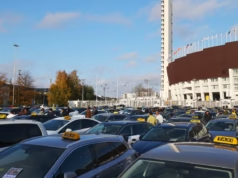
Helsinki paid street parking is set to expand into six residential neighborhoods as the city prepares to phase out free street parking in parts of the capital beginning in 2026.

According to Helsingin Sanomat, city officials plan to include Kulosaari, Kuusisaari, Lehtisaari, Kumpula, Käpylä, and Toukola in the residential parking permit system. The proposal will be reviewed by the Urban Environment Committee on November 25. If approved in spring 2026, the new rules will take effect gradually from autumn 2026 through early 2027.
The push for expanded paid parking follows a citizen initiative that called for uniform parking rules across the city. Residents argued that it was unfair for some districts to enjoy free parking while others were already required to pay monthly fees simply to park near their homes.
Ville Lehmuskoski, Director of Helsinki’s Urban Environment Division, acknowledged these concerns in his official response. However, he said it would not be realistic to implement paid residential parking across the entire city at once. Instead, the city has chosen to expand the system step by step in areas where parking pressure is high and demand is clear.
Lehmuskoski confirmed that the city’s long-term policy is to extend paid parking carefully rather than impose it all at once, using traffic data, environmental impact, and residential density as deciding factors.
Helsinki introduced residential parking permits in the 1980s. Today, the system covers 16 zones across the city, each identified by an alphabet code displayed on traffic signs. For example, Etu-Töölö is marked as Zone F.
Residents currently pay between 45 and 64.50 euros per month depending on the zone. Electric vehicles benefit from discounted rates, reflecting the city’s environmental policy goals.
City officials say the expansion is not just about parking. The policy also supports broader goals related to climate impact, traffic flow, and fair treatment between neighborhoods.
Reducing private car dependence is a central objective, especially for commuting. The city hopes that by limiting free street parking, more residents will consider public transport, cycling, or walking instead of driving daily.
Officials also want to encourage people to use private parking spaces provided within housing developments, particularly in newer areas where parking was already planned as part of construction requirements.
This is not the first time Helsinki has expanded paid residential parking, and it has not always been welcomed quietly.
In 2015, residents in Lauttasaari and Munkkiniemi organized protests against similar changes. Another wave of complaints followed in 2018 when paid parking reached Munkkivuori, Niemenmäki, Etelä-Haaga, and Kivihaka.
Despite opposition, the city has continued its gradual rollout, arguing that growing traffic volume and limited street space leave few alternatives.
The city clarified that newer residential areas built with private parking spaces will not be added to the paid parking system. Officials say these developments were designed with parking already accounted for on-site, making street permits unnecessary.