
Countries are facing a major decision at the United Nations over whether to begin negotiations on international rules governing killer robots, as concerns grow about the use of artificial intelligence in weapons capable of selecting and attacking targets without direct human control.
Government representatives began discussions in Geneva on Monday at the seventh review conference of the Convention on Certain Conventional Weapons. The meeting could determine whether countries move towards negotiating a legally binding agreement on autonomous weapons or allow discussions to continue without a formal regulatory process.
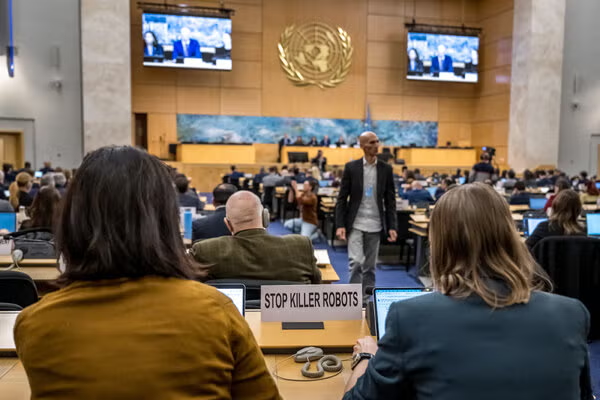
The debate centres on a fundamental question: should machines be allowed to make decisions about who lives and who dies during armed conflict? United Nations Secretary-General Antonio Guterres, Pope Leo XIV and several humanitarian and advocacy organisations have called for stronger international safeguards to ensure that humans remain responsible for decisions involving the use of lethal force.
Concerns about autonomous weapons have grown as artificial intelligence becomes increasingly important in military planning and modern warfare. Armed drones and other systems that can identify and engage targets with limited or no direct human intervention are among the technologies attracting attention. Advocacy groups say such weapons have already appeared in limited instances in conflict zones, including Ukraine and the Middle East, although widespread operational deployment has not yet taken place.
For campaigners, the current stage of development presents an opportunity to establish international rules before these weapons become more common on battlefields. Anna Hehir, head of military AI governance at the Future of Life Institute, said the technology was still in an experimental phase, making this an important moment for governments to consider regulation.
ALSO READ: Bulgaria Rescues 12 Crew Members After Cargo Ship Sinks in Suspected Black Sea Drone Attack
She warned that establishing restrictions could become considerably more difficult once autonomous weapons have been widely used in military operations for several years.
The discussions in Geneva follow growing international pressure for a formal agreement. Last month, Austria, Belgium, Brazil, Ireland, Mexico, New Zealand and Panama submitted a proposal calling for negotiations on a new legally binding agreement covering autonomous weapons systems.
The seven countries want governments to move beyond general discussions and begin working towards an international framework that would establish limits on the development and use of these weapons.
The proposal has received support from humanitarian organisations and campaign groups. Stop Killer Robots, an international advocacy organisation, says 130 countries support the introduction of new international rules for autonomous weapons.
United Nations Secretary-General Antonio Guterres has also called for progress, setting a deadline this year for the launch of negotiations towards regulating the technology. His position has added urgency to discussions that have continued for years without producing a binding international agreement.
The International Committee of the Red Cross has also urged governments to take action. Its president, Mirjana Spoljaric, said in a statement on Friday that states must ensure decisions about the future of warfare are not handed over to machines.
Public awareness campaigns have accompanied the diplomatic discussions. Activists have placed advertisements in streets and underground transport systems in Berlin, London and Paris, highlighting calls for governments to introduce restrictions on autonomous weapons.
However, reaching an agreement will not be straightforward. Under the rules of the Convention on Certain Conventional Weapons, decisions must be reached by consensus. This means that a single country can prevent an agreement from being adopted, even if most participating governments support it.
The requirement for consensus has raised concerns that negotiations could produce only limited restrictions or become delayed by disagreements over the process itself. The amount of time governments would be given to negotiate an agreement is another unresolved issue.
Russia has emerged as one of the countries reluctant to move quickly towards restrictions. Moscow has argued that discussions should first address organisational matters and that the process should remain free from what it describes as politicisation.
Russian Foreign Ministry spokeswoman Maria Zakharova said on Wednesday that her country wanted the conference to produce an outcome acceptable to all participating states and strengthen the convention.
However, her comments also indicated that Russia does not believe negotiations on restrictions or prohibitions should begin at this stage. Zakharova described proposals for such measures as premature.
The position reflects wider disagreements among major military powers over how far international rules should go. The United States and Russia have both been reluctant to accept restrictions that could limit their ability to develop and deploy advanced military technologies. Their positions present a significant challenge to countries seeking a comprehensive agreement.
Supporters of regulation point to previous international agreements on conventional weapons as evidence that governments can establish limits on military technologies. They have cited the existing restrictions on blinding laser weapons as an example of countries reaching an agreement on the use of a specific type of weapon.
The debate has also attracted attention from religious leaders. In his first encyclical in May, Pope Leo XIV criticised the growing competition to develop more sophisticated artificial intelligence technologies, particularly those used in remote warfare. He argued that decisions involving life and death should not be entrusted to remote AI systems.
As military technology continues to advance, governments are under pressure to decide whether existing international humanitarian rules are sufficient to address weapons that can operate with little or no human involvement. The Geneva conference presents an opportunity to move towards a formal negotiating process, but disagreements over the scope, timing and legal status of any agreement remain significant obstacles.
For now, the central issue is whether governments can agree to begin negotiations before autonomous weapons become a more established feature of modern warfare.


