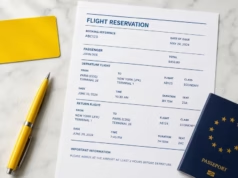
A Schengen visa travel itinerary is one of the documents that helps consular officers understand where an applicant intends to travel, how long they plan to stay and how their journey will be organised. A well-prepared itinerary should provide a clear account of the proposed trip, with destinations, travel dates, accommodation arrangements and transport details that correspond with the information provided in the visa application.
For many applicants, preparing this document can be confusing, particularly when the trip involves visiting several European countries. Some are unsure whether they need to book flights before applying, how to arrange accommodation for every destination or how much detail to include in their daily travel plans. Others submit a list of countries without explaining how they intend to move between them. The result can be an itinerary that is difficult to assess or that conflicts with other documents in the application.

The purpose of a travel itinerary is not to demonstrate how many places an applicant hopes to visit. It is to show that the proposed journey is understandable, realistic and consistent with the reason for travelling.
Under Article 14 of the Schengen Visa Code, applicants are required to provide supporting documents relating to the purpose of their journey, accommodation, financial means and their intention to leave the Schengen area before their visa expires. The regulation also recognises documents showing the proposed travel arrangements, including confirmation of an organised trip or other appropriate evidence of the intended journey. This means that an itinerary is part of a wider assessment rather than a document that independently determines whether a visa will be granted.
A useful itinerary does not have to be complicated. It should identify the applicant’s intended arrival and departure dates, the countries and cities to be visited, the accommodation for each part of the journey and the transport arrangements between destinations. For a straightforward holiday in one country, this may be relatively simple. For a trip covering France, Belgium, the Netherlands and Germany, for example, the applicant should make it possible to follow the journey from the first arrival to the final departure without having to guess where they will be on particular dates.
The first decision should be the country through which the visa application will be submitted. Applicants visiting only one Schengen country should normally apply through that country’s consulate. Those visiting several countries must identify their main destination. Under the Schengen Visa Code, this is generally the country where they will spend the longest period, although the main purpose of the visit can also determine the responsible country. If there is no identifiable main destination, the country through which the applicant intends to enter the Schengen area is generally responsible. The distinction matters because an applicant should not select an embassy simply because it appears to have a more convenient appointment system or because they believe it offers better chances of approval. The application should go to the country responsible for the actual trip.
Once the responsible country has been established, the applicant can begin building the itinerary around the intended dates of travel. The proposed departure date, arrival date and total length of stay should be decided before completing the document. These details must agree with the dates entered on the Schengen visa application form, the flight reservations, accommodation confirmations and any supporting letters. Even a small inconsistency, such as an accommodation reservation beginning a day after the applicant’s stated arrival, can create questions that could have been avoided with a final document check.
The itinerary should start with the applicant’s departure from their country of residence and explain how they intend to reach the Schengen area. It should identify the first country of entry, the expected arrival date, the city of arrival and the intended departure date. Where possible, the proposed flight details should include the departure and arrival airports, airline and connecting flights. Applicants travelling through a country outside the Schengen area should make the transit arrangements clear, particularly if the connection involves leaving the international transit area or entering another country where a separate visa may be required.
For example, someone planning a 12-day holiday in Europe might intend to arrive in Paris on 5 June, spend five nights in France, travel to Brussels for three nights and continue to Amsterdam for three nights before departing on 17 June. The itinerary should make the sequence clear, including the date of travel between the cities and the arrangements for returning home. The example is only an illustration; the number of countries and length of stay should reflect the applicant’s genuine travel plans, available time and financial circumstances.
One of the most important parts of preparing a multi-country itinerary is allocating realistic time to each destination. Travellers sometimes include too many cities in a short visit, apparently attempting to demonstrate an extensive European holiday. However, an itinerary that moves between several countries every day can be difficult to reconcile with the practicalities of transport, accommodation and sightseeing. Travelling from Paris to Brussels, for instance, involves more than simply listing two cities. The applicant should account for the journey, arrival at the next accommodation and the time available to explore the destination.
There is no universal requirement that every applicant must provide an elaborate hour-by-hour sightseeing schedule. The appropriate level of detail depends on the purpose of the visit and the requirements of the consulate handling the application. A sensible daily or date-by-date outline is generally more useful than a lengthy list of attractions with no clear connection to the travel dates. An applicant visiting Rome for tourism might identify the historic centre, the Colosseum and the Vatican Museums as planned places of interest. Someone travelling to Paris for a conference should instead explain the event, its venue and the dates of attendance, supported by the relevant invitation or registration documents.
Accommodation arrangements should cover the entire intended stay in the Schengen area. If the applicant plans to stay in hotels, the reservations should identify the property, its address, the booking dates and the name of the guest. The dates should correspond with the itinerary, including the nights spent in each city. If the applicant intends to stay with relatives or friends, the relevant host and accommodation information should be provided in accordance with the responsible country’s requirements. Where a trip involves several destinations, it is important not to provide a hotel reservation for the first few nights and leave the rest of the journey unexplained.
Applicants should also distinguish between an accommodation reservation and evidence that they can afford the trip. A hotel booking shows where they intend to stay; it does not necessarily establish that they have sufficient money to pay for the accommodation, meals, local transport and other expenses. Financial evidence is assessed separately, and the amount required can depend on the destination country and the circumstances of the visit. The itinerary should therefore be financially credible when considered alongside the applicant’s bank statements, sponsorship documents or other evidence of available funds.
Transport between destinations deserves similar attention. Where the proposed journey includes several cities, the applicant should explain how they intend to travel between them. Depending on the route, this may involve trains, buses, domestic flights or other forms of transport. Relevant reservations or booking confirmations should be included where the consulate’s checklist requests them. If a reservation has not yet been made, the applicant should consult the embassy’s instructions to establish what alternative evidence of the intended travel arrangements is acceptable.
The European Commission’s Visa Code does not establish one identical document checklist for every nationality and every application location. Although the general legal requirements apply across the Schengen visa system, individual consulates provide country-specific instructions and may request additional supporting documents. Some application checklists expressly request detailed travel plans covering all destinations, while others specify preliminary transport reservations and accommodation evidence. Applicants should therefore use the official checklist published by the embassy or consulate responsible for their application rather than relying entirely on advice from travel agents, online forums or social media.
The question of whether to purchase flight tickets before receiving a visa decision is another common source of confusion. Applicants should not assume that they must spend substantial amounts on non-refundable flights simply to demonstrate that they intend to travel. The documents requested can vary, and a flight reservation or other appropriate evidence of proposed travel arrangements may be accepted, depending on the consulate’s instructions. The distinction between a reservation and a fully paid ticket is important. A reservation may show the proposed route and travel dates without requiring the applicant to commit to a purchase that could result in a financial loss if the visa is refused.
The same caution applies to accommodation. Some embassies explicitly advise applicants against paying for hotel bookings before a visa decision. Others specify what kind of reservation or confirmation they expect. Where possible, applicants can consider genuine reservations with flexible cancellation or amendment conditions, provided those arrangements satisfy the relevant consulate’s requirements. They should never submit fabricated hotel confirmations, altered booking documents or flight reservations that do not represent genuine arrangements. An itinerary should be evidence of an actual intention to travel, not a collection of documents assembled to create an appearance of travel plans.
ALSO READ: How to Get a Flight Reservation for a Schengen Visa Application
A travel itinerary should also be consistent with the reason for visiting Europe. For a tourist, the destinations and activities should make sense as a holiday. For a business traveller, the schedule should reflect meetings, conferences, professional appointments or other stated business activities. An applicant visiting family or friends should ensure that the proposed dates and accommodation arrangements agree with the invitation and information supplied by the host. The supporting evidence should reinforce the purpose described in the application rather than introduce a different explanation.
The applicant’s personal circumstances are also relevant to the overall assessment. A proposed three-week holiday, for example, should be considered alongside the applicant’s employment situation, approved leave, available finances and other supporting evidence. If an employer’s letter confirms annual leave from 5 June to 17 June, an itinerary showing a return on 25 June would create an inconsistency that needs to be explained. Students, self-employed applicants and sponsored travellers may have different supporting documents, but the principle remains the same: the proposed dates and arrangements should be compatible with the evidence submitted.
It is equally important to understand that a travel itinerary does not guarantee a Schengen visa. Consular officers assess the application as a whole, including the purpose and conditions of the intended stay, financial resources, accommodation and the applicant’s intention to leave the Schengen area before the visa expires. A detailed itinerary cannot compensate for inadequate financial evidence, an unclear travel purpose or contradictions elsewhere in the application. Equally, a simple itinerary is not automatically a weakness if it accurately explains a straightforward trip and is supported by the required documentation.
Before submitting the application, the applicant should compare the itinerary against every relevant document. The names, passport details, travel dates, hotel addresses, destinations and transport arrangements should be checked for consistency. The total number of nights should add up correctly, and there should be no unexplained gaps between accommodation bookings. If a hotel reservation covers Paris from 5 to 9 June and another covers Brussels from 9 to 12 June, the applicant should be able to account for the transition between the two destinations. The departure date from the Schengen area should also be clear.
A final point concerns changes to travel plans. An itinerary submitted with a visa application should represent the journey the applicant genuinely intends to undertake. Circumstances can change, and a traveller may need to adjust accommodation or transport arrangements after receiving a decision. However, applicants should not deliberately submit one travel plan while intending to follow a substantially different route. They should also understand that the visa itself determines the permitted period of stay and conditions of entry, not simply the dates written in the original itinerary.
The European Commission allows short-stay Schengen visa applications to be submitted up to six months before the intended journey and, as a general rule, no later than 15 days before departure. Applicants should allow additional time for appointment availability and possible requests for further documents. Planning the itinerary early gives them an opportunity to identify missing reservations, check the correct consulate and ensure that the supporting documents tell the same story.
Ultimately, preparing a travel itinerary for a Schengen visa application is an exercise in clarity and consistency. It should allow someone reviewing the application to understand the journey without having to reconstruct it from disconnected reservations and supporting letters. A realistic route, properly accounted-for accommodation, clear transport arrangements and dates that match the rest of the application provide a sound basis for presenting the intended visit. The strongest itinerary is not necessarily the longest or most elaborate. It is one that accurately reflects the trip the applicant plans to take and can be supported by the rest of their documents.