
A flight reservation for a Schengen visa is one of the documents many travellers must prepare before submitting their application, but it is also one of the most misunderstood parts of the process. Applicants often assume they must purchase a return ticket before attending their visa appointment, while others turn to online services offering temporary flight bookings without understanding whether the documents will meet the requirements of the embassy handling their application.
The distinction matters. A flight reservation can demonstrate how an applicant intends to enter and leave the Schengen Area without necessarily requiring them to pay the full cost of their journey before a visa decision has been made. However, the type of reservation accepted, the information it must contain and whether an actual ticket is required can depend on the country receiving the application.
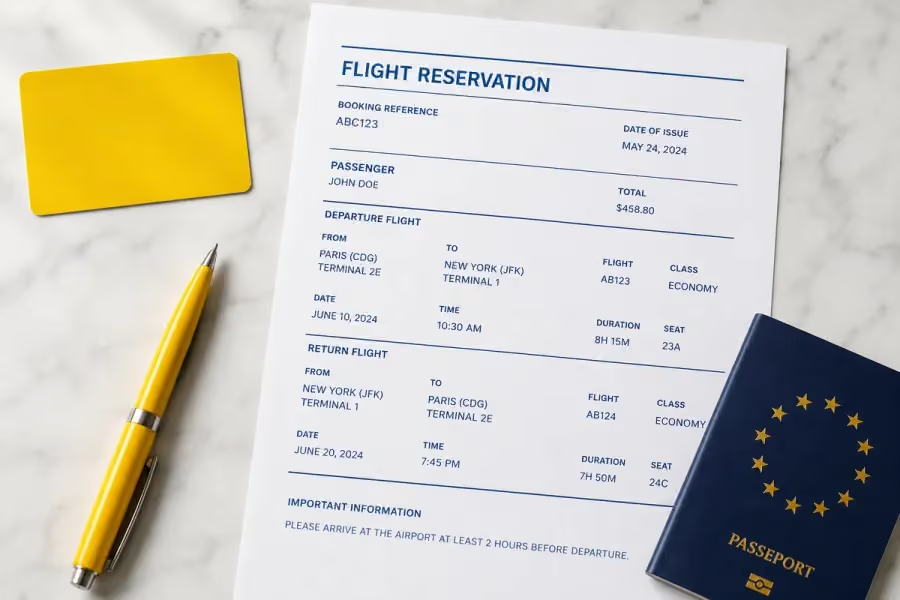
For travellers applying for a short-stay Schengen visa, generally allowing visits of up to 90 days within a 180-day period, the flight itinerary forms part of the wider evidence used to assess the purpose and arrangements of the proposed trip. It helps establish when the applicant intends to arrive, how long they plan to stay and when they expect to leave. It is not, on its own, proof that the applicant qualifies for a visa.
The European Commission identifies supporting documents relating to the purpose of travel, financial means, accommodation and the applicant’s intention to return as important elements of a Schengen visa application. Individual consulates can also request additional documents depending on the circumstances of the application. This means there is no single flight reservation format that applicants should assume will be accepted by every Schengen country. The checklist published by the embassy or consulate responsible for the application remains the most important reference.
A flight reservation is essentially evidence of a proposed journey. Depending on the airline or booking provider, it may be an itinerary held temporarily in the reservation system, a booking that has not yet been fully paid for, or a confirmed ticket that can be changed or refunded under specific conditions. These arrangements are not necessarily interchangeable, and applicants should understand what they are submitting.
One important distinction is the difference between a flight reservation and a fully issued flight ticket. A reservation may contain the passenger’s travel details and a booking reference, commonly known as a Passenger Name Record (PNR). An issued ticket, on the other hand, generally has an electronic ticket number confirming that the ticket has been issued. Some reservations remain valid only for a limited period before being automatically cancelled if payment is not completed.
For many applicants, a genuine, verifiable reservation is a more practical option than purchasing an expensive ticket before knowing the outcome of their visa application. Several Schengen diplomatic missions explicitly advise applicants against buying non-refundable flights before receiving a visa decision.
Finland’s visa application guidance, for example, requests a verifiable round-trip flight reservation containing a booking number or PNR code and states that purchasing tickets before the visa decision is not recommended. Germany’s Federal Foreign Office also advises applicants against making financial commitments before their visa has been approved, suggesting that fully refundable tickets may be worth considering where a booking is necessary.
The first step is to identify the correct embassy or consulate and examine its current document checklist. This should happen before making any flight reservation. An applicant travelling to France, for example, should not automatically rely on the requirements published by the Finnish or German authorities simply because all three countries belong to the Schengen Area.
The application must also be submitted to the correct country. When travelling to several Schengen countries, the general rule is to apply through the country where the applicant intends to spend the longest period. If the planned stays in different countries are of equal length, the application should normally be submitted to the country of first entry. The European Commission makes this distinction clear in its guidance on where to apply.
Once the relevant requirements have been established, the applicant can begin arranging the flight reservation. One option is to contact an airline directly and ask whether it offers a temporary reservation or a booking arrangement suitable for visa application purposes. Not every airline provides this service, and the conditions vary. Some airlines may allow a short reservation hold, while others require immediate payment before issuing a booking confirmation.
Another option is to use a reputable travel agency. Some agencies can arrange flight reservations through airline booking systems and provide an itinerary showing the passenger’s name, travel dates, flight numbers and booking reference. Applicants should ask whether the reservation is genuine, whether it can be independently verified and how long it will remain active.
Airline websites and established online travel agencies are also useful for comparing refundable and changeable fares. Although these options may cost more than restricted tickets, they can offer greater flexibility if the visa decision takes longer than expected or the proposed travel dates need to change. Applicants should read the fare conditions carefully because a ticket described as flexible may still carry cancellation charges or other restrictions.
Online services advertising so-called dummy tickets or temporary flight itineraries have also become common among visa applicants. These services generally claim to provide flight reservations without requiring the customer to purchase the full ticket. However, the label alone says very little about the quality or legitimacy of the document.
Some providers may supply genuine reservations that can be checked through an airline or booking system. Others may provide itineraries that expire quickly, contain information that cannot be verified or are not connected to an actual airline reservation. A document that looks like an airline booking confirmation is not necessarily evidence of a valid reservation.
Applicants should therefore be cautious about choosing a service based solely on low prices, promises of guaranteed visa approval or claims that a particular document is accepted by every embassy. No private reservation provider can guarantee that a Schengen visa will be granted. The European Union Delegation to Türkiye has specifically advised applicants to provide genuine flight and hotel reservations that reflect their actual travel arrangements, warning against fraudulent intermediaries and inaccurate documentation.
A properly prepared flight reservation should contain enough information for the visa officer to understand the proposed journey. The passenger’s full name should correspond with the name in the passport. The departure and arrival airports, flight dates, flight numbers and booking reference should be clearly visible. Where the itinerary includes connecting flights, the connections should be presented in a way that makes the complete journey understandable.
For a typical tourist application, a return reservation is particularly important because it shows both the intended arrival in the Schengen Area and the proposed departure. An itinerary showing only an outbound flight may not satisfy a checklist that specifically requests a round-trip reservation.
The travel dates must also be consistent with the rest of the application. If the applicant states in the visa application form that the intended visit will run from 10 June to 24 June, the flight reservation should normally reflect those dates. A hotel booking showing accommodation from 12 June, without an explanation for the first two nights, could raise questions about the proposed arrangements.
The same principle applies when the trip covers more than one country. Someone planning to visit Germany, the Netherlands and Belgium should ensure that the flight reservation and supporting travel documents reflect a realistic journey. If the applicant intends to fly into Frankfurt and leave from Amsterdam, the itinerary should show this arrangement rather than presenting an unrelated return flight from another airport.
Travellers who plan to move between Schengen countries by train, bus or other transport should provide additional information where required by the relevant consulate. A flight reservation only establishes the air journey. It does not necessarily explain how the applicant intends to travel between destinations once inside the Schengen Area.
For example, an applicant flying into Paris and spending several days in Brussels before returning home from Paris should be able to explain the journey between the two cities. Train reservations, a travel itinerary or other appropriate supporting documents may help establish that the proposed arrangements are genuine. The level of detail required will depend on the destination country’s checklist and the nature of the trip.
There is also the question of whether applicants should reserve flights before securing hotel accommodation. In practice, the two arrangements should be planned together. The flight dates should correspond with the hotel reservations, accommodation arrangements or invitation provided by a host. An itinerary showing a 14-day visit accompanied by hotel bookings covering only five nights may require an explanation.
This consistency becomes particularly important for applicants who are visiting friends or relatives, attending business meetings or travelling for an event. Their flight arrangements should reflect the purpose and duration of the visit rather than simply showing an arrival and departure date.
Another issue applicants should pay attention to is the validity of their reservation. A temporary booking that expires before the visa appointment or while the application is being examined may no longer represent an active travel arrangement. A booking reference printed on a document does not automatically mean the reservation remains valid.
Before submitting the application, applicants should contact the airline or reservation provider to establish whether the booking is still active. Where the airline offers an online booking management facility, they may be able to check the reservation using the booking reference and passenger details. If the reservation has expired or been cancelled, it is safer to arrange a new, genuine booking than to submit outdated information.
Applicants should also avoid changing their travel plans without considering the effect on the rest of their documents. If a new flight date is selected, the accommodation booking, travel insurance dates and itinerary may also need to be updated. Submitting documents that describe different travel periods can make an otherwise straightforward application more difficult to assess.
The financial implications of buying a ticket before receiving a visa decision should not be underestimated. Schengen visa applications are not guaranteed approval, even when an applicant has submitted the required documents. The European Commission states that the normal processing period is 15 calendar days, although an application may take up to 45 days when additional examination or documents are required. Applicants must also account for the time needed to secure a visa appointment and have their passport returned.
For this reason, purchasing a non-refundable ticket simply to demonstrate that travel arrangements have been made can expose applicants to unnecessary financial risk. A refundable ticket may offer protection, but applicants should examine the actual refund conditions, including administrative charges, cancellation deadlines and the method of reimbursement.
READ THIS: Schengen Visa Bank Balance Requirements: How Much Money Do You Really Need in Your Account?
It is equally important to understand that a flight reservation does not replace the other requirements of a Schengen visa application. An applicant may have a valid return booking but still be refused a visa because of insufficient financial evidence, unclear travel intentions, inadequate supporting documents or concerns about whether the applicant intends to leave the Schengen Area before the visa expires.
The flight itinerary is therefore one part of a broader assessment. It should support the applicant’s explanation of the trip, not carry the entire application.
Applicants should also be wary of anyone promising that a particular flight reservation will guarantee approval. There is no legitimate booking arrangement that can guarantee a positive visa decision. The decision belongs to the competent diplomatic authority, which considers the application as a whole.
Before attending the visa appointment, applicants should review the complete reservation and compare it against their passport, application form, accommodation evidence and travel itinerary. They should confirm that the booking is still valid, the passenger’s name is correct, the intended departure and return dates match and the route reflects the journey they genuinely plan to undertake.
Getting a flight reservation for a Schengen visa application does not necessarily mean paying for an entire international journey in advance. In many cases, a genuine and verifiable reservation is sufficient, provided it meets the requirements of the embassy handling the application. The safest approach is to check the official checklist first, choose a legitimate booking arrangement, keep the itinerary consistent with the rest of the application and avoid making unnecessary financial commitments before the visa decision.
For anyone preparing to travel to Europe, the objective should not simply be to obtain a document that looks like a flight ticket. It should be to provide credible evidence of a journey that is properly planned, accurately presented and supported by the rest of the visa application.


