
British adventurer Karl Bushby has returned home to Hull, England, after completing an extraordinary 50,000-kilometre journey that took him across four continents over 28 years, without using transport to advance his route.
A crowd of up to 1,000 people gathered in Hull on Monday to welcome the former British paratrooper, whose expedition began in Chile in 1998 and eventually brought him back to his hometown in northeast England. Cheering supporters greeted him as he arrived in the city centre, marking the end of one of the most unusual long-distance journeys ever attempted on foot.

Bushby thanked the people who had supported him throughout the expedition, making clear that completing the journey had required help from far beyond his own efforts.
“I didn’t do this alone,” he said, describing the achievement as a “global effort”. He also spoke about the difficulties of dealing with governments, border restrictions and some of the toughest conditions he encountered along the way.
His return had already attracted attention a day earlier when he crossed the Humber Bridge near Hull in thick mist. From there, he continued towards the city centre before heading to his mother’s home.
What was originally planned as a 12-year expedition became a 28-year undertaking. Bushby travelled through jungles, deserts, mountains and frozen landscapes, while visa restrictions, political disputes and the COVID-19 pandemic repeatedly interrupted his progress. He named the expedition the “Goliath Expedition”.
The idea began with a conversation with his father, Keith, in the mid-1990s. In a birthday card, his father recalled a discussion among special forces soldiers about whether it was possible to walk from London to New York using the Bering land bridge, which connected parts of Asia and North America during periods of lower sea levels.
The idea stayed with Bushby. He began tracing a route on a map, drawing a continuous line across Europe and Asia before reaching North America. Rather than stopping in New York, he extended the route south to the tip of Chile, creating a plan to walk back home from South America.
“And that was it,” he recalled. “With that under my skin, there was no going back.”
Bushby established two rules for the expedition. He would not use any form of transport to move forward along his route, and he would return to Britain on foot. Starting with just $500, he set off across South America, where he encountered hurricane-force winds on the Patagonian Steppe.
The challenges became more serious as he continued north. In 2001, he had to navigate the Darién Gap, a difficult stretch of jungle, rainforest and mountains between Colombia and Panama, where security risks and the absence of roads make travel particularly difficult. He was later detained for 18 days after crossing a restricted border area in Panama.
One of the expedition’s most dangerous moments came in 2006, when Bushby and American adventurer Dimitry Kieffer attempted to cross the 56-mile Bering Strait between Alaska and Russia. During the crossing, they were airlifted to safety after falling into freezing water. They also came close to losing their supplies.
Although they managed the rare crossing, their problems continued after reaching Russia. The pair were detained and faced possible deportation for entering the country illegally.
Russia became one of the longest obstacles of the entire journey. Bushby spent almost a decade trying to make progress through the country, with visa restrictions and extreme weather limiting the months available for walking.
When Russia refused to grant him a visa in 2012, he responded by walking from Los Angeles to the Russian Embassy in Washington, D.C., in protest. The unusual demonstration eventually helped him secure the necessary paperwork to continue.
During periods when he could not travel, Bushby returned to the United States or Mexico, where he could live more cheaply while waiting for another opportunity to resume the expedition from the point where he had stopped.
His route through Asia brought further difficulties. He was followed by police while travelling through China, while the COVID-19 pandemic caused another lengthy interruption.
Geopolitical tensions also forced him to change his plans. With routes through Russia and Iran no longer available, he faced the challenge of crossing the Caspian Sea. Bushby spent 31 days making the crossing by water, despite not being a strong swimmer. He relied on a flotation vest and wetsuit, using a backward-moving technique he called “floatimming”, combining floating and swimming.
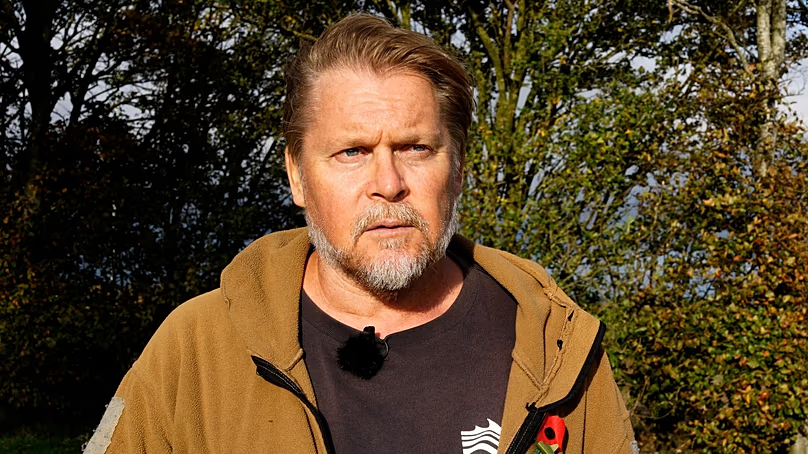
Europe presented a different set of restrictions. The 90-day limit on visits meant he had to organise his progress in separate three-month periods rather than travel continuously across the continent.
His final major challenge was reaching Britain. In early October, he swam across the English Channel, allowing him to continue the journey on British soil.
“Feels good to have UK soil under my feet after all these years,” he said in a statement, acknowledging that the expedition had been far from easy.
Funding the journey was another constant challenge. Bushby received support from different sponsors over the years, but some partnerships ended as the expedition continued and financial circumstances changed, particularly during the 2008 global financial crisis.
For the past 16 years, much of his support has come from a production company founded by Beau Willimon, creator of the television series “House of Cards”, and music producer Jordan Tappis. The company is backing a documentary about the expedition, directed by German filmmaker Werner Herzog.
However, Bushby has repeatedly highlighted the generosity of ordinary people as one of the most important reasons he managed to keep going. Throughout his travels, strangers offered him food, accommodation and assistance, often without expecting anything in return.
He recalled being welcomed into basic homes built from car parts and receiving medical care from the family of a doctor in Peru after suffering a serious stomach infection. In other places, people with very limited resources shared simple meals of rice and water with him.
“I’ve been welcomed in by the poorest of the poor,” he said. “I’ve met 99.9999% of the very best of humanity. Every culture, every country has been the same response.”
His return was also a significant moment for Hull, where Mayor Maria Coward praised his determination and the commitment required to complete the expedition.
“So many people have followed Karl on his epic journey. We have all felt inspired by his spirit, tenacity and dogged determination,” she said, adding that the city took pride in his achievement.
The homecoming also marked a personal reunion. Bushby was expected to see his mother, Angela, his 36-year-old son, Adam, and his 12-year-old granddaughter, whom he had never met in person.
Herzog and a film crew accompanied him during the final stages of his return. The filmmaker is producing a feature-length documentary titled “Walk of Life”, chronicling the expedition and the extraordinary obstacles Bushby encountered over nearly three decades.
Despite reaching the destination he had spent 28 years working towards, Bushby now faces a different adjustment. In an interview with AFP in northern France in September, he admitted that returning to ordinary life in Britain would require its own transition.
“I’ve got to try and get established in the grown-up world again,” he said.
For someone who spent nearly three decades moving across continents, crossing borders and adapting to unfamiliar environments, settling back into everyday life may prove to be a very different kind of journey.


