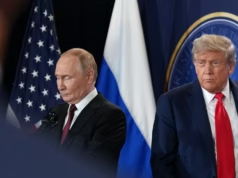
US President Donald Trump’s decision to waive a new Russia sanctions package has raised fresh questions about Washington’s approach to Moscow as the war in Ukraine continues and diplomatic tensions remain high.
Trump signed an executive order on Friday suspending the measures shortly before they were due to take effect, telling Congress that the decision was in the national interest of the United States. The move puts on hold a sanctions package he had signed into law in September, which was designed to increase economic pressure on the Russian government.

Known as the “Lindsey O. Graham Sanctioning Russia and Iran Act of 2026”, the legislation was named in honour of the late US Senator Lindsey Graham, who championed the measures. It sought to impose sanctions on Russian government and military officials, major banks and vessels associated with Russia’s shadow fleet, which is used to transport oil outside conventional shipping and sanctions restrictions.
The legislation also provided for tariffs on Russian goods and goods from certain countries that continued to purchase Russian oil and gas. Its provisions were intended to widen the economic consequences for Moscow and put additional pressure on countries maintaining energy trade with Russia.
The decision to suspend the measures has drawn a positive response from Moscow. Russian presidential envoy Kirill Dmitriev described the move as a “significant and truly historic moment”, arguing that the sanctions package could have “brought economic cooperation between Russia and the US to a complete standstill.”
The waiver comes as Trump has increasingly criticised Ukrainian President Volodymyr Zelenskyy, adding to uncertainty over Washington’s position on the war and its relationship with both Kyiv and Moscow.
It also follows Trump’s announcement earlier this month of an agreement with Russian President Vladimir Putin under which Russia would supply large quantities of diesel fuel to international markets. Trump presented the proposed arrangement as a way to help reduce fuel prices, as he prepares for the US midterm elections in November.
In a post on his Truth Social account, Trump said Russia had agreed to supply more than 300,000 tonnes of diesel fuel to the American and global markets immediately, followed by another 500,000 tonnes during November and 1 million tonnes thereafter. He also said Russia would deliver a further 3 million tonnes within a short period, subject to the condition of its diesel refineries.
The announcement placed energy trade at the centre of the latest developments in US-Russia relations, with potential implications for sanctions policy and international efforts to limit Moscow’s economic resources during the war.
Ukrainian President Volodymyr Zelenskyy addressed the implications of Trump’s latest moves during a visit to Brussels, where he met European leaders to discuss the war and Ukraine’s diplomatic priorities.
Asked by journalists on Friday whether he felt he had become a “scapegoat” for Trump’s own political difficulties ahead of the November midterm elections, Zelenskyy responded with a wry smile and said, “This is my answer.”
He also warned that the diesel arrangement with Russia could lead to further agreements involving Russian energy exports and a broader easing of sanctions. Ukraine, he said, could not accept diesel deals because gas agreements might follow.
“I’m absolutely sure of that,” Zelenskyy said. He predicted that any further easing of restrictions could eventually extend to the banking system, individuals and the chemical industry. He also raised concerns about the future of frozen Russian assets, which have become an important part of international discussions about how to hold Moscow accountable for the war.
“If I don’t defend that through diplomacy, who will do it for us?” Zelenskyy asked.
His remarks underline Kyiv’s concern that Washington could gradually relax economic restrictions on Russia, potentially weakening one of the main sources of Western pressure on the Kremlin. The sanctions waiver, combined with the proposed diesel arrangement, has added another point of tension as Ukraine seeks continued support from the United States and European allies.
The immediate effect of Trump’s executive order is to suspend the new measures under the 2026 legislation. The broader question for Ukraine and its European partners is whether the decision signals a temporary adjustment driven by US economic and political priorities or a more lasting shift in Washington’s approach to Russia.