
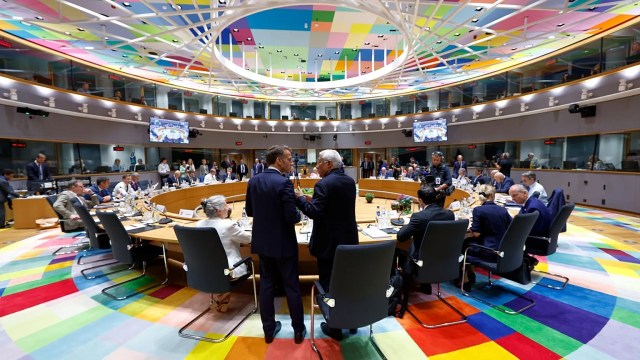
European Union leaders are meeting in Brussels for a two-day summit dominated by rising energy prices, disagreements over the bloc’s next long-term budget and renewed efforts to support Ukraine as tensions grow over US President Donald Trump’s approach to Russia.
The summit brings together the leaders of the EU’s 27 member states at a time when economic pressures and geopolitical disagreements are testing the bloc’s ability to agree on common policies. Trade relations with China, future EU enlargement, hybrid warfare and irregular migration are also on the agenda.
Energy prices are expected to lead Thursday’s discussions, as conflict in the Middle East continues to disrupt markets. Oil prices remain above $100 per barrel despite a coordinated release of reserves by the Group of Seven major industrialised economies. European gas prices have also climbed to their highest levels since the winter of 2022, while underground storage levels remain below average.
The increase has intensified pressure on European governments to protect households and businesses from higher energy costs as the colder months approach. Governments face the challenge of offering immediate financial relief without undermining efforts to reduce fossil fuel use and invest in cleaner energy.
Italian Prime Minister Giorgia Meloni and Greek Prime Minister Kyriakos Mitsotakis have called on Brussels to allow greater flexibility under EU fiscal rules. They want governments to have more room to introduce temporary, targeted measures to help consumers and industries manage the price shock.
Other member states are concerned that loosening the rules too far could encourage continued dependence on fossil fuels and slow investment in the green transition. The disagreement reflects a broader challenge for the EU: how to respond quickly to an energy crisis while maintaining its longer-term climate and economic goals.
A separate proposal to introduce an EU-wide windfall tax on energy companies has also divided member states. Austria, Germany, Italy, Poland, Portugal and Spain have backed the idea of taxing excess profits generated during the energy price surge. However, the proposal has yet to attract sufficient support across the bloc.
Trade relations with China will present another major challenge. The European Commission has been pressing Beijing to address the EU’s growing trade imbalance, which the original report describes as a deficit of approximately EUR 1 billion a day. Brussels had set October as a deadline for China to deliver measurable progress.
European Commission Trade Commissioner Maros Sefcovic secured preliminary concessions during a visit to Beijing last week. The discussions covered hybrid and plug-in hybrid vehicles, rare earth materials, permanent magnets and improved access to the Chinese market for European businesses.
A senior EU diplomat welcomed the initial progress but warned that the outcome would depend on implementation. The diplomat argued that the trade imbalance extends beyond individual industries and that China must demonstrate a broader willingness to address European concerns.
The preliminary agreement has eased the immediate threat of a wider trade confrontation, but tensions remain. According to draft summit conclusions cited by Euronews, EU leaders are expected to call for continued results-oriented dialogue with China while strengthening the bloc’s ability to respond to unfair trade practices.
Germany and France have also proposed a tougher mechanism that could restrict China’s access to the European market if the trade deficit remains unsustainable. The proposal highlights growing frustration among major EU economies over what they see as persistent imbalances in trade with Beijing.
The most difficult negotiations on Thursday are expected to concern the EU’s next seven-year budget. The talks come as governments face competing demands for spending, high borrowing costs and pressure to agree on how the bloc will finance its future priorities.
European Council President Antonio Costa has urged member states to move beyond their established positions and reach an agreement by the end of the year. An early deal would give EU institutions time to complete the necessary legislative work before the next budget period begins in January 2028.
Ireland, which holds the rotating presidency of the Council of the European Union, has presented a proposal that would reduce the original budget plan by EUR 141 billion. The proposed reductions largely protect agricultural and cohesion funding while placing greater pressure on research, technology, climate action, security and foreign policy programmes.
The revised proposal has failed to satisfy either side of the debate. The so-called frugal countries, including Austria, Denmark, Finland, the Netherlands, Sweden and Germany, argue that spending reductions should be deeper and apply more widely. The 17 countries grouped under the Friends of Cohesion, by contrast, believe the proposed cuts go too far.
The European Commission is also concerned that its plans for a more modern and flexible budget could be weakened by the scale of the proposed reductions. Disagreement over new EU-wide taxes, which could provide additional revenue for the common budget, adds another obstacle to negotiations.
Costa’s goal of securing unanimous agreement in December therefore faces significant political challenges. Spanish Prime Minister Pedro Sanchez’s decision to call a snap election has added further uncertainty to the discussions.
Despite the divisions, one senior EU diplomat suggested that the difficult negotiations were a necessary part of the process. The priority, the diplomat said, was to secure a good agreement rather than rush into a settlement simply to meet a deadline.
Thursday’s programme will conclude with discussions about preparing the EU for future enlargement and reforming its decision-making system. The prospect of admitting new members has renewed questions about whether the bloc’s existing institutions can function effectively as membership expands.
Montenegro, currently considered the leading candidate in the accession process, aims to close all negotiating chapters this year. However, enlargement will require member states to address how the EU makes decisions and whether its current arrangements can accommodate a larger membership.
On Friday, attention will shift to Ukraine, with President Volodymyr Zelenskyy expected to join the leaders for discussions about the war and Europe’s continued support for Kyiv.
The diplomatic situation has become more complicated following Trump’s decision to reach an arrangement with Russian President Vladimir Putin that would allow tens of thousands of tonnes of Russian diesel to enter the US market. Washington issued a sanctions waiver lasting until April 2027 to facilitate the sales.
The decision has angered European governments, which were not involved in the arrangement. It has also renewed concerns about Washington making major decisions affecting Russia and Ukraine without coordinating with its European allies.
Although the diesel arrangement is expected to have a limited effect on fuel prices at US petrol stations, its diplomatic implications are more significant. European governments are concerned about easing economic pressure on Moscow while Russian forces continue attacks on Ukraine’s infrastructure ahead of winter.
The draft conclusions for the summit have been revised to include an explicit criticism of Washington’s decision. The European Council is expected to state that it regrets the temporary lifting of sanctions on Russian diesel.
Trump has also called on Zelenskyy to halt attacks on Russian oil refineries as part of an energy ceasefire. Zelenskyy has indicated that Ukraine is prepared to observe a truce if Russia does the same. However, Russian attacks on Ukrainian power facilities have continued, complicating efforts to establish a lasting arrangement.
European governments have been reluctant to support restrictions that would leave Ukraine unable to strike Russian energy infrastructure while Moscow continues its own attacks. Such operations are viewed by Kyiv as an important source of leverage in its efforts to pressure Russia.
The disagreements have exposed differences between Washington and European capitals over how to pursue peace and manage the economic consequences of the war. Nevertheless, a senior EU official said continued dialogue with the United States remained preferable to a breakdown in communication, even when the two sides could not reach a common position.
The summit will conclude with a strategic discussion on migration, an issue that has also created divisions among member states. Spanish Prime Minister Sanchez is expected to face opposition from governments aligned with Meloni, reflecting competing approaches to border controls and the management of irregular migration.
Relations between Spain and Italy have been strained by disputes following the Ceuta border crisis. Italy introduced border checks affecting travel from Spain, and the Spanish government responded with checks of its own. According to the original report, random checks at airports remain in place.
The discussions will test whether EU leaders can find common ground across several difficult issues at once. Energy affordability, trade competition, the next long-term budget, support for Ukraine and migration policy each involve different national priorities, leaving the bloc with a demanding set of negotiations.


